



 Chat with AI
Exam 1: Thinking Like an Economist

Exam 1: Thinking Like an Economist142 Questions
Exam 2: Comparative Advantage163 Questions
Exam 3: Supply and Demand181 Questions
Exam 4: Elasticity154 Questions
Exam 5: Demand144 Questions
Exam 6: Perfectly Competitive Supply159 Questions
Exam 7: Efficiency, Exchange, and the Invisible Hand in Action159 Questions
Exam 8: Monopoly, Oligopoly, and Monopolistic Competition147 Questions
Exam 9: Games and Strategic Behavior150 Questions
Exam 10: An Introduction to Behavioral Economics111 Questions
Exam 11: Externalities, Property Rights, and the Environment184 Questions
Exam 12: The Economics of Information127 Questions
Exam 13: Labor Markets, Poverty, and Income Distribution138 Questions
Exam 14: Public Goods and Tax Policy142 Questions
Exam 15: International Trade and Trade Policy164 Questions
Exam 16: Macroeconomics: The Birds Eye View of the Economy154 Questions
Exam 17: Measuring Economic Activity: GDP and Unemployment210 Questions
Exam 18: Measuring the Price Level and Inflation160 Questions
Exam 19: Economic Growth, Productivity, and Living Standards158 Questions
Exam 20: The Labor Market: Workers, Wages, and Unemployment121 Questions
Exam 21: Saving and Capital Formation144 Questions
Exam 22: Money Prices and the Federal Reserve107 Questions
Exam 23: Financial Markets and International Capital Flows104 Questions
Exam 24: Short-Term Economic Fluctuations: An Introduction124 Questions
Exam 25: Spending and Output in the Short Run146 Questions
Exam 26: Stabilizing the Economy: The Role of the Fed162 Questions
Exam 27: Aggregate Demand, Aggregate Supply, and Inflation159 Questions
Exam 28: Exchange Rates and the Open Economy157 Questions
Select questions type


The accompanying table below shows the relationship between the number of times you get your car washed each month and your total monthly benefit from car washes. Each car wash costs $15. Number af Car Washes Per Month Tatal Munthly Benefit fram Car Washes 0 \ 0 1 \ 20 2 \ 36 3 \ 48 4 \ 56 5 \ 60
What's the average benefit of 4 car washes per month?
(Multiple Choice)
4.8/5  (88)
(88) Tony notes that an electronics store is offering a flat $20 off all prices in the store. Tony reasons that if he wants to buy something with a price of $50, then it is a good offer, but if he wants to buy something with a price of $500, then it is not a good offer. This is an example of:
(Multiple Choice)
4.8/5 (75)
(75) Refer to the accompanying table below. The average cost of 5 units of activity is: 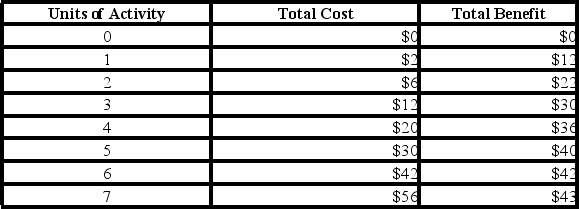
(Multiple Choice)
4.9/5 (76)
(76) Jen spends her afternoon at the beach, paying $1 to rent a beach umbrella and $11 for food and drinks rather than spending an equal amount of money to go to a movie. Her opportunity cost of going to the beach is:
(Multiple Choice)
4.9/5 (77)
(77) A firm pays Pam $40 per hour to assemble personal computers. Each day, Pam can assemble 4 computers if she works 1 hour, 7 computers if she works 2 hours, 9 computers if she works 3 hours, and 10 computers if she works 4 hours. Pam cannot work more than 4 hours day. Each computer consists of a motherboard, a hard drive, a case, a monitor, a keyboard, and a mouse. The total cost of these parts is $600 per computer. If the firm sells each computer for $625, then how many hours a day should the firm employ Pam to maximize its net benefit from her employment?
(Multiple Choice)
4.7/5 (85)
(85) The accompanying table below shows how total donations, average donations, total labor costs and average labor costs vary depending on the number of employees State U hires for its fundraising activities. 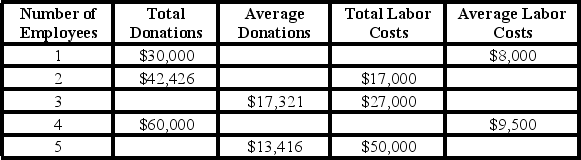 The total value of donations raised by three employees is:
 (Multiple Choice)
5.0/5 (82)
(82) Josh wants to go to the football game this weekend, but he has a paper due on Monday. It will take him the whole weekend to write the paper. Josh decides to stay home and work on the paper. According to the Scarcity Principle, the reason Josh doesn't go to the game is that:
(Multiple Choice)
4.9/5 (87)
(87) Jack has a ticket to see the Foo Fighters for which he paid $30 yesterday. He takes an unpaid day off from work to get ready for the concert. When he arrives at the concert, five different people offer him $70 for his ticket. Jack decides to keep his ticket. At the time he makes this decision, his opportunity cost of seeing the Foo Fighters is:
(Multiple Choice)
4.9/5 (78)
(78) Larry was accepted at three different graduate schools, and must choose one. Elite U costs $50,000 per year and did not offer Larry any financial aid. Larry values attending Elite U at $60,000 per year. State College costs $30,000 per year, and offered Larry an annual $10,000 scholarship. Larry values attending State College at $40,000 per year. NoName U costs $20,000 per year, and offered Larry a full $20,000 annual scholarship. Larry values attending NoName at $15,000 per year. Larry maximizes his economic surplus by attending:
(Multiple Choice)
4.8/5 (90)
(90) For the fall semester, you had to pay a nonrefundable fee of $600 for your meal plan, which gives you up to 150 meals. If you eat 100 meals, your marginal cost of the 100ᵗʰ meal is:
(Multiple Choice)
4.9/5 (72)
(72) Matt has decided to purchase his textbooks for the semester. His options are to purchase the books online with next day delivery at a cost of $175, or to drive to campus tomorrow to buy the books at the university bookstore at a cost of $170. Last week he drove to campus to buy a concert ticket because they offered 25 percent off the regular price of $16. Given that driving to campus to buy the concert ticket was rational for Matt, Matt should:
(Multiple Choice)
4.9/5 (83)
(83) Economists recognize that because people have limited resources:
(Multiple Choice)
5.0/5 (84)
(84) Matt has decided to purchase his textbooks for the semester. His options are to purchase the books online with next day delivery at a cost of $175, or to drive to campus tomorrow to buy the books at the university bookstore at a cost of $170. Last week he drove to campus to buy a concert ticket because they offered 25 percent off the regular price of $16. The benefit to Matt of driving to campus to buy the concert ticket last week was:
(Multiple Choice)
4.9/5 (79)
(79) The accompanying table below shows the relationship between the number of times you get your car washed each month and your total monthly benefit from car washes. Each car wash costs $15. Number af Car Washes Per Month Tatal Munthly Benefit fram Car Washes 0 \ 0 1 \ 20 2 \ 36 3 \ 48 4 \ 56 5 \ 60
What is the marginal benefit of the 3?? car wash each month?
(Multiple Choice)
4.9/5 (85)
(85) Refer to the accompanying table below. The average benefit of 4 units of activity is: 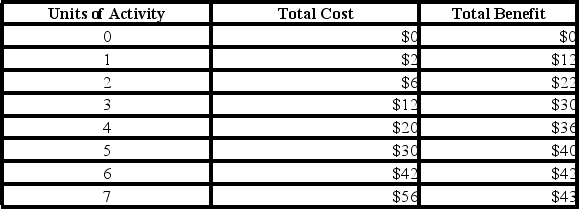
(Multiple Choice)
4.8/5 (85)
(85) Every time you go to the grocery store, you try to wait in the shortest line. But the lines always seem to be roughly the same length. Why?
(Multiple Choice)
4.8/5 (83)
(83) The following accompanying table shows the relationship between the speed of a computer's CPU and its benefits and costs. Assume that all other features of the computer are the same (that is, CPU speed is the only source of variation), and only the CPU speeds listed below are available for purchase. CPU GHz Total Benefit Marginal Benefit Total Cost Marginal Costs 2.0 \ 1,000 \ 900 2.5 \ 1,400 \ 100 3.0 \ 300 \ 1,200 3.5 \ 1,900 \ 1,500 4.0 \ 2,000 \ 400
The total benefit of a 3.0GHz computer is:
(Multiple Choice)
4.9/5 (93)
(93) 
Filters
- Essay(0)
- Multiple Choice(0)
- Short Answer(0)
- True False(0)
- Matching(0)