



 Chat with AI
Exam 14: Cardiovascular Diagnostic Procedures

Exam 1: Critical Care Nursing Practice20 Questions
Exam 2: Ethical Issues20 Questions
Exam 3: Legal Issues25 Questions
Exam 4: Genetics and Genomics in Critical Care20 Questions
Exam 5: Patient and Family Education25 Questions
Exam 6: Psychosocial and Spiritual Alterations and Management25 Questions
Exam 7: Sleep Alterations and Management25 Questions
Exam 8: Nutrition Alterations and Management30 Questions
Exam 9: Pain and Pain Management20 Questions
Exam 10: Sedation,Agitation,Delirium: Assessment and Management20 Questions
Exam 11: End-Of-Life Issues20 Questions
Exam 12: Cardiovascular Anatomy and Physiology25 Questions
Exam 13: Cardiovascular Clinical Assessment25 Questions
Exam 14: Cardiovascular Diagnostic Procedures75 Questions
Exam 15: Cardiovascular Disorders35 Questions
Exam 16: Cardiovascular Therapeutic Management35 Questions
Exam 17: Pulmonary Anatomy and Physiology40 Questions
Exam 18: Pulmonary Clinical Assessment25 Questions
Exam 19: Pulmonary Diagnostic Procedures30 Questions
Exam 20: Pulmonary Disorders25 Questions
Exam 21: Pulmonary Therapeutic Management30 Questions
Exam 22: Neurologic Anatomy and Physiology30 Questions
Exam 23: Neurologic Clinical Assessment and Diagnostic Procedures50 Questions
Exam 24: Neurologic Disorders and Therapeutic Management44 Questions
Exam 25: Kidney Anatomy and Physiology25 Questions
Exam 26: Kidney Clinical Assessment and Diagnostic Procedures20 Questions
Exam 27: Kidney Disorders and Therapeutic Management30 Questions
Exam 28: Gastrointestinal Anatomy and Physiology20 Questions
Exam 29: Gastrointestinal Clinical Assessment and Diagnostic Procedures25 Questions
Exam 30: Gastrointestinal Disorders and Therapeutic Management25 Questions
Exam 31: Endocrine Anatomy and Physiology25 Questions
Exam 32: Endocrine Clinical Assessment and Diagnostic Procedures30 Questions
Exam 33: Endocrine Disorders and Therapeutic Management60 Questions
Exam 34: Trauma30 Questions
Exam 35: Shock,sepsis,and Multiple Organ Dysfunction Syndrome30 Questions
Exam 36: Burns30 Questions
Exam 37: Organ Donation and Transplantation30 Questions
Exam 38: Hematologic Disorders and Oncologic Emergencies25 Questions
Exam 39: The Obstetric Patient30 Questions
Exam 40: The Pediatric Patient25 Questions
Exam 41: The Older Adult Patient25 Questions
Exam 42: The Perianesthesia Patient35 Questions
Select questions type


The patient is admitted to the ICU with a diagnosis of cardiogenic shock.The patient's VS includes HR 135 beats/min with weak peripheral pulses.The lungs have crackles in the bases bilaterally.O2 saturation is 90% on 4L/NC.The physician orders diuretics and vasodilators.The nurse expects which responses to the medications.
(Multiple Choice)
4.7/5  (87)
(87) Ventricular tachycardia has which of the following hemodynamic effects?
(Multiple Choice)
4.9/5 (83)
(83) Which of the following statements made by a patient would indicate the need for further education before an electrophysiology procedure?
(Multiple Choice)
4.8/5 (82)
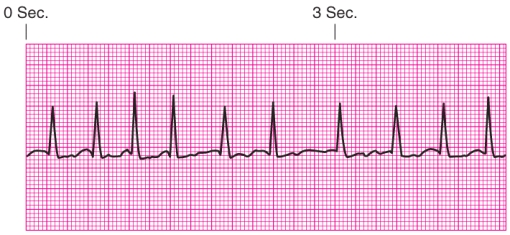
(82) 
The Allen test is used before radial arterial line placement to assess
(Multiple Choice)
5.0/5 (76)
(76) A patient presents with atrial flutter with an atrial rate of 280 beats/min and a ventricular rate of 70 beats/min.Which of the following best explains this discrepancy in rates?
(Multiple Choice)
4.8/5 (82)
(82) What is the noninvasive imaging technique which is useful in diagnosing complications of MI?
(Multiple Choice)
4.9/5 (83)
(83) The patient has an HR of 84 beats/min and an SV of 65 mL.Calculate the CO.
(Multiple Choice)
4.9/5 (91)
(91) Which of the following findings would be indicative reasons to abort an exercise stress test?
(Multiple Choice)
4.8/5 (81)
(81) The physician anticipates the CVC dwelling time to be 10 to 20 days.The nurse anticipates that the CVC will be placed in the
(Multiple Choice)
4.8/5 (65)
(65) A new-onset MI can be recognized by which of the following ECG changes?
(Multiple Choice)
4.8/5 (87)
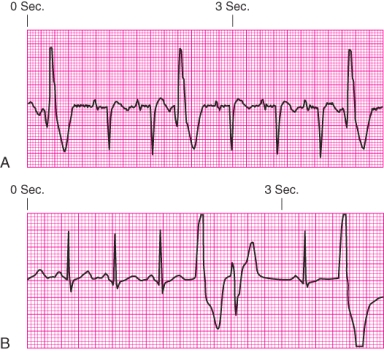
(87) 
A 55-year-old patient is scheduled for a stress test.The patient's maximal predicted HR is estimated to be
(Multiple Choice)
4.8/5 (72)
(72) A nurse is obtaining the history of a patient who reveals that he had an MI 5 years ago.When the admission 12-lead ECG is reviewed,Q waves are noted in leads V? and V? only.Which of the following conclusions is most consistent with this situation?
(Multiple Choice)
4.7/5 (86)
(86) ST segment monitoring for ischemia has gained increasing importance with the advent of thrombolytic therapy.The most accurate method for monitoring the existence of true ischemic changes is
(Multiple Choice)
4.9/5 (76)
(76) When performing a 12-lead ECG,how many wires are connected to the patient?
(Multiple Choice)
4.8/5 (76)
(76) 
Filters
- Essay(0)
- Multiple Choice(0)
- Short Answer(0)
- True False(0)
- Matching(0)