



 Chat with AI
Exam 6: Microbial Growth

Exam 1: The Microbial World and You65 Questions
Exam 2: Chemical Principles65 Questions
Exam 3: Observing Microorganisms Through a Microscope65 Questions
Exam 4: Functional Anatomy of Prokaryotic and Eukaryotic65 Questions
Exam 5: Microbial Metabolism67 Questions
Exam 6: Microbial Growth65 Questions
Exam 7: The Control of Microbial Growth67 Questions
Exam 8: Microbial Genetics65 Questions
Exam 9: Biotechnology and Dna Technology64 Questions
Exam 10: Classification of Microorganisms65 Questions
Exam 11: The Prokaryotes: Domains Bacteria and Archaea60 Questions
Exam 12: The Eukaryotes: Fungi, algae, protozoa, and Helminths65 Questions
Exam 13: Viruses,viroids,and Prions66 Questions
Exam 14: Principles of Disease and Epidemiology65 Questions
Exam 15: Microbial Mechanisms of Pathogenicity63 Questions
Exam 16: Innate Immunity: Nonspecific Defenses of the Host65 Questions
Exam 17: Adaptive Immunity: Specific Defenses of the Host65 Questions
Exam 18: Practical Applications of Immunology65 Questions
Exam 19: Disorders Associated With the Immune System67 Questions
Exam 20: Antimicrobial Drugs65 Questions
Exam 21: Microbial Diseases of the Skin and Eyes65 Questions
Exam 22: Microbial Diseases of the Nervous System65 Questions
Exam 23: Microbial Diseases of the Cardiovascular and Lymphatic Systems65 Questions
Exam 24: Microbial Diseases of the Respiratory System65 Questions
Exam 25: Microbial Diseases of the Digestive System66 Questions
Exam 26: Microbial Diseases of the Urinary and Reproductive Systems65 Questions
Exam 27: Environmental Microbiology65 Questions
Exam 28: Applied and Industrial Microbiology65 Questions
Select questions type


Which of the following is NOT a direct method to measure microbial growth?
(Multiple Choice)
4.9/5  (56)
(56) Which of the following is an advantage of the standard plate count?
(Multiple Choice)
4.9/5 (74)
(74) Figure 6.3
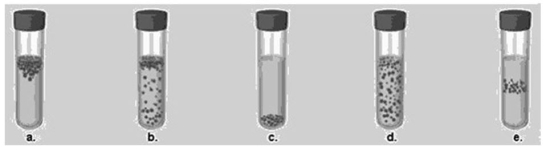 -In Figure 6.3,which tube shows the expected growth pattern for a microaerophile?
 (Multiple Choice)
4.7/5 (75)
(75) Nitrogen-fixing bacteria,such as cyanobacteria,can use atmospheric nitrogen (N₂)for their nitrogen source.
(True/False)
5.0/5 (85)
(85) Which of the following is the best definition of generation time?
(Multiple Choice)
4.9/5 (70)
(70) The addition of which of the following to a culture medium will neutralize acids?
(Multiple Choice)
4.7/5 (75)
(75) Figure 6.2
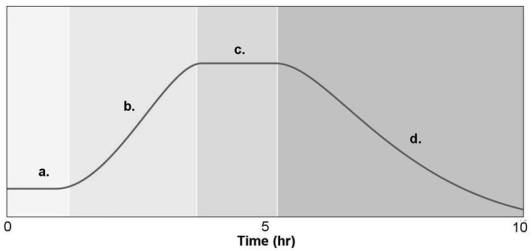 -Figure 6.2 shows a typical bacterial growth curve with the y-axis indicating the log of the number of bacteria and the x-axis indicating time in culture.In the figure,which section (or sections)shows a growth phase where the number of cells dying equals the number of cells dividing?
 (Multiple Choice)
4.7/5 (86)
(86) Pathogenic bacteria isolated from the respiratory or intestinal tracts of humans are
(Multiple Choice)
4.8/5 (74)
(74) A sample of ocean water is tested for its bacterial content in a plate count assay.A one-milliliter sample of the water is diluted in a 1:10 dilution series.0.1 milliliter of the second dilution tube is plated in a pour plate.After incubation,the plate has 191 colonies,indicating that the original water sample contained
(Multiple Choice)
4.8/5 (87)
(87) Three cells with generation times of 60 minutes are inoculated into a culture medium.Assuming no lag phase takes place,how many cells are there after 5 hours?
(Multiple Choice)
4.9/5 (87)
(87) In one hospital,Pseudomonas aeruginosa serotype 10 infected the biliary tract of 10 percent of 1300 patients who underwent gastrointestinal endoscopic procedures.After each use,endoscopes were washed with an automatic reprocessor that flushed detergent and glutaraldehyde through the endoscopes,followed by a tap water rinse.P.aeruginosa serotype 10 was not isolated from the detergent,glutaraldehyde,or tap water.What was the source of the infections?
(Multiple Choice)
4.8/5 (83)
(83) Figure 6.1
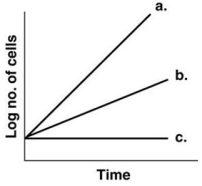 -In Figure 6.1,which line best depicts an obligate anaerobe in the presence of O₂?
 (Multiple Choice)
4.9/5 (85)
(85) As part of an experiment where absorbance values are measured using a spectrophotometer,you are taking readings of your sample every 20 minutes.The non-motile microbe you're testing has a generation time of roughly 20 minutes at an incubation temperature right around room temperature.Things start out fine,with the expected results - as time goes by at the correct incubation temperature,absorbance starts to rise as the medium starts to become more cloudy with growing microorganisms.But roughly 2 hours into the process,you notice that the absorbance levels flatten out,and then start to decrease unexpectedly.What is most likely taking place in your experiment?
(Essay)
5.0/5 (68)
(68) The U.S.Food and Drug Administration convention when performing pour or spread plate counts is to count only plates with ________ colonies.
(Multiple Choice)
4.8/5 (89)
(89) In measuring turbidity of a culture in indirect measurement of bacterial growth,absorbance and transmittance are identical and interchangeable values.
(True/False)
4.8/5 (83)
(83) Figure 6.1
-In Figure 6.1,which line best illustrates the growth of a facultative anaerobe incubated aerobically?
-In Figure 6.1,which line best illustrates the growth of a facultative anaerobe incubated aerobically? (Multiple Choice)
4.8/5 (72)
(72) Figure 6.1
-In Figure 6.1,which line shows the growth of an obligate aerobe incubated anaerobically?
-In Figure 6.1,which line shows the growth of an obligate aerobe incubated anaerobically? (Multiple Choice)
4.8/5 (75)
(75) Filtration methods,followed by growth of the bacteria trapped on the filters in growth media,are used to count bacteria present in very low concentrations,such as in lakes and streams.
(True/False)
4.8/5 (77)
(77) 
Filters
- Essay(0)
- Multiple Choice(0)
- Short Answer(0)
- True False(0)
- Matching(0)