



 Chat with AI
Exam 6: Microbial Growth


A patient with a heart pacemaker received antibiotic therapy for streptococcal bacteremia (bacteria in the blood).One month later,he was treated for recurrence of the bacteremia.When he returned six weeks later,again with bacteremia,the physician recommended replacing the pacemaker.Why did this cure his condition?

 (72)
 Answered by Examlex AI Copilot
The patient's recurring episodes of streptococcal bacteremia, despite antibiotic therapy, suggest that the source of the bacterial infection was not being adequately addressed. In cases where a patient has an implanted medical device, such as a heart pacemaker, there is a risk that the device can become a nidus for infection. This means that bacteria can adhere to the device and form a biofilm, which is a complex aggregation of microorganisms marked by the excretion of a protective and adhesive matrix.
Biofilms are particularly concerning because they can be very resistant to antibiotics. The protective matrix and the altered state of the bacteria within the biofilm can prevent antibiotics from effectively killing the bacteria. As a result, even after antibiotic treatment, the bacteria can persist on the device and re-enter the bloodstream, leading to recurrent infections.
When a patient with an implanted device experiences repeated infections despite appropriate antibiotic therapy, it raises the suspicion that the device itself is infected. In such cases, the most definitive treatment is often to remove the infected device and replace it with a new one. This is because it is extremely difficult, if not impossible, to completely eradicate the bacteria from the device with antibiotics alone.
By recommending the replacement of the pacemaker, the physician was targeting the likely source of the recurrent infections. After the infected pacemaker was removed and a new one was implanted, the source of the streptococcal bacteremia was eliminated. This, combined with a course of antibiotics to clear any remaining bacteria from the bloodstream, would have cured the patient's condition by removing both the source of the infection and the infection itself.
It is important to note that the decision to replace an infected pacemaker is not taken lightly due to the risks associated with surgery and the potential complications of the procedure. However, when the benefits of removing a source of persistent infection outweigh the risks, pacemaker replacement becomes a necessary and curative intervention.
If cells are grown in media containing amino acids labeled with radioactive nitrogen (¹⁵N),most of the radioactivity will be found in the cells'
(80)  Verified
D
A sample of well water is tested for its bacterial content in a plate count assay.A one-milliliter sample of the water is diluted in a 1:10 dilution series.One milliliter of the fourth dilution tube is plated in a pour plate.After incubation,the plate has 83 colonies,indicating that the original water sample contained
(73) VerifiedE
In performing a ten-fold dilutions series from a sample containing 10,000 bacteria per milliliter,the fourth tube in the dilution series will have 10 cells per milliliter.
(81) Which of the following is an advantage of the direct microscopic count?
(84) Which of the following pairs of microbe classification terms and optimal growth temperatures is mismatched?
(84) Figure 6.1
 -Figure 6.1,which line best depicts a facultative anaerobe in the absence of O₂?
 (85) Patients with indwelling catheters (long-term tubes inserted into body orifices for drainage,such as through the urethra and into the urinary bladder)are susceptible to infections because
(72) A sample of raw,unpasteurized milk is tested for its bacterial content in a plate count assay.A one-milliliter sample of the milk is diluted in a 1:10 dilution series.One milliliter of the third dilution tube is plated in a pour plate.After incubation,the plate has approximately 500 colonies,indicating that the original milk sample contained
(70) The ________ method is used to indirectly measure microbial growth of filamentous bacteria and molds.
(89) Figure 6.3
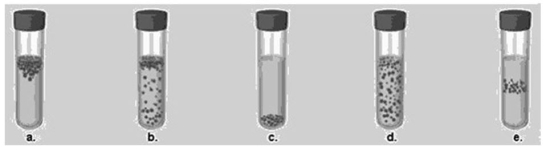 -In Figure 6.3,which tube shows the expected growth pattern for a facultative anaerobe?
 (89) Which group of microorganisms is most likely to spoil a freshwater trout preserved with salt?
(74) An experiment began with 4 cells in log phase and ended with 128 cells.How many generations did the cells go through?
(79) A culture medium consisting of agar,peptone,and beef heart is a
(84) A sample of milk is tested for its bacterial content in a plate count assay.A one-milliliter sample of the milk is diluted in a 1:10 dilution series.One milliliter of the third dilution tube is plated in a pour plate.After incubation,the plate has 54 colonies,indicating that the original milk sample contained
(68) Consider a culture medium on which only gram-positive organisms such as Staphylococcus aureus colonies can grow due to an elevated NaCl level.A yellow halo surrounds the growth,indicating the bacterium fermented a sugar in the medium,decreasing the pH as a result and changing the color of a pH indicator chemical.This type of medium would be referred to as a(n)
(85) Pure cultures can easily be obtained on streak plates,even if the desired bacteria are present in very low concentrations in the initial culture broth.
(86) 
Filters
- Essay(0)
- Multiple Choice(0)
- Short Answer(0)
- True False(0)
- Matching(0)