



 Chat with AI
Exam 11: Cranium, Facial Bones, and Paranasal Sinuses

Exam 1: Terminology, Positioning, and Imaging Principles199 Questions
Exam 2: Chest102 Questions
Exam 3: Abdomen92 Questions
Exam 4: Upper Limb107 Questions
Exam 5: Humerus and Shoulder Girdle80 Questions
Exam 6: Lower Limb110 Questions
Exam 7: Femur and Pelvic Girdle80 Questions
Exam 8: Cervical and Thoracic Spine84 Questions
Exam 9: Lumbar Spine, Sacrum, and Coccyx75 Questions
Exam 10: Bony Thoraxsternum and Ribs67 Questions
Exam 11: Cranium, Facial Bones, and Paranasal Sinuses181 Questions
Exam 12: Biliary Tract and Upper Gastrointestinal System127 Questions
Exam 13: Lower Gi System83 Questions
Exam 14: Urinary System and Venipuncture100 Questions
Exam 15: Trauma, Mobile, and Surgical Radiography108 Questions
Exam 16: Pediatric Radiography72 Questions
Exam 17: Angiography and Interventional Procedures72 Questions
Exam 18: Computed Tomography103 Questions
Exam 19: Special Radiographic Procedures69 Questions
Exam 20: Diagnostic and Therapeutic Modalities208 Questions
Select questions type


Which bony landmark represents the highest level of the facial bone mass?
(Multiple Choice)
5.0/5  (79)
(79) The lateral projection of the facial bones is typically a unilateral projection.
(True/False)
5.0/5 (85)
(85) A fracture involving the facial bones where a blow to one side causes a fracture to the opposite side is termed a ____ fracture.
(Multiple Choice)
4.9/5 (74)
(74) A patient comes to radiology with acute mastoiditis.Which one of the following imaging modalities will best demonstrate possible bony destruction within the mastoid region?
(Multiple Choice)
5.0/5 (68)
(68) Where is the CR centered for a lateral projection of the facial bones?
(Multiple Choice)
5.0/5 (62)
(62) Which positioning line is parallel to the IR for the oblique inferosuperior (tangential) projection of the zygomatic arches?
(Multiple Choice)
4.8/5 (78)
(78) An average-shaped skull with a 47° angle between the petrous pyramids and the midsagittal plane is classified as:
(Multiple Choice)
4.8/5 (81)
(81) The recommended digital systems kV range for the superoinferior tangential (axial) projection of the nasal bones is:
(Multiple Choice)
4.8/5 (91)
(91) Match each of the following radiographic appearances with the corresponding pathologic indication.(Use each selection only once.)
-Radiolucent areas within the bony cranium
(Multiple Choice)
4.9/5 (72)
(72) The modified parietoacanthial (modified Waters) projection requires more extension of the head and neck as compared with the parietoacanthial (Waters) projection.
(True/False)
4.9/5 (81)
(81) Both CT (computed tomography) and MRI (magnetic resonance imaging) can provide reconstructed images in three planes: axial, sagittal, and coronal.
(True/False)
4.8/5 (81)
(81) 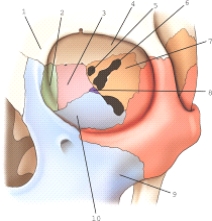
Which of the following projections will best demonstrate the entire mandible with one exposure?
(Multiple Choice)
5.0/5 (68)
(68) The cranial bone labeled i is the:  (Anatomic structures are labeled i through vi and sutures a through h.)
 (Multiple Choice)
4.9/5 (96)
(96) Which bony structure is labeled v?  (Anatomic structures are labeled i through vi and sutures a through h.)
 (Multiple Choice)
4.8/5 (77)
(77) Match each of the following radiographic appearances with the corresponding pathologic indication.(Use each selection only once.)
-Distinctive lesions with moth-eaten appearance, a combination of increased density and destructive irregular border lesions
(Multiple Choice)
4.7/5 (76)
(76) What can the technologist do if the patient cannot extend the head and neck adequately for the routine submentovertical projection of the zygomatic arches?
(Multiple Choice)
4.8/5 (79)
(79) A patient enters the ED with facial bone injuries.The physician is concerned about a possible blow-out fracture of the left orbit.Which one of the following projections would best diagnose this injury?
(Multiple Choice)
4.9/5 (83)
(83) Where are the ethmoid sinuses located within the ethmoid bone?
(Multiple Choice)
4.7/5 (79)
(79) 
Filters
- Essay(0)
- Multiple Choice(0)
- Short Answer(0)
- True False(0)
- Matching(0)