



 Chat with AI
Exam 11: Cranium, Facial Bones, and Paranasal Sinuses

Exam 1: Terminology, Positioning, and Imaging Principles199 Questions
Exam 2: Chest102 Questions
Exam 3: Abdomen92 Questions
Exam 4: Upper Limb107 Questions
Exam 5: Humerus and Shoulder Girdle80 Questions
Exam 6: Lower Limb110 Questions
Exam 7: Femur and Pelvic Girdle80 Questions
Exam 8: Cervical and Thoracic Spine84 Questions
Exam 9: Lumbar Spine, Sacrum, and Coccyx75 Questions
Exam 10: Bony Thoraxsternum and Ribs67 Questions
Exam 11: Cranium, Facial Bones, and Paranasal Sinuses181 Questions
Exam 12: Biliary Tract and Upper Gastrointestinal System127 Questions
Exam 13: Lower Gi System83 Questions
Exam 14: Urinary System and Venipuncture100 Questions
Exam 15: Trauma, Mobile, and Surgical Radiography108 Questions
Exam 16: Pediatric Radiography72 Questions
Exam 17: Angiography and Interventional Procedures72 Questions
Exam 18: Computed Tomography103 Questions
Exam 19: Special Radiographic Procedures69 Questions
Exam 20: Diagnostic and Therapeutic Modalities208 Questions
Select questions type


Which one of the following technical considerations is most critical for demonstrating air and/or fluid levels within the cranium?
(Multiple Choice)
4.8/5  (73)
(73) Which of the following imaging modalities is utilized to determine the degree of skeletal metastases especially in the cranium?
(Multiple Choice)
4.9/5 (91)
(91) Select the imaging modality that would best demonstrate the following pathologies.
-Early detection of metastases
(Multiple Choice)
4.8/5 (72)
(72) The sutural point or area labeled d is the: 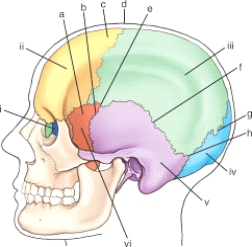 (Anatomic structures are labeled i through vi and sutures a through h.)
 (Multiple Choice)
4.7/5 (68)
(68) The point of union between both halves of the mandible is termed:
(Multiple Choice)
4.8/5 (87)
(87) A patient comes to radiology for a routine study of the cranium.He is unable to flex his head and neck sufficiently to place the OML perpendicular to the IR for the AP axial projection.What should the technologist do to compensate for this problem without creating excessive magnification of the occipital bone?
(Multiple Choice)
4.7/5 (80)
(80) Which cranial suture is labeled g? 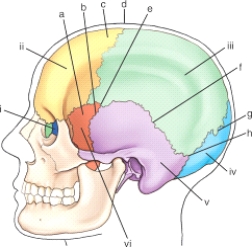 (Anatomic structures are labeled i through vi and sutures a through h.)
 (Multiple Choice)
4.8/5 (90)
(90) A pediatric patient enters radiology for a paranasal sinus series.Because of her age, the child is unable to hold still for the projections even with the use of immobilization devices.The decision is to hold the child during each exposure.Which of the following individuals should be asked to hold the child?
(Multiple Choice)
4.9/5 (72)
(72) What primary type of joint movement occurs with the temporomandibular joint?
(Multiple Choice)
4.9/5 (76)
(76) Match each radiographic appearance with the corresponding pathologic indication.(Use each selection only once.)
-Increased densities replace mastoid air cells
(Multiple Choice)
4.9/5 (68)
(68) Infections involving the upper teeth may involve the frontal sinuses.
(True/False)
4.7/5 (79)
(79) Which one of the following cranial projections will best demonstrate a possible basilar fracture?
(Multiple Choice)
4.9/5 (76)
(76) 
The CR must be placed parallel to the ____ positioning line for the superoinferior tangential (axial) projection of nasal bones.
(Multiple Choice)
4.7/5 (72)
(72) The most common radiographic sign for secondary osteomyelitis of the paranasal sinuses is:
(Multiple Choice)
4.8/5 (94)
(94) The pathway of communication between the frontal, maxillary, and ethmoid sinuses that provides drainage between them is termed:
(Multiple Choice)
4.7/5 (85)
(85) The ____ passageway drains the maxillary sinus into the middle nasal conchae.
(Multiple Choice)
4.9/5 (83)
(83) Match each radiographic appearance with the corresponding pathologic indication.(Use each selection only once.)
-Excessive bone formation generally involving both the middle and inner ear
(Multiple Choice)
4.7/5 (82)
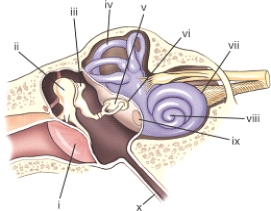
(82) Which one of the following structures is part of the middle ear?
(Multiple Choice)
4.8/5 (63)
(63) 
Filters
- Essay(0)
- Multiple Choice(0)
- Short Answer(0)
- True False(0)
- Matching(0)