



 Chat with AI
Exam 6: Lower Limb

Exam 1: Terminology, Positioning, and Imaging Principles199 Questions
Exam 2: Chest102 Questions
Exam 3: Abdomen92 Questions
Exam 4: Upper Limb107 Questions
Exam 5: Humerus and Shoulder Girdle80 Questions
Exam 6: Lower Limb110 Questions
Exam 7: Femur and Pelvic Girdle80 Questions
Exam 8: Cervical and Thoracic Spine84 Questions
Exam 9: Lumbar Spine, Sacrum, and Coccyx75 Questions
Exam 10: Bony Thoraxsternum and Ribs67 Questions
Exam 11: Cranium, Facial Bones, and Paranasal Sinuses181 Questions
Exam 12: Biliary Tract and Upper Gastrointestinal System127 Questions
Exam 13: Lower Gi System83 Questions
Exam 14: Urinary System and Venipuncture100 Questions
Exam 15: Trauma, Mobile, and Surgical Radiography108 Questions
Exam 16: Pediatric Radiography72 Questions
Exam 17: Angiography and Interventional Procedures72 Questions
Exam 18: Computed Tomography103 Questions
Exam 19: Special Radiographic Procedures69 Questions
Exam 20: Diagnostic and Therapeutic Modalities208 Questions
Select questions type


A patient enters radiology with a possible ligament tear to the lateral aspect of the ankle.Initial ankle radiographs are negative for fracture or dislocation.Because the clinic is in a rural setting, the patient cannot have an MRI performed to evaluate the ligaments of the ankle.Which of the following techniques may provide an assessment of the soft tissue structures of the ankle?

Free
(Multiple Choice)
4.8/5  (73)
(73) Correct Answer: Verified
C
To ensure that both joints are included on an AP projection of the tibia and fibula on an adult, the technologist can:
Free
(Multiple Choice)
4.7/5 (77)
(77) Correct Answer:Verified
VerifiedC
The correct CR placement for an AP projection of the knee is midpatella.
Free
(True/False)
4.8/5 (79)
(79) Correct Answer:Verified
VerifiedFalse
Which of these labeled structures or bones identifies the navicular? 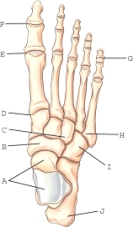
(Multiple Choice)
4.9/5 (76)
(76) What is the major disadvantage of using 45° of flexion for the mediolateral projection of the knee?
(Multiple Choice)
4.7/5 (79)
(79) What CR angulation is recommended for an AP projection of the knee on a patient with an ASIS-to-tabletop measurement of 18 cm?
(Multiple Choice)
4.8/5 (59)
(59) A radiograph of an AP projection of the second toe reveals that the interphalangeal joints are not open.What is the most likely cause for this radiographic outcome?
(Multiple Choice)
4.8/5 (101)
(101) The AP mortise projection of the ankle is commonly taken in surgery during open reductions.
(True/False)
4.8/5 (94)
(94) Which of the following knee projections requires the use of a special IR holding device?
(Multiple Choice)
4.8/5 (92)
(92) For the AP weight-bearing knee projection on an average patient, the CR should be:
(Multiple Choice)
4.8/5 (79)
(79) Which of these labeled structures or bones identifies the talus? 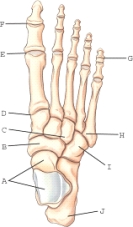
(Multiple Choice)
4.7/5 (81)
(81) A radiographic appearance of a well-circumscribed lucency within bones describes:
(Multiple Choice)
4.8/5 (78)
(78) Which special position of the knee requires that the patient be placed supine with 40° flexion of the knee and the CR angled 30° from the long axis of the femur?
(Multiple Choice)
4.7/5 (80)
(80) Where is the CR placed for a mediolateral projection of the calcaneus?
(Multiple Choice)
4.9/5 (88)
(88) A correctly positioned lateral ankle will demonstrate the lateral malleolus superimposed over the posterior half of the tibia.
(True/False)
4.8/5 (85)
(85) The disadvantage of the superoinferior sitting, tangential (Hobbs modification) method is that it requires acute flexion of the knee.
(True/False)
4.9/5 (91)
(91) How much knee flexion is required for the weight-bearing PA axial projection (Rosenberg method) of the knee?
(Multiple Choice)
5.0/5 (72)
(72) 
Filters
- Essay(0)
- Multiple Choice(0)
- Short Answer(0)
- True False(0)
- Matching(0)