



 Chat with AI
Exam 6: Lower Limb

Exam 1: Terminology, Positioning, and Imaging Principles199 Questions
Exam 2: Chest102 Questions
Exam 3: Abdomen92 Questions
Exam 4: Upper Limb107 Questions
Exam 5: Humerus and Shoulder Girdle80 Questions
Exam 6: Lower Limb110 Questions
Exam 7: Femur and Pelvic Girdle80 Questions
Exam 8: Cervical and Thoracic Spine84 Questions
Exam 9: Lumbar Spine, Sacrum, and Coccyx75 Questions
Exam 10: Bony Thoraxsternum and Ribs67 Questions
Exam 11: Cranium, Facial Bones, and Paranasal Sinuses181 Questions
Exam 12: Biliary Tract and Upper Gastrointestinal System127 Questions
Exam 13: Lower Gi System83 Questions
Exam 14: Urinary System and Venipuncture100 Questions
Exam 15: Trauma, Mobile, and Surgical Radiography108 Questions
Exam 16: Pediatric Radiography72 Questions
Exam 17: Angiography and Interventional Procedures72 Questions
Exam 18: Computed Tomography103 Questions
Exam 19: Special Radiographic Procedures69 Questions
Exam 20: Diagnostic and Therapeutic Modalities208 Questions
Select questions type


The patellofemoral joint is a ____ joint with a ____ type of movement.
(Multiple Choice)
4.9/5  (87)
(87) Which of the following routines should be performed for a study of the second toe?
(Multiple Choice)
4.8/5 (84)
(84) The superoinferior, sitting tangential (Hobbs modification) projection for patellofemoral joint space requires a CR angle of 5° to 10° posterior.
(True/False)
4.8/5 (73)
(73) How much flexion of the knee is recommended for the lateral projection of the patella?
(Multiple Choice)
5.0/5 (89)
(89) To properly visualize the joint spaces with the AP projection of the foot, the CR must be:
(Multiple Choice)
4.8/5 (80)
(80) A tear of the tibial (medial) collateral ligament (MCL) caused by a trauma injury is frequently associated with tears of:
(Multiple Choice)
4.8/5 (80)
(80) Which of these labeled structures or bones identifies the lateral (third) cuneiform? 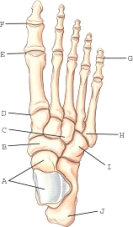
(Multiple Choice)
4.8/5 (77)
(77) Match the correct disease or condition with the corresponding pathologic description.(Use each choice only once.)
-Sprains and/or fractures involving the bases of the first and second metatarsals
(Multiple Choice)
4.9/5 (67)
(67) 
Filters
- Essay(0)
- Multiple Choice(0)
- Short Answer(0)
- True False(0)
- Matching(0)