



 Chat with AI
Exam 6: Lower Limb

Exam 1: Terminology, Positioning, and Imaging Principles199 Questions
Exam 2: Chest102 Questions
Exam 3: Abdomen92 Questions
Exam 4: Upper Limb107 Questions
Exam 5: Humerus and Shoulder Girdle80 Questions
Exam 6: Lower Limb110 Questions
Exam 7: Femur and Pelvic Girdle80 Questions
Exam 8: Cervical and Thoracic Spine84 Questions
Exam 9: Lumbar Spine, Sacrum, and Coccyx75 Questions
Exam 10: Bony Thoraxsternum and Ribs67 Questions
Exam 11: Cranium, Facial Bones, and Paranasal Sinuses181 Questions
Exam 12: Biliary Tract and Upper Gastrointestinal System127 Questions
Exam 13: Lower Gi System83 Questions
Exam 14: Urinary System and Venipuncture100 Questions
Exam 15: Trauma, Mobile, and Surgical Radiography108 Questions
Exam 16: Pediatric Radiography72 Questions
Exam 17: Angiography and Interventional Procedures72 Questions
Exam 18: Computed Tomography103 Questions
Exam 19: Special Radiographic Procedures69 Questions
Exam 20: Diagnostic and Therapeutic Modalities208 Questions
Select questions type


A patient comes to radiology with a clinical history of a Lisfranc joint injury.Which of the following projections would best demonstrate this condition?
(Multiple Choice)
4.8/5  (63)
(63) A 3° to 5° caudad CR angle should be used for an AP knee projection for patients with an ASIS-to-tabletop measurement of 20 cm.
(True/False)
4.9/5 (79)
(79) Which joint surfaces of the ankle joint are most commonly open with an AP projection of the ankle?
(Multiple Choice)
4.8/5 (88)
(88) A radiograph of an AP medial oblique projection of the foot, if positioned correctly, should demonstrate:
(Multiple Choice)
4.9/5 (72)
(72) This radiograph represents which of the following positions? 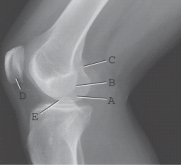
(Multiple Choice)
4.8/5 (92)
(92) A patient comes to radiology with a clinical history of osteoarthritis of both knees.The referring physician wants a projection to evaluate the damage to the articular facets.Which of the following projections will provide the best image of this region of the knee?
(Multiple Choice)
4.8/5 (76)
(76) The purpose of the AP stress views of the ankle is to demonstrate:
(Multiple Choice)
4.8/5 (92)
(92) The patella is drawn into the intercondylar sulcus when the knee is overextended.
(True/False)
4.9/5 (78)
(78) A patient comes to radiology with an infection involving the sesamoid bones of the foot.Beyond the routine foot projections, which one of the following projections can be performed to best demonstrate these structures?
(Multiple Choice)
4.8/5 (63)
(63) Which of the following joints is a modified ellipsoidal or condyloid joint?
(Multiple Choice)
4.8/5 (78)
(78) How much central ray (CR) angulation (if any) should be used for an AP projection of the toes (without elevation of forefoot)?
(Multiple Choice)
4.7/5 (77)
(77) When multiple exposures are placed on a single computed radiography image receptor (IR), lead masking should not be placed on the unexposed regions of the imaging plate.
(True/False)
4.9/5 (85)
(85) A radiograph of an AP mortise projection of the ankle reveals that the lateral malleolus is slightly superimposed over the talus and the lateral joint space is not open.What is most likely cause for this radiographic outcome?
(Multiple Choice)
4.8/5 (89)
(89) Which of the labeled structures is the lateral condyle of the femur? 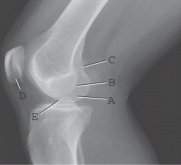
(Multiple Choice)
4.9/5 (86)
(86) A radiograph of an AP knee reveals rotation with almost total superimposition of the fibular head and the proximal tibia.What must the technologist do to correct this positioning error on the repeat exposure?
(Multiple Choice)
4.9/5 (78)
(78) Saclike structures found in the knee joint that allow smooth articulation between ligaments and tendons are called:
(Multiple Choice)
5.0/5 (90)
(90) Match the correct disease or condition with the corresponding pathologic description.(Use each choice only once.)
-Condition affecting the sacroiliac joints and lower limbs of young men, especially the posterosuperior margin of calcaneus
(Multiple Choice)
4.7/5 (92)
(92) Match the correct disease or condition with the corresponding pathologic description.(Use each choice only once.)
-Benign, neoplastic bone lesion due to overproduction of bone at a joint (usually the knee)
(Multiple Choice)
4.8/5 (81)
(81) A patient comes to the radiology department for a knee study with special interest in the region of the proximal tibiofibular joint and the lateral condyle of the tibia.Which of the following positioning routines should the technologist obtain?
(Multiple Choice)
4.8/5 (90)
(90) 
Filters
- Essay(0)
- Multiple Choice(0)
- Short Answer(0)
- True False(0)
- Matching(0)