



 Chat with AI
Exam 6: Lower Limb

Exam 1: Terminology, Positioning, and Imaging Principles199 Questions
Exam 2: Chest102 Questions
Exam 3: Abdomen92 Questions
Exam 4: Upper Limb107 Questions
Exam 5: Humerus and Shoulder Girdle80 Questions
Exam 6: Lower Limb110 Questions
Exam 7: Femur and Pelvic Girdle80 Questions
Exam 8: Cervical and Thoracic Spine84 Questions
Exam 9: Lumbar Spine, Sacrum, and Coccyx75 Questions
Exam 10: Bony Thoraxsternum and Ribs67 Questions
Exam 11: Cranium, Facial Bones, and Paranasal Sinuses181 Questions
Exam 12: Biliary Tract and Upper Gastrointestinal System127 Questions
Exam 13: Lower Gi System83 Questions
Exam 14: Urinary System and Venipuncture100 Questions
Exam 15: Trauma, Mobile, and Surgical Radiography108 Questions
Exam 16: Pediatric Radiography72 Questions
Exam 17: Angiography and Interventional Procedures72 Questions
Exam 18: Computed Tomography103 Questions
Exam 19: Special Radiographic Procedures69 Questions
Exam 20: Diagnostic and Therapeutic Modalities208 Questions
Select questions type


What is the recommended SID for the superoinferior sitting tangential (Hobbs modification) method?
(Multiple Choice)
4.9/5  (86)
(86) A radiograph of an AP ankle projection reveals that the lateral joint space is not open (lateral malleolus is partially superimposed by the talus).The superior and medial joint spaces are open.What should the technologist do to correct this problem and improve the image?
(Multiple Choice)
5.0/5 (71)
(71) Match the correct disease or condition with the corresponding pathologic description.(Use each choice only once.)
-Malignant tumor of the cartilage usually occurring in men older than age 45 in the pelvis and long bones
(Multiple Choice)
4.9/5 (63)
(63) Which of these labeled structures or bones identifies the metatarsophalangeal joint? 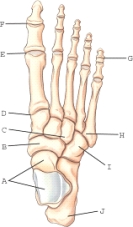
(Multiple Choice)
4.9/5 (78)
(78) A mediolateral knee radiograph that is overrotated toward the image receptor can be recognized by which of the following?
(Multiple Choice)
4.8/5 (77)
(77) How much CR angulation to the long axis of the foot is required for the plantodorsal (axial) projection of the calcaneus?
(Multiple Choice)
4.9/5 (79)
(79) The radiographic hallmark of Reiter's syndrome seen in young men is:
(Multiple Choice)
4.9/5 (87)
(87) The ankle joint is a ____ joint with a ____ type of movement.
(Multiple Choice)
4.9/5 (79)
(79) Match the correct disease or condition with the corresponding pathologic description.(Use each choice only once.)
-Common primary bone malignancy in pediatric and young adult patients
(Multiple Choice)
4.7/5 (78)
(78) A patient enters the emergency department (ED) with a possible transverse fracture of the patella.Which of the following routines would safely provide the best images of the patella?
(Multiple Choice)
4.9/5 (79)
(79) The foot must be force dorsiflexed so that the long axis of the foot is perpendicular to the image receptor for AP and mortise projections of the ankle.
(True/False)
4.8/5 (90)
(90) For the AP weight-bearing feet projection, the CR should be:
(Multiple Choice)
4.8/5 (86)
(86) Which one of the following projections will best demonstrate signs of Osgood-Schlatter disease?
(Multiple Choice)
4.9/5 (81)
(81) What CR angle should be used for a mediolateral projection of the knee on a short, wide-pelvis patient?
(Multiple Choice)
4.7/5 (76)
(76) A patient comes to radiology for an evaluation of the longitudinal arch of the foot.Which of the following projections would provide the best information about the arch?
(Multiple Choice)
5.0/5 (80)
(80) The profile appearance of the adductor tubercle and excessive superimposition of the fibular head and neck on a mediolateral knee projection indicate:
(Multiple Choice)
4.8/5 (77)
(77) The best method of evaluating injuries to the menisci and ligaments of the knee joint involves:
(Multiple Choice)
4.9/5 (79)
(79) Which metatarsal bone of the foot has a prominent tuberosity most frequently fractured?
(Multiple Choice)
4.8/5 (77)
(77) What type of CR angle is required for the PA axial weight-bearing bilateral knee projection (Rosenberg method)?
(Multiple Choice)
4.7/5 (78)
(78) 
Filters
- Essay(0)
- Multiple Choice(0)
- Short Answer(0)
- True False(0)
- Matching(0)