



 Chat with AI
Exam 5: Consumer Choice: Individual and Market Demand

Exam 1: What Is Economics232 Questions
Exam 2: The Economy: Myth and Reality155 Questions
Exam 3: The Fundamental Economic Problem: Scarcity and Choice255 Questions
Exam 4: Supply and Demand: an Initial Look313 Questions
Exam 5: Consumer Choice: Individual and Market Demand206 Questions
Exam 6: Demand and Elasticity214 Questions
Exam 7: Production, Inputs, and Cost: Building Blocks for Supply Analysis221 Questions
Exam 8: Output, Price, and Profit: the Importance of Marginal Analysis194 Questions
Exam 9: Securities: Business Finance and the Economy: the Tail That Wags the Dog203 Questions
Exam 10: The Firm and the Industry Under Perfect Competition212 Questions
Exam 11: Monopoly208 Questions
Exam 12: Between Competition and Monopoly230 Questions
Exam 13: Limiting Market Power: Regulation and Antitrust155 Questions
Exam 14: The Case for Free Markets: the Price System225 Questions
Exam 15: The Shortcomings of Free Markets219 Questions
Exam 16: Externalities, the Environment, and Natural Resources222 Questions
Exam 17: Taxation and Resource Allocation221 Questions
Exam 18: Pricing the Factors of Production233 Questions
Exam 19: Labor and Entrepreneurship: the Human Inputs271 Questions
Exam 20: Poverty, Inequality, and Discrimination172 Questions
Exam 21: Is Useconomic Leadership Threatened75 Questions
Exam 22: An Introduction to Macroeconomics216 Questions
Exam 23: The Goals of Macroeconomic Policy212 Questions
Exam 24: Economic Growth: Theory and Policy228 Questions
Exam 25: Aggregate Demand and the Powerful Consumer219 Questions
Exam 26: Demand-Side Equilibrium: Unemployment or Inflation216 Questions
Exam 27: Bringing in the Supply Side: Unemployment and Inflation228 Questions
Exam 28: Managing Aggregate Demand: Fiscal Policy210 Questions
Exam 29: Money and the Banking System224 Questions
Exam 30: Monetary Policy: Conventional and Unconventional210 Questions
Exam 31: He Financial Crisis and the Great Recession66 Questions
Exam 32: The Debate Over Monetary and Fiscal Policy219 Questions
Exam 33: Budget Deficits in the Short and Long Run215 Questions
Exam 34: The Trade-Off Between Inflation and Unemployment219 Questions
Exam 35: International Trade and Comparative Advantage223 Questions
Exam 36: The International Monetary System: Order or Disorder218 Questions
Exam 37: Exchange Rates and the Macroeconomy219 Questions
Select questions type


Figure 5-19
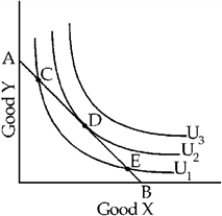 -In Figure 5-19, the consumer experiences at point C
 (Multiple Choice)
4.7/5  (94)
(94) Figure 5-14
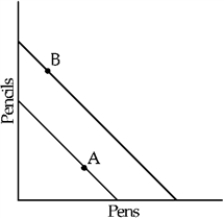 -Martha initially buys the combination of pens and pencils shown as A in Figure 5-14.After the prices of both goods change, she buys combination B.It must be true that
 (Multiple Choice)
4.8/5 (75)
(75) The Wall Street Journal reports that "hard times aid poultry companies as people eat cheaper fowl." In the language of economists, this means
(Multiple Choice)
4.9/5 (74)
(74) When using the terms "total utility" or "marginal utility" we assume:
(Multiple Choice)
4.9/5 (83)
(83) The real cost of a decision is the opportunity cost measured in the commodities forgone.
(True/False)
4.8/5 (79)
(79) Figure 5-5
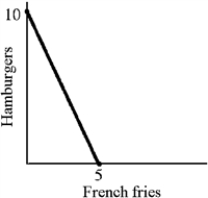 -Figure 5-5 shows a consumer budget line for French fries and hamburgers.The household allocates a budget for these two goods..If the price of an order of french fries is $2, how much income is allocated to fries and burgers combined?
 (Multiple Choice)
5.0/5 (85)
(85) Tom is buying a quantity of wheat at which the marginal utility (in dollars) exceeds price.He should
(Multiple Choice)
4.8/5 (91)
(91) A change in the price of a good will shift the indifference curves.
(True/False)
4.7/5 (89)
(89) If the marginal net utility of beer is a positive number, the consumer should buy more beer in order to maximize utility.
(True/False)
4.7/5 (82)
(82) Modern economists measure how much utility Fred gets from a hot dog by
(Multiple Choice)
4.9/5 (72)
(72) Quantity demanded is not only affected by price but by variables such as income and the prices of other goods.
(True/False)
5.0/5 (87)
(87) Indifference curves show all combinations of commodities that are equally desirable to the consumer.
(True/False)
4.8/5 (71)
(71) 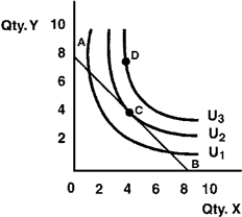 -In Figure 5-18, point D for the consumer
A consumer will consume the combination of goods at the crossing point of a budget line and indifference curve.
(True/False)
4.8/5 (93)
(93) The law of diminishing marginal utility holds that at some point consumption of additional units of a commodity adds less to total utility.
(True/False)
4.8/5 (84)
(84) Elaine values the utility of her first cup of coffee at $1; a second cup, $.75; and a third cup, $.50.If Elaine drinks three cups of coffee for breakfast, her marginal utility is equal to
(Multiple Choice)
4.8/5 (76)
(76) Alice has $10 to spend on wine and cheese.If wine is $2.50 a glass and cheese $2, draw the corresponding budget line.Then draw three indifference curves, one showing the amount of wine and cheese Alice would choose, one showing less preferred combinations of wine and cheese, and the last showing preferred but unaffordable combinations.
(Essay)
4.8/5 (81)
(81) The slope of an indifference curve represents the maximum amount of one commodity that a consumer is willing to give up in exchange for one more unit of another commodity.
(True/False)
4.9/5 (72)
(72) 
Filters
- Essay(0)
- Multiple Choice(0)
- Short Answer(0)
- True False(0)
- Matching(0)