



 Chat with AI
Exam 5: Consumer Choice: Individual and Market Demand

Exam 1: What Is Economics232 Questions
Exam 2: The Economy: Myth and Reality155 Questions
Exam 3: The Fundamental Economic Problem: Scarcity and Choice255 Questions
Exam 4: Supply and Demand: an Initial Look313 Questions
Exam 5: Consumer Choice: Individual and Market Demand206 Questions
Exam 6: Demand and Elasticity214 Questions
Exam 7: Production, Inputs, and Cost: Building Blocks for Supply Analysis221 Questions
Exam 8: Output, Price, and Profit: the Importance of Marginal Analysis194 Questions
Exam 9: Securities: Business Finance and the Economy: the Tail That Wags the Dog203 Questions
Exam 10: The Firm and the Industry Under Perfect Competition212 Questions
Exam 11: Monopoly208 Questions
Exam 12: Between Competition and Monopoly230 Questions
Exam 13: Limiting Market Power: Regulation and Antitrust155 Questions
Exam 14: The Case for Free Markets: the Price System225 Questions
Exam 15: The Shortcomings of Free Markets219 Questions
Exam 16: Externalities, the Environment, and Natural Resources222 Questions
Exam 17: Taxation and Resource Allocation221 Questions
Exam 18: Pricing the Factors of Production233 Questions
Exam 19: Labor and Entrepreneurship: the Human Inputs271 Questions
Exam 20: Poverty, Inequality, and Discrimination172 Questions
Exam 21: Is Useconomic Leadership Threatened75 Questions
Exam 22: An Introduction to Macroeconomics216 Questions
Exam 23: The Goals of Macroeconomic Policy212 Questions
Exam 24: Economic Growth: Theory and Policy228 Questions
Exam 25: Aggregate Demand and the Powerful Consumer219 Questions
Exam 26: Demand-Side Equilibrium: Unemployment or Inflation216 Questions
Exam 27: Bringing in the Supply Side: Unemployment and Inflation228 Questions
Exam 28: Managing Aggregate Demand: Fiscal Policy210 Questions
Exam 29: Money and the Banking System224 Questions
Exam 30: Monetary Policy: Conventional and Unconventional210 Questions
Exam 31: He Financial Crisis and the Great Recession66 Questions
Exam 32: The Debate Over Monetary and Fiscal Policy219 Questions
Exam 33: Budget Deficits in the Short and Long Run215 Questions
Exam 34: The Trade-Off Between Inflation and Unemployment219 Questions
Exam 35: International Trade and Comparative Advantage223 Questions
Exam 36: The International Monetary System: Order or Disorder218 Questions
Exam 37: Exchange Rates and the Macroeconomy219 Questions
Select questions type


Suppose that Joan, the only consumer of pork, has a downward-sloping demand curve for pork and faces an upward-sloping supply curve.If her demand curve shifts out because she develops a craving for pork, then at the new equilibrium (everything else equal),
(Multiple Choice)
5.0/5  (74)
(74) Figure 5-15
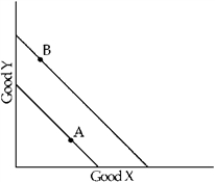 -Hal initially consumes the combination marked as A in Figure 5-15.After his income increases, Hal consumes combination B.We can conclude that Hal views
 (Multiple Choice)
4.9/5 (78)
(78) You have five hours left to study for two exams tomorrow.The relationship between hours of study and test scores is as follows:
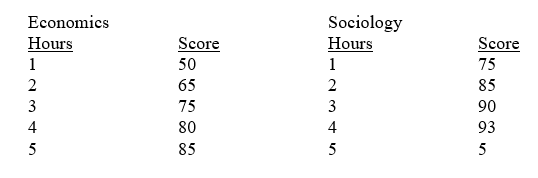 Use the rule for determining optimal purchases to allocate your time, where each point is one "util" of utility.
 (Essay)
4.7/5 (69)
(69) By changing the amount of income a consumer has to spend, a change in the price of one good may affect the quantity demanded of another good.
(True/False)
4.7/5 (87)
(87) Economists consider instances of increasing marginal utility to be
(Multiple Choice)
4.8/5 (84)
(84) Use consumer indifference curves and budget lines to illustrate the effects of an increase in income for a normal good and an inferior good (use two graphs).Be sure your diagrams are fully and correctly labeled.
(Essay)
4.8/5 (76)
(76) Table 5-1B
 -If a graph of Robinson's marginal utility were constructed from Table 5-1B, it would
 (Multiple Choice)
4.8/5 (83)
(83) Figure 5-8
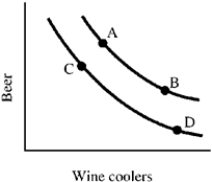 -In Figure 5-8, the consumer is indifferent between the combinations of beer and wine coolers indicated by points
 (Multiple Choice)
4.8/5 (83)
(83) Total utility increases if one more unit of a product is purchased and marginal utility is positive.
(True/False)
4.9/5 (68)
(68) The marginal rate of substitution represents the maximum amount of one commodity a consumer is willing to give up in exchange for one more unit of another commodity.
(True/False)
4.8/5 (93)
(93) A consumer will go to a point on the highest attainable indifference curve.
(True/False)
4.9/5 (76)
(76) Figure 5-7
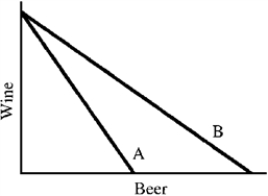 -In Figure 5-7, budget line B compared to A clearly shows that the
 (Multiple Choice)
4.8/5 (81)
(81) The law of diminishing marginal utility guarantees that demand curves will have positive slopes.
(True/False)
4.9/5 (86)
(86) The resolution of Adam Smith's diamond-water puzzle is based on the distinction between marginal and total utility.
(True/False)
4.9/5 (77)
(77) Figure 5-9
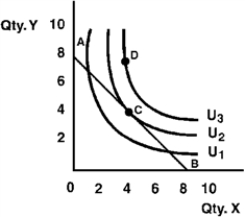 -In Figure 5-9, the consumer's marginal rate of substitution at his optimum choice of X and Y is
 (Multiple Choice)
4.7/5 (77)
(77) The host at a party offers Justin a sixth beer.Justin says, "No thanks, man.The marginal utility of that fifth beer was, like, 20 cents, but the marginal utility of the sixth would be minus 10 cents." If Justin consumes the sixth beer, his total utility will
(Multiple Choice)
4.9/5 (68)
(68) 
Filters
- Essay(0)
- Multiple Choice(0)
- Short Answer(0)
- True False(0)
- Matching(0)