



 Chat with AI
Exam 5: Consumer Choice: Individual and Market Demand

Exam 1: What Is Economics232 Questions
Exam 2: The Economy: Myth and Reality155 Questions
Exam 3: The Fundamental Economic Problem: Scarcity and Choice255 Questions
Exam 4: Supply and Demand: an Initial Look313 Questions
Exam 5: Consumer Choice: Individual and Market Demand206 Questions
Exam 6: Demand and Elasticity214 Questions
Exam 7: Production, Inputs, and Cost: Building Blocks for Supply Analysis221 Questions
Exam 8: Output, Price, and Profit: the Importance of Marginal Analysis194 Questions
Exam 9: Securities: Business Finance and the Economy: the Tail That Wags the Dog203 Questions
Exam 10: The Firm and the Industry Under Perfect Competition212 Questions
Exam 11: Monopoly208 Questions
Exam 12: Between Competition and Monopoly230 Questions
Exam 13: Limiting Market Power: Regulation and Antitrust155 Questions
Exam 14: The Case for Free Markets: the Price System225 Questions
Exam 15: The Shortcomings of Free Markets219 Questions
Exam 16: Externalities, the Environment, and Natural Resources222 Questions
Exam 17: Taxation and Resource Allocation221 Questions
Exam 18: Pricing the Factors of Production233 Questions
Exam 19: Labor and Entrepreneurship: the Human Inputs271 Questions
Exam 20: Poverty, Inequality, and Discrimination172 Questions
Exam 21: Is Useconomic Leadership Threatened75 Questions
Exam 22: An Introduction to Macroeconomics216 Questions
Exam 23: The Goals of Macroeconomic Policy212 Questions
Exam 24: Economic Growth: Theory and Policy228 Questions
Exam 25: Aggregate Demand and the Powerful Consumer219 Questions
Exam 26: Demand-Side Equilibrium: Unemployment or Inflation216 Questions
Exam 27: Bringing in the Supply Side: Unemployment and Inflation228 Questions
Exam 28: Managing Aggregate Demand: Fiscal Policy210 Questions
Exam 29: Money and the Banking System224 Questions
Exam 30: Monetary Policy: Conventional and Unconventional210 Questions
Exam 31: He Financial Crisis and the Great Recession66 Questions
Exam 32: The Debate Over Monetary and Fiscal Policy219 Questions
Exam 33: Budget Deficits in the Short and Long Run215 Questions
Exam 34: The Trade-Off Between Inflation and Unemployment219 Questions
Exam 35: International Trade and Comparative Advantage223 Questions
Exam 36: The International Monetary System: Order or Disorder218 Questions
Exam 37: Exchange Rates and the Macroeconomy219 Questions
Select questions type


The market demand curve is the horizontal summation of all individual demand curves.
(True/False)
4.8/5  (78)
(78) Figure 5-11
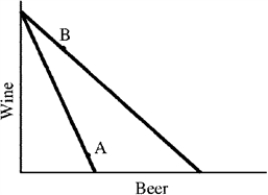 -In Figure 5-11, a consumer is initially at point A.There is a price change and she moves to B.It follows that
 (Multiple Choice)
4.7/5 (70)
(70) When the price of a good changes but the price of the only other good bought by a consumer stays constant, his
(Multiple Choice)
4.9/5 (79)
(79)
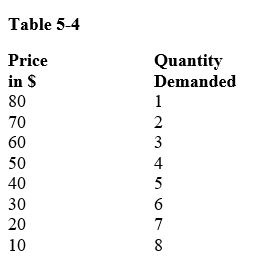 -Table 5-4 shows the demand schedule for concert tickets for a particular consumer.What will be this consumer's surplus if the price of tickets is $50?
 (Multiple Choice)
4.9/5 (67)
(67) Figure 5-6
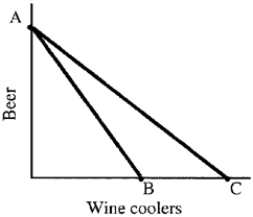 -In Figure 5-6, a shift in the budget line from AC to AB indicates
 (Multiple Choice)
4.9/5 (94)
(94) Bob values the utility of a single scoop of Baskin-Robbins ice cream at $1.50.A double scoop gives total utility of $2.25, while a triple scoop yields $2.60.Baskin-Robbins charges $1.35 for a single, $1.95 for a double, and $2.35 for a triple.How many scoops will Bob buy?
(Essay)
4.8/5 (87)
(87) Given a typical demand curve and a decline in price, the consumer who wishes to maximize total utility must increase the quantity purchased of a good to arrive at an optimal MU = P point.
(True/False)
4.8/5 (78)
(78) If the marginal utility to Juan of sleeping an extra hour (from 8 a.m.to 9 a.m.) is negative,
(Multiple Choice)
4.8/5 (96)
(96) Which of the following factors is always present in consumer decision making?
(Multiple Choice)
4.8/5 (81)
(81) Figure 5-5
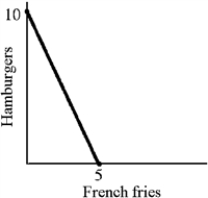 -Figure 5-5 shows a consumer budget line for french fries and hamburgers.The price of an order fries is $2.The price of a burger is
 (Multiple Choice)
4.9/5 (77)
(77) Use the law of diminishing marginal utility to explain why Domino's and Pizza Hut allow the purchase of a second pizza for only $4 when one pays full price (around $10) for the first pizza.Why not simply charge $7 a pizza instead?
(Essay)
4.9/5 (73)
(73) Any point on the lowest indifference curve is preferable to a point on a higher indifference curve.
(True/False)
4.8/5 (85)
(85) 
Filters
- Essay(0)
- Multiple Choice(0)
- Short Answer(0)
- True False(0)
- Matching(0)