



 Chat with AI
Exam 5: Consumer Choice: Individual and Market Demand

Exam 1: What Is Economics232 Questions
Exam 2: The Economy: Myth and Reality155 Questions
Exam 3: The Fundamental Economic Problem: Scarcity and Choice255 Questions
Exam 4: Supply and Demand: an Initial Look313 Questions
Exam 5: Consumer Choice: Individual and Market Demand206 Questions
Exam 6: Demand and Elasticity214 Questions
Exam 7: Production, Inputs, and Cost: Building Blocks for Supply Analysis221 Questions
Exam 8: Output, Price, and Profit: the Importance of Marginal Analysis194 Questions
Exam 9: Securities: Business Finance and the Economy: the Tail That Wags the Dog203 Questions
Exam 10: The Firm and the Industry Under Perfect Competition212 Questions
Exam 11: Monopoly208 Questions
Exam 12: Between Competition and Monopoly230 Questions
Exam 13: Limiting Market Power: Regulation and Antitrust155 Questions
Exam 14: The Case for Free Markets: the Price System225 Questions
Exam 15: The Shortcomings of Free Markets219 Questions
Exam 16: Externalities, the Environment, and Natural Resources222 Questions
Exam 17: Taxation and Resource Allocation221 Questions
Exam 18: Pricing the Factors of Production233 Questions
Exam 19: Labor and Entrepreneurship: the Human Inputs271 Questions
Exam 20: Poverty, Inequality, and Discrimination172 Questions
Exam 21: Is Useconomic Leadership Threatened75 Questions
Exam 22: An Introduction to Macroeconomics216 Questions
Exam 23: The Goals of Macroeconomic Policy212 Questions
Exam 24: Economic Growth: Theory and Policy228 Questions
Exam 25: Aggregate Demand and the Powerful Consumer219 Questions
Exam 26: Demand-Side Equilibrium: Unemployment or Inflation216 Questions
Exam 27: Bringing in the Supply Side: Unemployment and Inflation228 Questions
Exam 28: Managing Aggregate Demand: Fiscal Policy210 Questions
Exam 29: Money and the Banking System224 Questions
Exam 30: Monetary Policy: Conventional and Unconventional210 Questions
Exam 31: He Financial Crisis and the Great Recession66 Questions
Exam 32: The Debate Over Monetary and Fiscal Policy219 Questions
Exam 33: Budget Deficits in the Short and Long Run215 Questions
Exam 34: The Trade-Off Between Inflation and Unemployment219 Questions
Exam 35: International Trade and Comparative Advantage223 Questions
Exam 36: The International Monetary System: Order or Disorder218 Questions
Exam 37: Exchange Rates and the Macroeconomy219 Questions
Select questions type


Draw individual demands for caviar for Al, Barbara, Chuck, and Denise where Al's demand is relatively inelastic, Barbara's is elastic, Chuck's is upward sloping, and Denise refuses to eat caviar at any price.Then draw the corresponding market demand.
(Essay)
4.8/5  (86)
(86) Since price tends to equal marginal utility, the price of water is low and the price of diamonds is high.
(True/False)
4.9/5 (80)
(80) Because the consumer's budget is limited, purchase decisions among available goods must of necessity be interdependent.
(True/False)
4.9/5 (92)
(92)  -In Figure 5-13, the consumer is better off
Why is it that the consumer can maximize total net utility only if the purchase quantity brings marginal utility as close as possible to equality with price?
(Essay)
4.8/5 (81)
(81) Gwen's decision to buy a new television instead of a bicycle for the same price
(Multiple Choice)
4.9/5 (77)
(77) Consumer surplus is the difference between the worth of a commodity to the consumer and the price the consumer pays for the commodity.
(True/False)
4.7/5 (69)
(69) The law of demand holds that as prices of goods decrease, people are willing to buy more.
(True/False)
4.8/5 (67)
(67) Figure 5-17
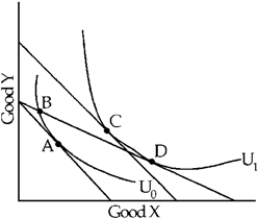 -In Figure 5-17, which of the marked points would an economist use to help him construct a single demand curve for X?
 (Multiple Choice)
4.9/5 (78)
(78) Total utility always decreases when additional amounts of a commodity are consumed.
(True/False)
4.9/5 (84)
(84) The theory of consumer choice is based on the hypothesis that each consumer wants to
(Multiple Choice)
4.9/5 (84)
(84) Utility is the pleasure, satisfaction, or enjoyment derived from consumption.
(True/False)
4.8/5 (74)
(74) The host at a party offers Justin a sixth beer.Justin says, "No thanks, man.The marginal utility of that fifth beer was, like, 20 cents, but the marginal utility of the sixth would be minus 10 cents." From his comments, we deduce that Justin
(Multiple Choice)
4.9/5 (80)
(80) 
Filters
- Essay(0)
- Multiple Choice(0)
- Short Answer(0)
- True False(0)
- Matching(0)