



 Chat with AI
Exam 5: Consumer Choice: Individual and Market Demand

Exam 1: What Is Economics232 Questions
Exam 2: The Economy: Myth and Reality155 Questions
Exam 3: The Fundamental Economic Problem: Scarcity and Choice255 Questions
Exam 4: Supply and Demand: an Initial Look313 Questions
Exam 5: Consumer Choice: Individual and Market Demand206 Questions
Exam 6: Demand and Elasticity214 Questions
Exam 7: Production, Inputs, and Cost: Building Blocks for Supply Analysis221 Questions
Exam 8: Output, Price, and Profit: the Importance of Marginal Analysis194 Questions
Exam 9: Securities: Business Finance and the Economy: the Tail That Wags the Dog203 Questions
Exam 10: The Firm and the Industry Under Perfect Competition212 Questions
Exam 11: Monopoly208 Questions
Exam 12: Between Competition and Monopoly230 Questions
Exam 13: Limiting Market Power: Regulation and Antitrust155 Questions
Exam 14: The Case for Free Markets: the Price System225 Questions
Exam 15: The Shortcomings of Free Markets219 Questions
Exam 16: Externalities, the Environment, and Natural Resources222 Questions
Exam 17: Taxation and Resource Allocation221 Questions
Exam 18: Pricing the Factors of Production233 Questions
Exam 19: Labor and Entrepreneurship: the Human Inputs271 Questions
Exam 20: Poverty, Inequality, and Discrimination172 Questions
Exam 21: Is Useconomic Leadership Threatened75 Questions
Exam 22: An Introduction to Macroeconomics216 Questions
Exam 23: The Goals of Macroeconomic Policy212 Questions
Exam 24: Economic Growth: Theory and Policy228 Questions
Exam 25: Aggregate Demand and the Powerful Consumer219 Questions
Exam 26: Demand-Side Equilibrium: Unemployment or Inflation216 Questions
Exam 27: Bringing in the Supply Side: Unemployment and Inflation228 Questions
Exam 28: Managing Aggregate Demand: Fiscal Policy210 Questions
Exam 29: Money and the Banking System224 Questions
Exam 30: Monetary Policy: Conventional and Unconventional210 Questions
Exam 31: He Financial Crisis and the Great Recession66 Questions
Exam 32: The Debate Over Monetary and Fiscal Policy219 Questions
Exam 33: Budget Deficits in the Short and Long Run215 Questions
Exam 34: The Trade-Off Between Inflation and Unemployment219 Questions
Exam 35: International Trade and Comparative Advantage223 Questions
Exam 36: The International Monetary System: Order or Disorder218 Questions
Exam 37: Exchange Rates and the Macroeconomy219 Questions
Select questions type


In Poland's free market, Felix Siemienas is making a fortune in cold cuts.Prices are much higher than formerly.Siemienas says, "Yes, my prices are high.If nobody buys, I bring my prices down.That is the market rule." This "rule" best describes
(Multiple Choice)
4.8/5  (81)
(81) If I use 1,000 gallons of water a month at a price of $.01 a gallon, is my consumer surplus likely to be large or small?
Explain.
(Essay)
4.8/5 (72)
(72) A change in the price of one good, such as staples, may affect the quantity demanded of another good, such as rubber bands.
(True/False)
4.9/5 (86)
(86) A change in the price of one good results in a rotation of the budget line, so that it is steeper or flatter.
(True/False)
4.9/5 (72)
(72) Figure 5-4
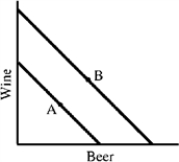 -In Figure 5-4, the rightward shift in budget lines from the one containing point A to the one containing point B
 (Multiple Choice)
4.9/5 (74)
(74) What is the relationship between marginal utility and an individual demand curve?
(Essay)
4.7/5 (73)
(73) The number of Compact Discs purchased by a consumer depends on the price of the discs as well as the prices of all other goods purchased.
(True/False)
4.8/5 (75)
(75) Elaine values the utility of her first cup of coffee at $1; a second cup, $.75; and a third cup, $.50.If Elaine drinks three cups of coffee for breakfast, her total utility is equal to
(Multiple Choice)
4.8/5 (78)
(78) Even if all individual demand curves are downwardly sloped, the market demand curve may slope upward.
(True/False)
4.9/5 (77)
(77) Figure 5-2
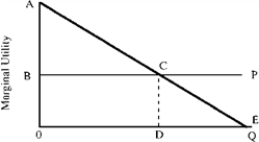 -In Figure 5-2, consumer surplus is measured by the area
 (Multiple Choice)
4.8/5 (69)
(69) Figure 5-13
 -According to Figure 5-13, if the price of good X falls, a consumer making her optimal decision will move from a point on
 (Multiple Choice)
4.9/5 (77)
(77) The law of diminishing marginal utility states that total utility will increase at a decreasing rate as additional units of a commodity are acquired.
(True/False)
4.8/5 (87)
(87) For a ____, if incomes rise and prices do not change, quantity demanded will increase.
(Multiple Choice)
4.9/5 (76)
(76) Marginal utility can fall even as total utility from the consumption of a good is rising.
(True/False)
4.9/5 (71)
(71) 
Filters
- Essay(0)
- Multiple Choice(0)
- Short Answer(0)
- True False(0)
- Matching(0)