



 Chat with AI
Exam 18: Gas Exchange and Transport

Exam 1: Introduction to Physiology69 Questions
Exam 2: Molecular Interactions149 Questions
Exam 3: Compartmentation: Cells and Tissues160 Questions
Exam 4: Energy and Cellular Metabolism147 Questions
Exam 5: Membrane Dynamics144 Questions
Exam 6: Communication, Integration, and Homeostasis82 Questions
Exam 7: Introduction to the Endocrine System76 Questions
Exam 8: Neurons: Cellular and Network Properties229 Questions
Exam 9: The Central Nervous System107 Questions
Exam 10: Sensory Physiology175 Questions
Exam 11: Efferent Division: Autonomic and Somatic Motor Control78 Questions
Exam 12: Muscles106 Questions
Exam 13: Integrative Physiology I: Control of Body Movement76 Questions
Exam 14: Cardiovascular Physiology191 Questions
Exam 15: Blood Flow and the Control of Blood Pressure125 Questions
Exam 16: Blood114 Questions
Exam 17: Mechanics of Breathing118 Questions
Exam 18: Gas Exchange and Transport87 Questions
Exam 19: The Kidneys76 Questions
Exam 20: Integrative Physiology II: Fluid and Electrolyte Balance83 Questions
Exam 21: The Digestive System140 Questions
Exam 22: Metabolism and Energy Balance133 Questions
Exam 23: Endocrine Control of Growth and Metabolism100 Questions
Exam 24: The Immune System120 Questions
Exam 25: Integrative Physiology III: Exercise62 Questions
Exam 26: Reproduction and Development124 Questions
Select questions type


Blocking afferent action potentials from the chemoreceptors in the carotid and aortic bodies would interfere with the brain's ability to regulate breathing in response to all EXCEPT which of the following?
(Multiple Choice)
4.7/5  (75)
(75) Of the factors that influence diffusion of respiratory gases, the most variable and, therefore, important factor to consider is the
(Multiple Choice)
4.9/5 (86)
(86) In the science fiction movie The Abyss, a diver is able to breathe while his head is immersed in a specially prepared liquid pumped into a water-tight helmet attached to a suit, thus allowing him to dive without an air tank and at greater depths than possible for scuba divers.Is this purely fiction, or is it at least theoretically possible? Explain, considering the nature of alveoli and alveolar gas exchange.Assuming it is possible, describe the composition and nature of the liquid in terms of its oxygen pressure and concentration.
(Essay)
4.7/5 (82)
(82) Diffusion rate is directly proportional to ________ and ________.
(Short Answer)
4.8/5 (89)
(89) At a PO₂ of 70 mm Hg and normal temperature and pH, hemoglobin is ________% saturated with oxygen.
(Multiple Choice)
4.9/5 (84)
(84) ________ is characterized by a decreased surface area for gas exchange in the lungs.
(Short Answer)
4.8/5 (91)
(91) What are the two possible causes of lower alveolar PO₂? Give examples of each.
(Essay)
4.9/5 (84)
(84) Hemoglobin binds to and has a much higher affinity for carbon monoxide (CO)than for oxygen.CO is colorless and odorless and can be produced in homes heated by natural gas; victims usually do not realize they are being poisoned and often die in their sleep.Describe the likely changes in a CO poisoning victim.
(Essay)
4.9/5 (78)
(78) In the medulla oblongata, the nucleus tractus solitarius contains the ________ of neurons.
(Multiple Choice)
4.9/5 (97)
(97) Explain how oxygen and carbon dioxide are transported in the blood.How does the means of transport relate to the solubility and chemical reactivity of these gases in plasma?
(Essay)
4.8/5 (78)
(78) Match the lung disease to its description.
-thickened alveolar membrane and decreased lung compliance
(Multiple Choice)
4.9/5 (61)
(61) Specialized ________ in the carotid and aortic bodies are activated by a decrease in PO₂ and pH or an increase in PCO₂.What do they trigger?
(Short Answer)
4.9/5 (75)
(75) Jill lives in St.Louis, which is close to sea level.She decides to spend a month of her summer vacation working in the mountains outside of Denver.After a week in the mountains, what kinds of changes would you expect to see as Jill adapts to the higher altitude?
(Multiple Choice)
4.7/5 (79)
(79) Match the lung disease to its description.
-destruction of alveoli
(Multiple Choice)
4.9/5 (80)
(80) Match the factor with its effect on the affinity of hemoglobin for oxygen.
-increased PCO₂
(Multiple Choice)
4.8/5 (74)
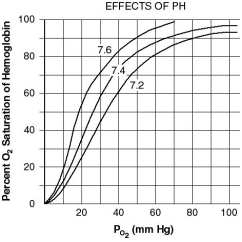
(74) The graph below shows an oxygen dissociation curve, with the normal curve in the center.What is the name of the phenomenon that shifts the curve to the right? What causes this change in oxygen dissociation? Is the shift beneficial or detrimental? Explain.
(Essay)
4.7/5 (84)
(84) Match the lung disease to its description.
-increased airway resistance
(Multiple Choice)
4.9/5 (76)
(76) Inappropriate relaxation of the ________ muscles during sleep contributes to ________, a sleep disorder associated with snoring.
(Short Answer)
5.0/5 (89)
(89) Write the chemical equation catalyzed by the enzyme carbonic anhydrase.Suppose the concentration of H⁺ is increased by an outside force in a solution that had been at equilibrium.According to the law of mass action, what must happen to the CO₂ concentration to reestablish equilibrium after this disturbance? What must happen to the concentration of bicarbonate?
(Essay)
4.8/5 (81)
(81) 
Filters
- Essay(0)
- Multiple Choice(0)
- Short Answer(0)
- True False(0)
- Matching(0)