



 Chat with AI
Exam 18: Gas Exchange and Transport

Exam 1: Introduction to Physiology69 Questions
Exam 2: Molecular Interactions149 Questions
Exam 3: Compartmentation: Cells and Tissues160 Questions
Exam 4: Energy and Cellular Metabolism147 Questions
Exam 5: Membrane Dynamics144 Questions
Exam 6: Communication, Integration, and Homeostasis82 Questions
Exam 7: Introduction to the Endocrine System76 Questions
Exam 8: Neurons: Cellular and Network Properties229 Questions
Exam 9: The Central Nervous System107 Questions
Exam 10: Sensory Physiology175 Questions
Exam 11: Efferent Division: Autonomic and Somatic Motor Control78 Questions
Exam 12: Muscles106 Questions
Exam 13: Integrative Physiology I: Control of Body Movement76 Questions
Exam 14: Cardiovascular Physiology191 Questions
Exam 15: Blood Flow and the Control of Blood Pressure125 Questions
Exam 16: Blood114 Questions
Exam 17: Mechanics of Breathing118 Questions
Exam 18: Gas Exchange and Transport87 Questions
Exam 19: The Kidneys76 Questions
Exam 20: Integrative Physiology II: Fluid and Electrolyte Balance83 Questions
Exam 21: The Digestive System140 Questions
Exam 22: Metabolism and Energy Balance133 Questions
Exam 23: Endocrine Control of Growth and Metabolism100 Questions
Exam 24: The Immune System120 Questions
Exam 25: Integrative Physiology III: Exercise62 Questions
Exam 26: Reproduction and Development124 Questions
Select questions type


Cary deliberately hyperventilates for several minutes before diving into a swimming pool.Shortly after he enters the water and begins swimming, he blacks out and almost drowns.What caused this to happen?
(Essay)
4.9/5  (94)
(94) The expiratory neurons control the ________ muscles, whereas the inspiratory neurons control the ________ muscles.
(Multiple Choice)
4.8/5 (85)
(85) You are a scientist who has been hired to write a screenplay for a popular TV series.The plot involves the discovery by a rogue botanist of a plant toxin that interferes with the function of the exchange pump responsible for the chloride shift.This scientist provides the toxin to bioterrorists.What should you write for the coroner to say about symptoms in the poisoning victims?
(Essay)
4.8/5 (73)
(73) The ________ group of neurons contains mostly inspiratory neurons.The ________ group of neurons controls muscles used for active expiration and some inspiratory muscles.
(Short Answer)
4.8/5 (68)
(68) Match the lung disease to its description.
-increased diffusion distance
(Multiple Choice)
4.8/5 (69)
(69) Refer to the graph below.
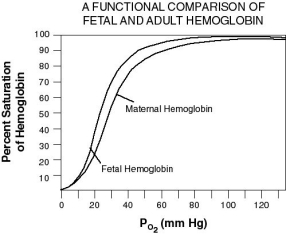 A.At a PO₂ of 80 mm Hg, which type of hemoglobin binds more oxygen?
B.At a PO₂ of 40 mm Hg, which type of hemoglobin has released more oxygen to the cell?
C.Explain the significance of the differences in fetal and maternal hemoglobin affinity.
D.If a worm lived in low oxygen mud flats where the PO₂ is 60 mm Hg, which type of hemoglobin would be better for it to have? Explain.
A.At a PO₂ of 80 mm Hg, which type of hemoglobin binds more oxygen?
B.At a PO₂ of 40 mm Hg, which type of hemoglobin has released more oxygen to the cell?
C.Explain the significance of the differences in fetal and maternal hemoglobin affinity.
D.If a worm lived in low oxygen mud flats where the PO₂ is 60 mm Hg, which type of hemoglobin would be better for it to have? Explain. (Essay)
4.8/5 (82)
(82) Timmy is a cantankerous toddler who has just threatened that he will hold his breath until Mom gives him some chocolate.His mother refuses to be manipulated and watches in amusement as Timmy stubbornly refuses to breathe.To her horror, Timmy loses consciousness and collapses onto the floor.Her cousin, who is enrolled in a course for emergency medical technical (EMT)training, is visiting, and tells her there is no need to call for an ambulance.Why did Timmy lose consciousness? Should his mother trust her instincts and call for help and begin CPR, or should she listen to her well-meaning but young and inexperienced cousin? Explain.
(Essay)
4.9/5 (61)
(61) What are the PO₂ and PCO₂ in the alveoli, artery, peripheral tissue, and veins?
Explain why the PO₂ and PCO₂ change.
(Short Answer)
4.7/5 (83)
(83) List, compare, and contrast the brain's centers for monitoring and controlling respiration.
(Essay)
4.8/5 (75)
(75) The lung pathology most likely to result from certain kinds of heart disease is
(Multiple Choice)
4.8/5 (67)
(67) In ________, fluid accumulates in the interstitial spaces of the lungs, slowing gas exchange.
(Short Answer)
4.9/5 (59)
(59) Which is typically more important in regulating the respiratory system, PO₂ or PCO₂? Explain your answer and briefly discuss the receptors involved.Give examples of situations in which each of those factors changes enough to stimulate a reflex.How and why are these factors related to each other?
(Essay)
4.8/5 (88)
(88) List and explain the factors that influence the presence of gases in liquids.
(Essay)
4.8/5 (71)
(71) Describe the different causes of hypoxia, and give specific examples of the associated conditions.
(Short Answer)
4.9/5 (79)
(79) 
Filters
- Essay(0)
- Multiple Choice(0)
- Short Answer(0)
- True False(0)
- Matching(0)