



 Chat with AI
Exam 17: International Banking: Reserves, Debt, and Risk

Exam 1: The International Economy and Globalization48 Questions
Exam 2: Foundations of Modern Trade Theory: Comparative Advantage170 Questions
Exam 3: Sources of Comparative Advantage109 Questions
Exam 4: Tariffs124 Questions
Exam 5: Nontariff Trade Barriers133 Questions
Exam 6: Trade Regulations and Industrial Policies129 Questions
Exam 7: Trade Policies for the Developing Nations100 Questions
Exam 8: Regional Trading Arrangements130 Questions
Exam 9: International Factor Movements and Multinational Enterprises96 Questions
Exam 10: The Balance of Payments99 Questions
Exam 11: Foreign Exchange121 Questions
Exam 12: Exchange-Rate Determination133 Questions
Exam 13: Mechanisms of International Adjustment107 Questions
Exam 14: Exchange-Rate Adjustments and the Balance of Payments100 Questions
Exam 15: Exchange-Rate Systems and Currency Crises107 Questions
Exam 16: Macroeconomic Policy in an Open Economy72 Questions
Exam 17: International Banking: Reserves, Debt, and Risk96 Questions
Select questions type


Are international reserve needs different for different exchange rate regimes?
(Essay)
5.0/5  (68)
(68) The diagram below represents the exchange market position of the United States in trade with the United Kingdom. Starting at the equilibrium exchange rate of $3 per pound, suppose the demand for pounds rises from D0 to D1.
Figure 17.1 Foreign Exchange Market
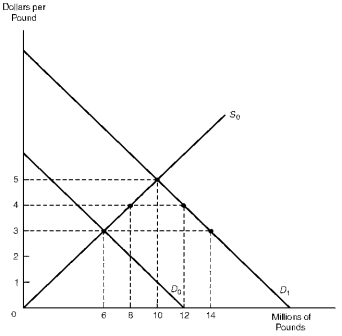 -Refer to Figure 17.1. Under a floating exchange rate system, the exchange rate would rise to $4 and U.S. monetary authorities would have to supply 4 million pounds to the foreign exchange market in exchange for dollars to maintain this rate.
 (True/False)
4.8/5 (68)
(68) Which term best describes the process in which the International Monetary Fund provides loans to countries facing balance-of-payments difficulties provided that they initiate programs holding promise of correcting these difficulties?
(Multiple Choice)
4.9/5 (90)
(90) Gold constitutes the largest component of the world's international reserves.
(True/False)
4.9/5 (74)
(74) The supply of international reserves consists of owned reserves and borrowed reserves.
(True/False)
4.8/5 (80)
(80) Concerning international lending risk, country risk refers to the risk that part or all of the interest or principal of a loan will not be repaid.
(True/False)
4.8/5 (77)
(77) The demand for international reserves tend to increase with the level of world income and trade activity.
(True/False)
4.9/5 (84)
(84) The demand for international reserves is negatively related to the level of world prices and income.
(True/False)
4.9/5 (74)
(74) In 1975 the official price of gold was abolished as the unit of account for the international monetary system. As a result, gold was demonetized as an international reserve asset.
(True/False)
4.8/5 (91)
(91) A goal of the International Monetary Fund is to make short-term loans to member nations so as to allow them to correct balance of payments disequilibriums without resorting to measures that would destroy national prosperity.
(True/False)
4.8/5 (73)
(73) To reduce losses on developing country loans, commercial banks sometimes sell their loans, at a discount, to a developing country government for local currency which is then used to finance purchases of ownership shares in developing country industries. This practice is known as:
(Multiple Choice)
4.8/5 (84)
(84) To reduce their exposure to developing country debt, lending commercial banks have practiced all of the following :
(Multiple Choice)
4.9/5 (80)
(80) Foreign currencies constitute the smallest component of the world's international reserves.
(True/False)
4.9/5 (78)
(78) The exchange of borrowing country debt for an ownership position in the borrowing country is known as:
(Multiple Choice)
4.8/5 (75)
(75) 
Filters
- Essay(0)
- Multiple Choice(0)
- Short Answer(0)
- True False(0)
- Matching(0)