



 Chat with AI
Exam 4: Tariffs

Exam 1: The International Economy and Globalization48 Questions
Exam 2: Foundations of Modern Trade Theory: Comparative Advantage170 Questions
Exam 3: Sources of Comparative Advantage109 Questions
Exam 4: Tariffs124 Questions
Exam 5: Nontariff Trade Barriers133 Questions
Exam 6: Trade Regulations and Industrial Policies129 Questions
Exam 7: Trade Policies for the Developing Nations100 Questions
Exam 8: Regional Trading Arrangements130 Questions
Exam 9: International Factor Movements and Multinational Enterprises96 Questions
Exam 10: The Balance of Payments99 Questions
Exam 11: Foreign Exchange121 Questions
Exam 12: Exchange-Rate Determination133 Questions
Exam 13: Mechanisms of International Adjustment107 Questions
Exam 14: Exchange-Rate Adjustments and the Balance of Payments100 Questions
Exam 15: Exchange-Rate Systems and Currency Crises107 Questions
Exam 16: Macroeconomic Policy in an Open Economy72 Questions
Exam 17: International Banking: Reserves, Debt, and Risk96 Questions
Select questions type


Although tariffs on imported steel may lead to job gains for domestic steel workers, they can lead to job losses for domestic auto workers.

Free
(True/False)
4.8/5  (86)
(86) Correct Answer: Verified
True
According to the infant-industry argument, temporary tariff protection granted to an infant industry will help it become competitive in the world market; when international competitiveness is achieved, the tariff should be removed.
Free
(True/False)
4.8/5 (86)
(86) Correct Answer:Verified
VerifiedTrue
The most vocal political pressure for tariffs is generally made by:
Free
(Multiple Choice)
4.9/5 (81)
(81) Correct Answer:Verified
VerifiedD
Suppose an importer of steel is required to pay a tariff of $20 per ton plus 5 percent of the value of steel. This is an example of a (an):
(Multiple Choice)
4.9/5 (93)
(93) Figure 4.1 illustrates the demand and supply schedules for pocket calculators in Mexico, a "small" nation that is unable to affect the world price.
Figure 4.1. Import Tariff Levied by a "Small" Country
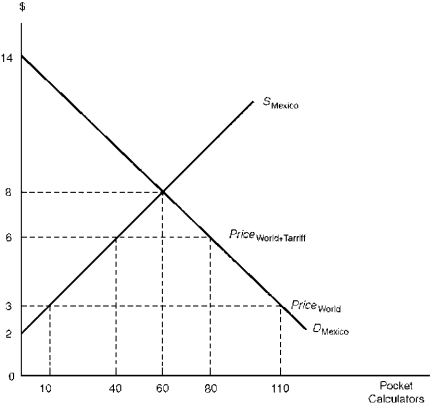 -Consider Figure 4.1. With a per-unit tariff of $3, the quantity of imports decreases to:
 (Multiple Choice)
4.8/5 (81)
(81) An import tariff reduces the welfare of a "small" country by an amount equal to the redistribution effect plus the revenue effect.
(True/False)
4.8/5 (83)
(83) Figure 4.1 illustrates the demand and supply schedules for pocket calculators in Mexico, a "small" nation that is unable to affect the world price.
Figure 4.1. Import Tariff Levied by a "Small" Country
-Consider Figure 4.1. In the absence of trade, Mexico's producer surplus and consumer surplus respectively equal:
-Consider Figure 4.1. In the absence of trade, Mexico's producer surplus and consumer surplus respectively equal: (Multiple Choice)
4.8/5 (80)
(80) With a specific tariff, the degree of protection afforded domestic producers varies directly with changes in import prices.
(True/False)
4.9/5 (77)
(77) Figure 4.4 Market for Gasoline in a Small Nation
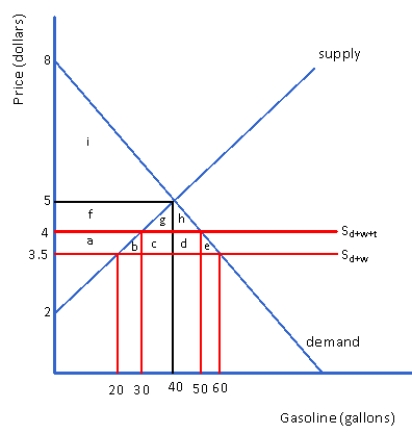 -Figure 4.4 represents the market for gasoline in a small nation. The free trade world price of gasoline is $3.50. Suppose this small nation imposes a tariff on gasoline of $.50 per gallon. The change in consumer surplus would be
 (Multiple Choice)
4.8/5 (72)
(72) Of the many arguments in favor of tariffs, the one that has enjoyed the significant economic justification has been the:
(Multiple Choice)
4.7/5 (86)
(86) Table 4.1. Production Costs and Prices of Imported and Domestic VCRs
Imparted VCRs Damestic VCRs Campanent parts 4150 Imported campanent parts \ 150 Assembly cast/profit 50 Assembly cast 50 Naminal tariff 25 Profit 25 --- --- Impart price Damestic price 225 after tariff 225 after tariff 225
-Consider Table 4.1. The nominal tariff rate on imported VCRs equals:
(Multiple Choice)
4.9/5 (77)
(77) If a "small" country levies a tariff on an imported good, its overall welfare increases if the monetary value of the tariff's consumption effect plus protective effect is less than the monetary value of the terms-of-trade effect.
(True/False)
4.9/5 (81)
(81) Assume the United States is a large consumer of steel that is able to influence the world price. Its demand and supply schedules are respectively denoted by DU.S. and SU.S. in Figure 4.2. The overall (United States plus world) supply schedule of steel is denoted by SU.S.+W.
Figure 4.2. Import Tariff Levied by a "Large" Country
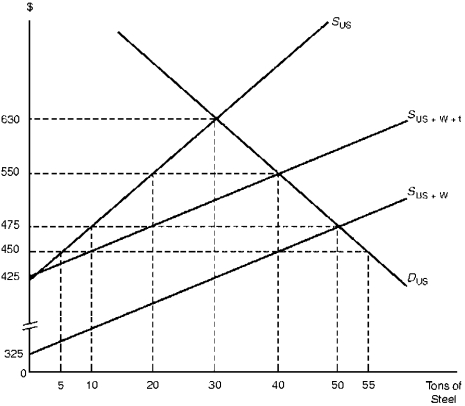 -Consider Figure 4.2. Of the $100 tariff, $____ is passed on to the U.S. consumer via a higher price, while $____ is borne by the foreign exporter; the U.S. terms of trade:
 (Multiple Choice)
4.8/5 (69)
(69) A nation whose imports constitute a very small portion of the world market supply is a price taker, facing a constant world price for its import commodity.
(True/False)
4.9/5 (77)
(77) If a "large" country levies a tariff on an imported good, its overall welfare increases if the monetary value of the tariff's consumption effect plus protective effect exceeds the monetary value of the terms-of-trade effect.
(True/False)
4.9/5 (69)
(69) A problem encountered when implementing an "infant industry" tariff is that:
(Multiple Choice)
4.8/5 (82)
(82) Assume that the United States imports televisions from Taiwan at a price of $300 per unit and that these televisions are subject to an import tariff of 25 percent. Also assume that U.S. components are used in the televisions assembled by Taiwan and that these components have a value of $100. Under the Offshore Assembly Provision of U.S. tariff policy, the price of an imported television to the U.S. consumer after the tariff has been levied is $375
(True/False)
4.9/5 (77)
(77) Exhibit 4.2
In the absence of international trade, assume that the equilibrium price and quantity of motorcycles in Canada is $14,000 and 10 units respectively. Assuming that Canada is a small country that is unable to affect the world price of motorcycles, suppose its market is opened to international trade. As a result, the price of motorcycles falls to $12,000 and the total quantity demanded rises to 14 units; out of this total, 6 units are produced in Canada while 8 units are imported. Now assume that the Canadian government levies an import tariff of $1,000 on motorcycles.
-Refer to Exhibit 4.2. The tariff leads to an increase in Canadian consumer surplus totaling $11,000.
(True/False)
4.7/5 (84)
(84) Exhibit 4.2
In the absence of international trade, assume that the equilibrium price and quantity of motorcycles in Canada is $14,000 and 10 units respectively. Assuming that Canada is a small country that is unable to affect the world price of motorcycles, suppose its market is opened to international trade. As a result, the price of motorcycles falls to $12,000 and the total quantity demanded rises to 14 units; out of this total, 6 units are produced in Canada while 8 units are imported. Now assume that the Canadian government levies an import tariff of $1,000 on motorcycles.
-Refer to Exhibit 4.2. The tariff's revenue effect equals $6,000.
(True/False)
4.9/5 (83)
(83) A tariff quota is a combination of a specific tariff and an ad valorem tariff.
(True/False)
4.8/5 (74)
(74) 
Filters
- Essay(0)
- Multiple Choice(0)
- Short Answer(0)
- True False(0)
- Matching(0)