



 Chat with AI
Exam 4: Tariffs

Exam 1: The International Economy and Globalization48 Questions
Exam 2: Foundations of Modern Trade Theory: Comparative Advantage170 Questions
Exam 3: Sources of Comparative Advantage109 Questions
Exam 4: Tariffs124 Questions
Exam 5: Nontariff Trade Barriers133 Questions
Exam 6: Trade Regulations and Industrial Policies129 Questions
Exam 7: Trade Policies for the Developing Nations100 Questions
Exam 8: Regional Trading Arrangements130 Questions
Exam 9: International Factor Movements and Multinational Enterprises96 Questions
Exam 10: The Balance of Payments99 Questions
Exam 11: Foreign Exchange121 Questions
Exam 12: Exchange-Rate Determination133 Questions
Exam 13: Mechanisms of International Adjustment107 Questions
Exam 14: Exchange-Rate Adjustments and the Balance of Payments100 Questions
Exam 15: Exchange-Rate Systems and Currency Crises107 Questions
Exam 16: Macroeconomic Policy in an Open Economy72 Questions
Exam 17: International Banking: Reserves, Debt, and Risk96 Questions
Select questions type


Figure 4.1 illustrates the demand and supply schedules for pocket calculators in Mexico, a "small" nation that is unable to affect the world price.
Figure 4.1. Import Tariff Levied by a "Small" Country
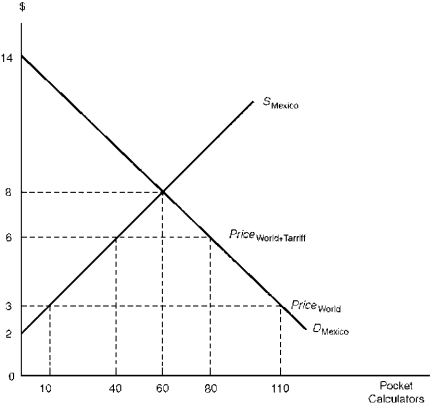 -According to Figure 4.1, the tariff results in the Mexican government collecting:
 (Multiple Choice)
4.8/5  (74)
(74) Figure 4.1 illustrates the demand and supply schedules for pocket calculators in Mexico, a "small" nation that is unable to affect the world price.
Figure 4.1. Import Tariff Levied by a "Small" Country
-Consider Figure 4.1. The tariff would be prohibitive (i.e., eliminate imports) if it equaled:
-Consider Figure 4.1. The tariff would be prohibitive (i.e., eliminate imports) if it equaled: (Multiple Choice)
4.9/5 (84)
(84) Exhibit 4.2
In the absence of international trade, assume that the equilibrium price and quantity of motorcycles in Canada is $14,000 and 10 units respectively. Assuming that Canada is a small country that is unable to affect the world price of motorcycles, suppose its market is opened to international trade. As a result, the price of motorcycles falls to $12,000 and the total quantity demanded rises to 14 units; out of this total, 6 units are produced in Canada while 8 units are imported. Now assume that the Canadian government levies an import tariff of $1,000 on motorcycles.
-Refer to Exhibit 4.2. The tariff leads to a deadweight welfare loss for Canada totaling $1,000.
(True/False)
4.9/5 (80)
(80) Graphically, consumer surplus is represented by the area above the demand curve and below the product's market price.
(True/False)
4.9/5 (79)
(79) Assume the United States is a large consumer of steel that is able to influence the world price. Its demand and supply schedules are respectively denoted by DU.S. and SU.S. in Figure 4.2. The overall (United States plus world) supply schedule of steel is denoted by SU.S.+W.
Figure 4.2. Import Tariff Levied by a "Large" Country
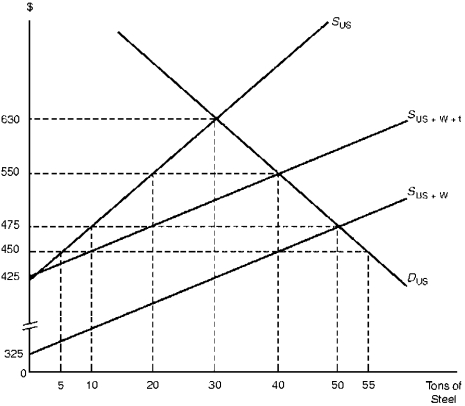 -Consider Figure 4.2. With free trade, the United States achieves market equilibrium at a price of $____. At this price, ____ tons of steel are produced by U.S. firms, ____ tons are bought by U.S. buyers, and ____ tons are imported.
 (Multiple Choice)
4.8/5 (84)
(84) The deadweight losses of an import tariff consist of the protection effect plus the consumption effect.
(True/False)
4.9/5 (84)
(84) When a government allows raw materials and other intermediate products to enter a country , its tariff policy generally results in a:
(Multiple Choice)
4.7/5 (74)
(74) Table 4.1. Production Costs and Prices of Imported and Domestic VCRs
Imparted VCRs Damestic VCRs Campanent parts 4150 Imported campanent parts \ 150 Assembly cast/profit 50 Assembly cast 50 Naminal tariff 25 Profit 25 --- --- Impart price Damestic price 225 after tariff 225 after tariff 225
-Consider Table 4.1. Prior to the tariff, the total price of domestically-produced VCRs is:
(Multiple Choice)
4.9/5 (83)
(83) Developing nations often maintain that industrial countries permit raw materials to be imported at very low tariff rates while maintaining high tariff rates on manufactured imports. Which of the following refers to the above statement?
(Multiple Choice)
4.9/5 (82)
(82) Figure 4.1 illustrates the demand and supply schedules for pocket calculators in Mexico, a "small" nation that is unable to affect the world price.
Figure 4.1. Import Tariff Levied by a "Small" Country
-According to Figure 4.1, the loss in Mexican consumer surplus due to the tariff equals:
-According to Figure 4.1, the loss in Mexican consumer surplus due to the tariff equals: (Multiple Choice)
4.9/5 (89)
(89) Under the Offshore Assembly Provision of U.S. tariff policy, U.S. import duties apply only to the value added in the foreign assembly process, provided that U.S.-made components are used by overseas companies in their assembly operations.
(True/False)
4.8/5 (75)
(75) Producer surplus is the revenue producers receive over and above the minimum necessary for production.
(True/False)
4.8/5 (87)
(87) With a compound tariff, a domestic importer of an automobile might be required to pay a duty of $200 plus 4 percent of the value of the automobile.
(True/False)
4.8/5 (63)
(63) Assume the United States adopts a tariff quota on steel in which the quota is set at 2 million tons, the within-quota tariff rate equals 5 percent, and the over-quota tariff rate equals 10 percent. Suppose the U.S. imports 1 million tons of steel. The resulting revenue effect of the tariff quota would accrue to:
(Multiple Choice)
4.8/5 (83)
(83) Figure 4.4 Market for Gasoline in a Small Nation
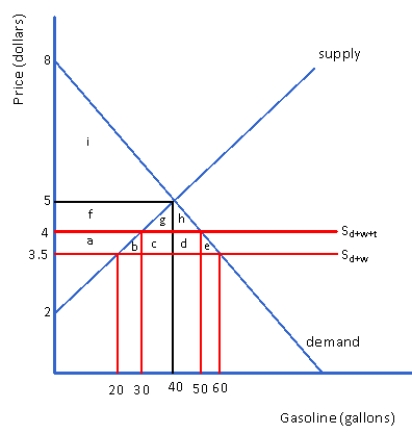 -Figure 4.4 represents the market for gasoline in a small nation. The free trade world price of gasoline is $3.50. Suppose this small nation imposes a tariff on gasoline of $.50 per gallon. The change in consumer surplus would be
 (Multiple Choice)
4.9/5 (72)
(72) A tariff can increase the welfare of a "large" levying country if the favorable terms-of-trade effect more than offsets the unfavorable protective effect and consumption effect.
(True/False)
4.8/5 (88)
(88) Bonded warehouses and foreign trade zones have the effect of allowing domestic importers to postpone and prorate over time their import duty obligations.
(True/False)
4.8/5 (69)
(69) If a tariff reduces the quantity of Japanese autos imported by the United States, over time it reduces the ability of Japan to import goods from the United States.
(True/False)
4.8/5 (76)
(76) 
Filters
- Essay(0)
- Multiple Choice(0)
- Short Answer(0)
- True False(0)
- Matching(0)