



 Chat with AI
Exam 4: Tariffs

Exam 1: The International Economy and Globalization48 Questions
Exam 2: Foundations of Modern Trade Theory: Comparative Advantage170 Questions
Exam 3: Sources of Comparative Advantage109 Questions
Exam 4: Tariffs124 Questions
Exam 5: Nontariff Trade Barriers133 Questions
Exam 6: Trade Regulations and Industrial Policies129 Questions
Exam 7: Trade Policies for the Developing Nations100 Questions
Exam 8: Regional Trading Arrangements130 Questions
Exam 9: International Factor Movements and Multinational Enterprises96 Questions
Exam 10: The Balance of Payments99 Questions
Exam 11: Foreign Exchange121 Questions
Exam 12: Exchange-Rate Determination133 Questions
Exam 13: Mechanisms of International Adjustment107 Questions
Exam 14: Exchange-Rate Adjustments and the Balance of Payments100 Questions
Exam 15: Exchange-Rate Systems and Currency Crises107 Questions
Exam 16: Macroeconomic Policy in an Open Economy72 Questions
Exam 17: International Banking: Reserves, Debt, and Risk96 Questions
Select questions type


Exhibit 4.2
In the absence of international trade, assume that the equilibrium price and quantity of motorcycles in Canada is $14,000 and 10 units respectively. Assuming that Canada is a small country that is unable to affect the world price of motorcycles, suppose its market is opened to international trade. As a result, the price of motorcycles falls to $12,000 and the total quantity demanded rises to 14 units; out of this total, 6 units are produced in Canada while 8 units are imported. Now assume that the Canadian government levies an import tariff of $1,000 on motorcycles.
-Refer to Exhibit 4.2. The tariff's redistribution effect equals $7,000.
(True/False)
4.7/5  (82)
(82) Table 4.1. Production Costs and Prices of Imported and Domestic VCRs
Imparted VCRs Damestic VCRs Campanent parts 4150 Imported campanent parts \ 150 Assembly cast/profit 50 Assembly cast 50 Naminal tariff 25 Profit 25 --- --- Impart price Damestic price 225 after tariff 225 after tariff 225
-Consider Table 4.1. After the tariff, domestic value added equals:
(Multiple Choice)
4.9/5 (81)
(81) Figure 4.1 illustrates the demand and supply schedules for pocket calculators in Mexico, a "small" nation that is unable to affect the world price.
Figure 4.1. Import Tariff Levied by a "Small" Country
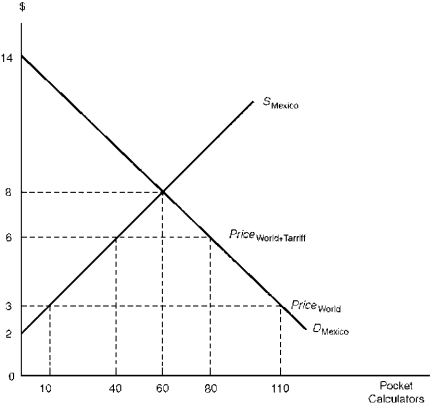 -According to Figure 4.1, the deadweight cost of the tariff totals:
 (Multiple Choice)
4.7/5 (93)
(93) With a compound duty, its "specific" portion neutralizes the cost disadvantage of domestic manufacturers that results from tariff protection granted to domestic suppliers of raw materials, and the "ad valorem" portion of the duty grants protection to the finished-goods industry.
(True/False)
4.8/5 (70)
(70) Arguments for U.S. trade restrictions include all of the following except
(Multiple Choice)
4.8/5 (91)
(91) Figure 4.3 Domestic Market for Gasoline in the United States
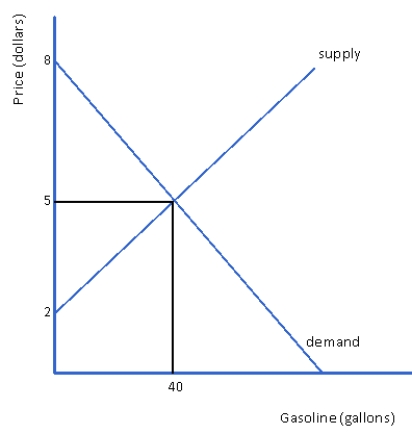 -Figure 4.3 represents the domestic market for gasoline in the United States. What is the consumer surplus in this market?
 (Multiple Choice)
4.8/5 (66)
(66) Assume the United States is a large consumer of steel that is able to influence the world price. Its demand and supply schedules are respectively denoted by DU.S. and SU.S. in Figure 4.2. The overall (United States plus world) supply schedule of steel is denoted by SU.S.+W.
Figure 4.2. Import Tariff Levied by a "Large" Country
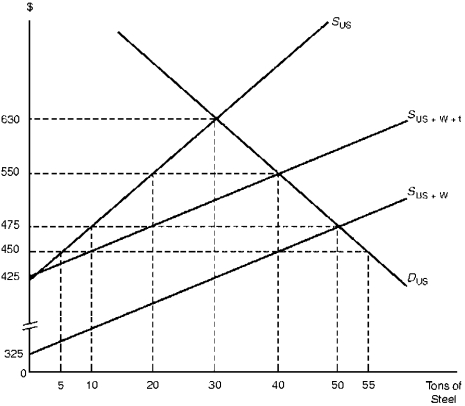 -According to Figure 4.2, the tariff's terms-of-trade effect equals:
 (Multiple Choice)
4.7/5 (72)
(72) The protective effect of a tariff occurs to the extent that less efficient domestic production is substituted for more efficient foreign production.
(True/False)
4.9/5 (68)
(68) Figure 4.3 Domestic Market for Gasoline in the United States
-Figure 4.3 represents the domestic market for gasoline in the United States. What is the producer surplus in this market?
-Figure 4.3 represents the domestic market for gasoline in the United States. What is the producer surplus in this market? (Multiple Choice)
4.9/5 (91)
(91) Assume the United States is a large consumer of steel that is able to influence the world price. Its demand and supply schedules are respectively denoted by DU.S. and SU.S. in Figure 4.2. The overall (United States plus world) supply schedule of steel is denoted by SU.S.+W.
Figure 4.2. Import Tariff Levied by a "Large" Country
-Consider Figure 4.2. Suppose the United States imposes a tariff of $100 on each ton of steel imported. With the tariff, the price of steel rises to $____ and imports fall to ____ tons.
-Consider Figure 4.2. Suppose the United States imposes a tariff of $100 on each ton of steel imported. With the tariff, the price of steel rises to $____ and imports fall to ____ tons. (Multiple Choice)
4.8/5 (76)
(76) If the world price of steel is $600 per ton, a specific tariff of $120 per ton is equivalent to an ad valorem tariff of 25 percent.
(True/False)
5.0/5 (86)
(86) Which of the following policies permits a specified quantity of goods to be imported at one tariff rate and applies a higher tariff rate to imports above this quantity?
(Multiple Choice)
4.8/5 (70)
(70) Figure 4.1 illustrates the demand and supply schedules for pocket calculators in Mexico, a "small" nation that is unable to affect the world price.
Figure 4.1. Import Tariff Levied by a "Small" Country
-According to Figure 4.1, Mexican manufacturers gain ____ because of the tariff.
-According to Figure 4.1, Mexican manufacturers gain ____ because of the tariff. (Multiple Choice)
4.9/5 (76)
(76) When material inputs enter a country at a very low duty while the final imported product is protected by a high duty, the result tends to be a high rate of protection for domestic producers of the final product.
(True/False)
4.7/5 (86)
(86) Figure 4.1 illustrates the demand and supply schedules for pocket calculators in Mexico, a "small" nation that is unable to affect the world price.
Figure 4.1. Import Tariff Levied by a "Small" Country
-Consider Figure 4.1. With free trade, Mexico's producer surplus and consumer surplus respectively equal:
-Consider Figure 4.1. With free trade, Mexico's producer surplus and consumer surplus respectively equal: (Multiple Choice)
4.8/5 (63)
(63) For a "small" country, a tariff raises the domestic price of an imported product by the full amount of the duty.
(True/False)
4.8/5 (75)
(75) Exhibit 4.1
Assume that the United States imports automobiles from South Korea at a price of $20,000 per vehicle and that these vehicles are subject to an import tariff of 20 percent. Also assume that U.S. components are used in the vehicles assembled by South Korea and that these components have a value of $10,000.
-Refer to Exhibit 4.1. Under the Offshore Assembly Provision of U.S. tariff policy, the price of an imported vehicle to the U.S. consumer after the tariff has been levied is:
(Multiple Choice)
4.7/5 (91)
(91) If the domestic value added before an import tariff for a product is $500 and the domestic value added after the tariff is $550, the effective rate of protection is:
(Multiple Choice)
4.9/5 (70)
(70) The nominal tariff rate signifies the total increase in domestic productive activities compared to what would occur under free-trade conditions.
(True/False)
4.8/5 (97)
(97) 
Filters
- Essay(0)
- Multiple Choice(0)
- Short Answer(0)
- True False(0)
- Matching(0)