



 Chat with AI
Exam 11: Foreign Exchange

Exam 1: The International Economy and Globalization48 Questions
Exam 2: Foundations of Modern Trade Theory: Comparative Advantage170 Questions
Exam 3: Sources of Comparative Advantage109 Questions
Exam 4: Tariffs124 Questions
Exam 5: Nontariff Trade Barriers133 Questions
Exam 6: Trade Regulations and Industrial Policies129 Questions
Exam 7: Trade Policies for the Developing Nations100 Questions
Exam 8: Regional Trading Arrangements130 Questions
Exam 9: International Factor Movements and Multinational Enterprises96 Questions
Exam 10: The Balance of Payments99 Questions
Exam 11: Foreign Exchange121 Questions
Exam 12: Exchange-Rate Determination133 Questions
Exam 13: Mechanisms of International Adjustment107 Questions
Exam 14: Exchange-Rate Adjustments and the Balance of Payments100 Questions
Exam 15: Exchange-Rate Systems and Currency Crises107 Questions
Exam 16: Macroeconomic Policy in an Open Economy72 Questions
Exam 17: International Banking: Reserves, Debt, and Risk96 Questions
Select questions type


A currency speculator's goal is to buy a currency at a low price and immediately resell it at a higher price, thus realizing a riskless profit.

Free
(True/False)
4.8/5  (80)
(80) Correct Answer: Verified
False
Swap transactions among commercial banks involve the conversion of one currency to another at one point with an agreement to reconvert it back into the original currency at some point in the future.
Free
(True/False)
4.8/5 (66)
(66) Correct Answer:Verified
VerifiedTrue
The most important (in terms of dollar value) type of foreign exchange transaction by U.S. banks is the:
Free
(Multiple Choice)
4.7/5 (89)
(89) Correct Answer:Verified
VerifiedA
The "spread" is a bank's profit margin on foreign exchange trading and equals the difference between the bid rate and the offer rate.
(True/False)
4.8/5 (80)
(80) A "call" option gives General Motors the right to sell pounds at a specified price, while a put option gives General Motors the right to buy pounds at a specified price.
(True/False)
4.9/5 (78)
(78) Suppose the exchange rate between the Japanese yen and the U.S. dollar is 100 yen per dollar. A Japanese stereo with a price of 60,000 yen will cost:
(Multiple Choice)
4.9/5 (84)
(84) In the interbank market for foreign exchange, the ____ refers to the price for which a bank is willing to sell a unit of foreign currency.
(Multiple Choice)
4.7/5 (83)
(83) Under a system of floating exchange rates, the Swiss franc would depreciate in value if which of the following occurs?
(Multiple Choice)
4.8/5 (76)
(76) Table 11.3. Key Currency Cross Rates
Canada 1.5326 1.4400 2.2362 0.9790 Japan 124.48 116.96 181.63 79.515 Mexico 9.7410 9.1526 14.213 6.2223 Switzerland 1.5655 1.4709 2.2842 \ldots\ldots\ldots UK .68540 .6440 \ldots\ldots\ldots .4378 Euro 1.06430 \ldots\ldots\ldots 1.5529 .67984 US \ldots\ldots\ldots 9396 1.4591 63877
-Referring to Table 11.3, the cross exchange rate between the euro and Swiss franc is approximately:
(Multiple Choice)
4.9/5 (79)
(79) Table 11.2. Supply and Demand of British Pounds
Quantity Dollars Quantity of Pounds per of Pounds Supplied Pound Demanded 1,000 2.00 200 800 1.80 400 600 1.60 600 400 1.40 800 200 1.20 1,000
-Refer to Table 11.2. At the exchange rate of $1.80 per pound, there is an ____ for pounds. This imbalance causes ____ in the price of the pound, which leads to ____ in the quantity of pounds supplied and ____ in the quantity of pounds demanded.
(Multiple Choice)
5.0/5 (67)
(67) Is it possible to trade foreign exchange in the futures market? How does such trading differ from the forward market?
(Essay)
4.8/5 (79)
(79) Suppose that real incomes increase more rapidly in the United States than in Mexico. In the United States, this situation would likely result in a (an):
(Multiple Choice)
4.8/5 (90)
(90) Similar to stock and commodity exchanges, the foreign exchange market is an organized structure with a central meeting place and formal licensing requirements.
(True/False)
4.8/5 (65)
(65) Concerning the foreign exchange market, one can best say that:
(Multiple Choice)
4.9/5 (83)
(83) An increase in the dollar price of other currencies tends to cause:
(Multiple Choice)
4.9/5 (81)
(81) If Chase Manhattan Bank quotes bid and offer rates for the Swiss franc at $.5250/$.5260, the bank would realize profits of $1,000 on the purchase and sale of 1 million francs.
(True/False)
4.7/5 (81)
(81) Given an upward-sloping supply schedule of pounds and a downward-sloping demand schedule for pounds, an increase in the demand schedule causes an appreciation of the dollar against the pound.
(True/False)
4.8/5 (76)
(76) With arbitrage, a trader attempts to purchase a foreign currency at a low price and, at a later date, resell the currency at a higher price in order to make a profit.
(True/False)
5.0/5 (81)
(81) The figure below illustrates the market for Swiss francs in a world of market-determined exchange rates. Assume the equilibrium exchange rate is $0.5 per franc, given by the intersection of schedules S0 and D0.
Figure 11.2. Market for Francs
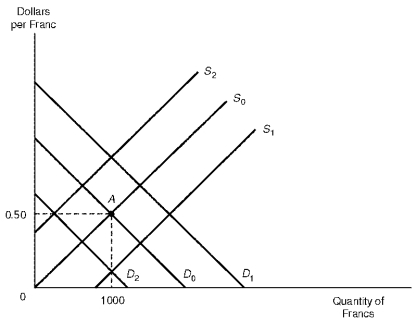 -Refer to Figure 11.2. A shift in the demand for francs from D0 to D1 or a shift in the supply of francs from S0 to S2, would result in a (an):
 (Multiple Choice)
4.7/5 (73)
(73) 
Filters
- Essay(0)
- Multiple Choice(0)
- Short Answer(0)
- True False(0)
- Matching(0)