



 Chat with AI
Exam 6: Trade Regulations and Industrial Policies

Exam 1: The International Economy and Globalization48 Questions
Exam 2: Foundations of Modern Trade Theory: Comparative Advantage170 Questions
Exam 3: Sources of Comparative Advantage109 Questions
Exam 4: Tariffs124 Questions
Exam 5: Nontariff Trade Barriers133 Questions
Exam 6: Trade Regulations and Industrial Policies129 Questions
Exam 7: Trade Policies for the Developing Nations100 Questions
Exam 8: Regional Trading Arrangements130 Questions
Exam 9: International Factor Movements and Multinational Enterprises96 Questions
Exam 10: The Balance of Payments99 Questions
Exam 11: Foreign Exchange121 Questions
Exam 12: Exchange-Rate Determination133 Questions
Exam 13: Mechanisms of International Adjustment107 Questions
Exam 14: Exchange-Rate Adjustments and the Balance of Payments100 Questions
Exam 15: Exchange-Rate Systems and Currency Crises107 Questions
Exam 16: Macroeconomic Policy in an Open Economy72 Questions
Exam 17: International Banking: Reserves, Debt, and Risk96 Questions
Select questions type


According to the General Agreement on Tariffs and Trade and its successor, the World Trade Organization, only bilateral trade negotiations can take place between a country and its trading partners.

Free
(True/False)
4.8/5  (77)
(77) Correct Answer: Verified
False
Assume that Russia has a comparative advantage in vodka. If the United States extends Russia the benefits of the normal-trade-relations (most favored nation)principle, U.S. consumer surplus decreases in the vodka market.
Free
(True/False)
4.8/5 (77)
(77) Correct Answer:Verified
VerifiedFalse
Under the government procurement policy of the World Trade Organization, federal-state-local governments are prevented from discriminating in favor of the products of domestic suppliers on contracts valued at $1 million and more.
Free
(True/False)
4.8/5 (68)
(68) Correct Answer:Verified
VerifiedFalse
The U.S. trade-remedy laws attempt to redress hardships for U.S. firms resulting from actions and policies of foreign firms and governments.
(True/False)
4.8/5 (77)
(77) Assume that the United States is the only supplier of grain to China and that it levies a partial export embargo against China. The embargo leads to increased U.S. welfare if the resulting improvement in the U.S. terms of trade with China more than offset the costs of the lower export volume to China.
(True/False)
4.8/5 (75)
(75) Proponents of the Smoot-Hawley Act of 1930 viewed it as a means of combating domestic unemployment.
(True/False)
4.9/5 (88)
(88) Members of the General Agreement on Tariffs and Trade and its successor, the World Trade Organization, agree to the principle of nondiscrimination in trade and the reduction of trade barriers by multilateral negotiations.
(True/False)
4.8/5 (72)
(72) The purpose of "countervailing duties," as levied by the domestic government, is to neutralize import tariffs imposed by foreign governments.
(True/False)
4.8/5 (88)
(88) By reducing available supplies of a product, an export embargo leads to falling prices in the target nation and increasing target-nation consumer surplus.
(True/False)
4.7/5 (84)
(84) U.S. antidumping duties are intended to neutralize exports to the United States at prices below average total cost or exports to the United States at prices lower than those charged in the exporter's home market.
(True/False)
5.0/5 (83)
(83) Figure 6.3 represents the Iraqi computer market. Assume Iraq purchases all of its computers from the United States.
Figure 6.3 Iraqi Computer Market and Economic Sanctions
 -Consider Figure 6.3. For the United States, the export quota results in a (an):
 (Multiple Choice)
5.0/5 (66)
(66) Figure 6.5 Japanese Market for Jetliners
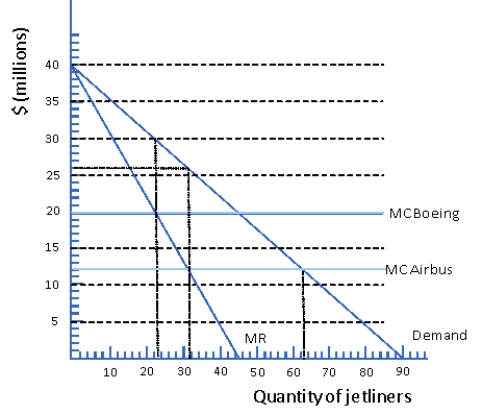 -Consider the Japanese market for jetliners as depicted in Figure 6.5. Suppose lone producer of jetliners in the world is Boeing and Boeing faces a constant marginal cost of $20 million per jetliner but now a European manufacturer, Airbus, begins production. Airbus faces the same marginal cost as Boeing but the European government provides Airbus with a subsidy of $8 million per jetliner produced. As a result of the competition, Boeing leaves the Japanese market leaving Airbus as a monopoly. How many jetlines will airbus produce and what price will they sell them for?
 (Multiple Choice)
4.7/5 (73)
(73) The most recent round of multilateral trade negotiations is the:
(Multiple Choice)
5.0/5 (72)
(72) The Export-Import Bank provides export-credit subsidies to U.S. producers of agricultural goods.
(True/False)
4.9/5 (79)
(79) Countervailing duties are intended to neutralize any unfair advantage that foreign exporters might gain over domestic producers because of foreign:
(Multiple Choice)
4.7/5 (84)
(84) As a way of helping American firms trade in the world market, U.S. trade law provides antitrust exemptions for horizontal combinations of American firms engaged solely in export trade. Such firms are permitted to form:
(Multiple Choice)
4.8/5 (79)
(79) ____ attempt to produce a fair and free-trading environment in which there exists a level playing field.
(Multiple Choice)
5.0/5 (68)
(68) 
Filters
- Essay(0)
- Multiple Choice(0)
- Short Answer(0)
- True False(0)
- Matching(0)