



 Chat with AI
Exam 6: Trade Regulations and Industrial Policies

Exam 1: The International Economy and Globalization48 Questions
Exam 2: Foundations of Modern Trade Theory: Comparative Advantage170 Questions
Exam 3: Sources of Comparative Advantage109 Questions
Exam 4: Tariffs124 Questions
Exam 5: Nontariff Trade Barriers133 Questions
Exam 6: Trade Regulations and Industrial Policies129 Questions
Exam 7: Trade Policies for the Developing Nations100 Questions
Exam 8: Regional Trading Arrangements130 Questions
Exam 9: International Factor Movements and Multinational Enterprises96 Questions
Exam 10: The Balance of Payments99 Questions
Exam 11: Foreign Exchange121 Questions
Exam 12: Exchange-Rate Determination133 Questions
Exam 13: Mechanisms of International Adjustment107 Questions
Exam 14: Exchange-Rate Adjustments and the Balance of Payments100 Questions
Exam 15: Exchange-Rate Systems and Currency Crises107 Questions
Exam 16: Macroeconomic Policy in an Open Economy72 Questions
Exam 17: International Banking: Reserves, Debt, and Risk96 Questions
Select questions type


Intellectual property refers to holdings of rare books and pieces of art that are traded on the world market.
(True/False)
4.9/5  (76)
(76) Figure 6.5 Japanese Market for Jetliners
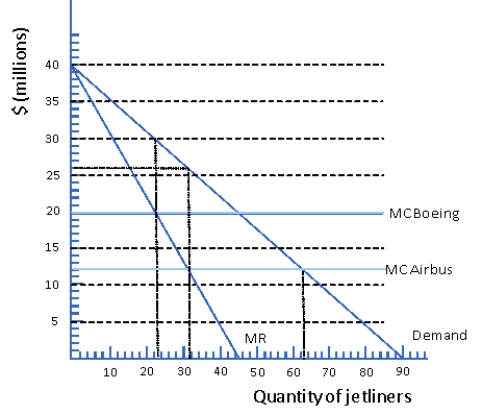 -Consider the Japanese market for jetliners as depicted in Figure 6.5. Suppose lone producer of jetliners in the world is Boeing and Boeing faces a constant marginal cost of $20 million per jetliner but now a European manufacturer, Airbus, begins production. Airbus faces the same marginal cost as Boeing but the European government provides Airbus with a subsidy of $8 million per jetliner produced. As a result of the competition, Boeing leaves the Japanese market leaving Airbus as a monopoly. As a result of the entery of the subsidized producer what will happen to the consumer surplus gained by Japanese airlines from buying jetliners?
 (Multiple Choice)
4.9/5 (86)
(86) Assume Boeing Inc. (of the United States) and Airbus Industrie (of Europe) rival for monopoly profits in the Canadian aircraft market. Suppose the two firms face identical cost and demand conditions, as seen in Figure 6.1.
Figure 6.1. Strategic Trade Policy: Boeing versus Airbus
 -Referring to Figure 6.1, assume that Boeing is the first to enter the Canadian market. Without a governmental subsidy, the firm maximizes profits by selling ____ aircraft at a price of $____, and realizes profits totaling $____.
 (Multiple Choice)
4.9/5 (80)
(80) The principle of normal trade relations (most-favored-nation)treatment was established with the passage of the:
(Multiple Choice)
4.9/5 (61)
(61) Assume Boeing Inc. (of the United States) and Airbus Industrie (of Europe) rival for monopoly profits in the Canadian aircraft market. Suppose the two firms face identical cost and demand conditions, as seen in Figure 6.1.
Figure 6.1. Strategic Trade Policy: Boeing versus Airbus
-Consider Figure 6.1. For Europe as a whole (Airbus and European taxpayers), the subsidy leads to a (an) increase/decrease in net revenues of $____.
-Consider Figure 6.1. For Europe as a whole (Airbus and European taxpayers), the subsidy leads to a (an) increase/decrease in net revenues of $____. (Multiple Choice)
4.9/5 (77)
(77) The only members of the General Agreement on Tariffs and Trade and its successor, the World Trade Organization, are developing countries rather than developed countries.
(True/False)
4.7/5 (77)
(77) Figure 6.3 represents the Iraqi computer market. Assume Iraq purchases all of its computers from the United States.
Figure 6.3 Iraqi Computer Market and Economic Sanctions
 -Consider Figure 6.3. In response to Iraq's armed invasion of neighboring countries, suppose the United States imposes a partial embargo that limits exports to Iraq to 10 computers. The export quota leads to an increase/decrease in the price of computers equal to $____, and an increase/decrease in consumer surplus equal to $____.
 (Multiple Choice)
4.8/5 (81)
(81) Figure 6.2 illustrates the calculator market for Mexico, assumed to be a small nation that is unable influence the South Korean (world) price. Assume the South Korean price to be $60 per calculator.
Figure 6.2. Effects of an Export Subsidy
 -Consider Figure 6.2. For Mexico's producers and consumers as a whole, the South Korean subsidy leads to a:
 (Multiple Choice)
4.9/5 (85)
(85) The World Trade Organization was established by the ____ of multilateral trade negotiations:
(Multiple Choice)
4.8/5 (86)
(86) If the U.S. government pursued a "knowledge-based growth policy," it would subsidize particular firms to help them compete in the world economy.
(True/False)
4.8/5 (79)
(79) Economic sanctions are most effective in pressuring the target country to modify its behavior when the sanctions are imposed by a small number of countries and when the target country had weak economic ties to the imposing countries before the sanctions were initiated.
(True/False)
4.9/5 (58)
(58) Figure 6.3 represents the Iraqi computer market. Assume Iraq purchases all of its computers from the United States.
Figure 6.3 Iraqi Computer Market and Economic Sanctions
-Consider Figure 6.3. Of the quota-induced change in Iraqi consumer surplus, $____ is not transferred to other sectors of Iraq's economy and represents deadweight loss.
-Consider Figure 6.3. Of the quota-induced change in Iraqi consumer surplus, $____ is not transferred to other sectors of Iraq's economy and represents deadweight loss. (Multiple Choice)
4.9/5 (82)
(82) Those who argue in favor of import protection generally give the impression that such restricted trade will:
(Multiple Choice)
4.9/5 (74)
(74) A trade policy designed to alleviate some domestic economic problem by exporting it to foreign countries is known as a (an):
(Multiple Choice)
4.8/5 (63)
(63) The Uruguay Round of Multilateral Trade Negotiations accomplished all of the following :
(Multiple Choice)
5.0/5 (87)
(87) Throughout the post-World War II era, the importance of tariffs as a trade barrier has:
(Multiple Choice)
4.9/5 (79)
(79) Figure 6.5 Japanese Market for Jetliners
-Consider the Japanese market for jetliners as depicted in Figure 6.5. Suppose lone producer of jetliners in the world is Boeing and Boeing faces a constant marginal cost of $20 million per jetliner but now a European manufacturer, Airbus, begins production. Airbus faces the same marginal cost as Boeing but the European government provides Airbus with a subsidy of $8 million per jetliner produced. As a result of the competition, Boeing leaves the Japanese market leaving Airbus as a monopoly. How much profit will Airbus earn?
-Consider the Japanese market for jetliners as depicted in Figure 6.5. Suppose lone producer of jetliners in the world is Boeing and Boeing faces a constant marginal cost of $20 million per jetliner but now a European manufacturer, Airbus, begins production. Airbus faces the same marginal cost as Boeing but the European government provides Airbus with a subsidy of $8 million per jetliner produced. As a result of the competition, Boeing leaves the Japanese market leaving Airbus as a monopoly. How much profit will Airbus earn? (Multiple Choice)
4.9/5 (89)
(89) The main focus of the Uruguay Round of multilateral trade negotiations was on tariff barriers rather than nontariff trade barriers.
(True/False)
4.9/5 (80)
(80) In 1980 the United States announced an embargo on grain exports to the Soviet Union in response to the Soviet armed invasion of Afghanistan. The embargo was mainly resisted by:
(Multiple Choice)
4.9/5 (81)
(81) 
Filters
- Essay(0)
- Multiple Choice(0)
- Short Answer(0)
- True False(0)
- Matching(0)