



 Chat with AI
Exam 6: Trade Regulations and Industrial Policies

Exam 1: The International Economy and Globalization48 Questions
Exam 2: Foundations of Modern Trade Theory: Comparative Advantage170 Questions
Exam 3: Sources of Comparative Advantage109 Questions
Exam 4: Tariffs124 Questions
Exam 5: Nontariff Trade Barriers133 Questions
Exam 6: Trade Regulations and Industrial Policies129 Questions
Exam 7: Trade Policies for the Developing Nations100 Questions
Exam 8: Regional Trading Arrangements130 Questions
Exam 9: International Factor Movements and Multinational Enterprises96 Questions
Exam 10: The Balance of Payments99 Questions
Exam 11: Foreign Exchange121 Questions
Exam 12: Exchange-Rate Determination133 Questions
Exam 13: Mechanisms of International Adjustment107 Questions
Exam 14: Exchange-Rate Adjustments and the Balance of Payments100 Questions
Exam 15: Exchange-Rate Systems and Currency Crises107 Questions
Exam 16: Macroeconomic Policy in an Open Economy72 Questions
Exam 17: International Banking: Reserves, Debt, and Risk96 Questions
Select questions type


Which international organization stipulates procedures for the settlement of international trade disputes?
(Multiple Choice)
4.8/5  (90)
(90) With the passage of the Smoot-Hawley Act in 1930, U.S. average tariffs were raised to over 50 percent on protected imports.
(True/False)
4.9/5 (90)
(90) An antidumping duty levied on imports of foreign-produced steel leads to an increase in consumer surplus in the home country.
(True/False)
4.7/5 (77)
(77) Has industrial policy contributed significantly to Japan's economic growth?
(Essay)
4.8/5 (81)
(81) Although the Uruguay Round of multilateral trade negotiations succeeded in reducing nontariff trade barriers, it could not achieve reductions in tariff trade barriers.
(True/False)
4.9/5 (90)
(90) Figure 6.4 Japanese Market for Jetliners
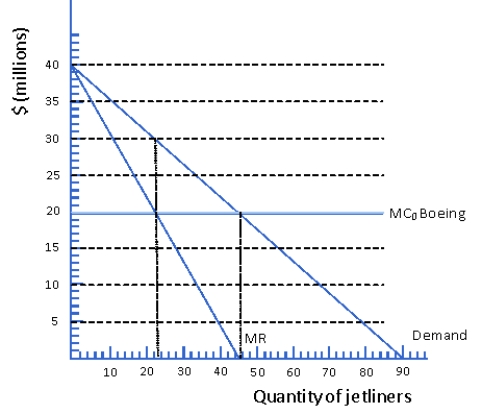 -Consider the Japanese market for jetliners as depicted in Figure 6.4. Suppose lone producer of jetliners in the world is Boeing and Boeing faces a constant marginal cost of $20 million per jetliner. How much profit will boeing make?
 (Multiple Choice)
4.8/5 (84)
(84) According to the normal-trade-relations (most-favored-nation) principle, if the United States extends MFN treatment to China and then grants a low tariff on imports of shirts from South Korea, the United States is obligated to provide the identical low-tariff on imports of shirts from China.
(True/False)
4.8/5 (84)
(84) Under the trade adjustment assistance program, a domestic firm or worker can file for governmental assistance only if it demonstrates that it suffered economic hardship due to imports of foreign-subsidized goods.
(True/False)
4.9/5 (61)
(61) In 1995 the ____ was established to administer the new global trade rules agreed in the Uruguay Round of multilateral trade negotiations.
(Multiple Choice)
4.9/5 (72)
(72) Industrial policies of the U.S. government have included subsidizing particular firms to promote national champions, nationalizing basic industries, and encouraging cartelization of industries.
(True/False)
4.8/5 (81)
(81) Under the original provisions of the Reciprocal Trade Agreements Act, the president of the United States was authorized to cut tariffs up to:
(Multiple Choice)
4.9/5 (84)
(84) Copyrights, trademarks, and patents are used to protect the intellectual property of a nation from foreign imitators.
(True/False)
4.8/5 (74)
(74) Industrial policy attempts to fulfill all of the following objectives :
(Multiple Choice)
4.9/5 (68)
(68) In 1995 the General Agreement on Tariffs and Trade was replaced by the ____.
(Multiple Choice)
4.8/5 (77)
(77) In U.S. trade law, Section 301 cases involve accusations of:
(Multiple Choice)
4.9/5 (90)
(90) The Uruguay Round of trade negotiations resulted in the General Agreement on Tariffs and Trade being succeeded by the World Trade Organization.
(True/False)
4.8/5 (86)
(86) The General Agreement on Tariffs and Trade was founded in 1995 as a successor to the World Trade Organization.
(True/False)
4.9/5 (79)
(79) In U.S. trade law, which measure permits the levying of restrictions on fairly traded imports that harm or threaten to harm American manufacturers?
(Multiple Choice)
4.7/5 (90)
(90) The Smoot-Hawley Tariff Act of 1930 has generally been associated with:
(Multiple Choice)
4.8/5 (77)
(77) In the post World War II era, the Japanese government formed industrial policies to encourage the development of its steel, auto, shipbuilding, and machine tool industries.
(True/False)
5.0/5 (74)
(74) 
Filters
- Essay(0)
- Multiple Choice(0)
- Short Answer(0)
- True False(0)
- Matching(0)