



 Chat with AI
Exam 15: Exchange-Rate Systems and Currency Crises

Exam 1: The International Economy and Globalization48 Questions
Exam 2: Foundations of Modern Trade Theory: Comparative Advantage170 Questions
Exam 3: Sources of Comparative Advantage109 Questions
Exam 4: Tariffs124 Questions
Exam 5: Nontariff Trade Barriers133 Questions
Exam 6: Trade Regulations and Industrial Policies129 Questions
Exam 7: Trade Policies for the Developing Nations100 Questions
Exam 8: Regional Trading Arrangements130 Questions
Exam 9: International Factor Movements and Multinational Enterprises96 Questions
Exam 10: The Balance of Payments99 Questions
Exam 11: Foreign Exchange121 Questions
Exam 12: Exchange-Rate Determination133 Questions
Exam 13: Mechanisms of International Adjustment107 Questions
Exam 14: Exchange-Rate Adjustments and the Balance of Payments100 Questions
Exam 15: Exchange-Rate Systems and Currency Crises107 Questions
Exam 16: Macroeconomic Policy in an Open Economy72 Questions
Exam 17: International Banking: Reserves, Debt, and Risk96 Questions
Select questions type


Given an initial equilibrium in the money market and foreign exchange market, suppose the Federal Reserve the money supply of the United States. Under a floating exchange rate system, the dollar would:

Free
(Multiple Choice)
4.8/5  (76)
(76) Correct Answer: Verified
A
Given a two-country world, assume Canada and Sweden their currencies by 20 percent. This would result in:
Free
(Multiple Choice)
5.0/5 (76)
(76) Correct Answer:Verified
VerifiedD
To help insulate their economies from inflation, currency depreciation, and capital flight, developing countries have implemented:
Free
(Multiple Choice)
4.8/5 (66)
(66) Correct Answer:Verified
VerifiedB
A "dirty float" occurs when a nation used central bank intervention in the foreign exchange market to promote a depreciation of its currency's exchange value, thus gaining a competitive advantage compared to its trading partners.
(True/False)
4.8/5 (77)
(77) Today, special drawing rights (SDRs) represent the most important currency basket against which developing countries maintain pegged exchange rates.
(True/False)
4.8/5 (77)
(77) Which exchange-rate system involves a "leaning against the wind" strategy in which short-term fluctuations in exchange rates are reduced adhering to any particular exchange rate over the long run?
(Multiple Choice)
4.9/5 (65)
(65) Suppose that Japan maintains a pegged exchange rate that the yen. This would likely result in:
(Multiple Choice)
4.8/5 (87)
(87) Figure 15.2 Market for the British Pound
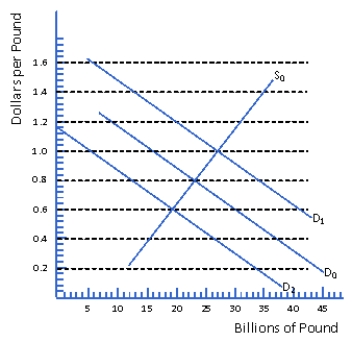 -Refer to Figure 15.2. Suppose that the United States increases its imports from England. Under a floating exchange rate system, the new equilibrium exchange rate would be:
 (Multiple Choice)
4.8/5 (79)
(79) Under a floating exchange-rate system, if the U.S. dollar against the Swiss franc:
(Multiple Choice)
4.9/5 (85)
(85) Under a system of floating exchange rates, a U.S. trade with Japan will cause:
(Multiple Choice)
4.8/5 (72)
(72) The par values of most developing-country currencies are currently defined in terms of gold.
(True/False)
4.8/5 (86)
(86) Smaller nations with relatively undiversified economies and large trade sectors tend to peg their currencies to one of the world's key currencies.
(True/False)
4.7/5 (72)
(72) Which exchange-rate mechanism calls for redefining of the par value by small amounts to remove a payments disequilibrium?
(Multiple Choice)
4.8/5 (89)
(89) Assume that interest rates in London relative to those in Switzerland. Under a floating exchange-rate system, one would expect the pound (relative to the franc) to:
(Multiple Choice)
4.8/5 (71)
(71) Small nations (e.g., Tanzania) with more than one major trading partner tend to peg the value of their currencies to:
(Multiple Choice)
4.8/5 (78)
(78) A market-determined in the dollar price of the pound is associated with:
(Multiple Choice)
4.8/5 (81)
(81) Unlike floating exchange rates, fixed exchange rates are not characterized by par values and central bank intervention in the foreign exchange market.
(True/False)
4.9/5 (79)
(79) 
Filters
- Essay(0)
- Multiple Choice(0)
- Short Answer(0)
- True False(0)
- Matching(0)