



 Chat with AI
Exam 13: Mechanisms of International Adjustment

Exam 1: The International Economy and Globalization48 Questions
Exam 2: Foundations of Modern Trade Theory: Comparative Advantage170 Questions
Exam 3: Sources of Comparative Advantage109 Questions
Exam 4: Tariffs124 Questions
Exam 5: Nontariff Trade Barriers133 Questions
Exam 6: Trade Regulations and Industrial Policies129 Questions
Exam 7: Trade Policies for the Developing Nations100 Questions
Exam 8: Regional Trading Arrangements130 Questions
Exam 9: International Factor Movements and Multinational Enterprises96 Questions
Exam 10: The Balance of Payments99 Questions
Exam 11: Foreign Exchange121 Questions
Exam 12: Exchange-Rate Determination133 Questions
Exam 13: Mechanisms of International Adjustment107 Questions
Exam 14: Exchange-Rate Adjustments and the Balance of Payments100 Questions
Exam 15: Exchange-Rate Systems and Currency Crises107 Questions
Exam 16: Macroeconomic Policy in an Open Economy72 Questions
Exam 17: International Banking: Reserves, Debt, and Risk96 Questions
Select questions type


Figure 13.2. Australian Economy Under a Fixed Exchange Rate System
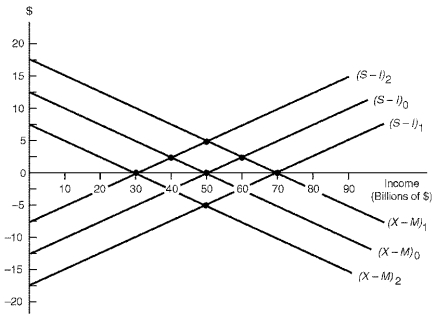 -Refer to Figure 13.2. The slope of the (X-M) schedule and (S-I) schedule indicates that Australia's foreign trade multiplier is:
Free
(Multiple Choice)
4.9/5  (76)
(76) Correct Answer: Verified
D
In explaining balance-of-payments adjustments, the classical economists
Free
(Multiple Choice)
4.8/5 (69)
(69) Correct Answer:Verified
VerifiedB
According to the monetary approach, balance-of-payments disequilibriums are the result of imbalances in a country's money supply and money demand.
Free
(True/False)
4.9/5 (72)
(72) Correct Answer:Verified
VerifiedTrue
For an open economy subject to international trade, equilibrium income occurs where saving plus investment equals imports plus exports.
(True/False)
4.8/5 (90)
(90) Figure 13.4. Canadian Economy Under a Fixed Exchange Rate System
 -Refer to Figure 13.4. Starting at equilibrium income $100 billion, where (S - I)0 intersects (X - M)0, an autonomous increase in Canadian investment of $10 billion leads to a $20 billion increase in income and no change in the country's trade account.
 (True/False)
4.7/5 (78)
(78) Figure 13.2. Australian Economy Under a Fixed Exchange Rate System
-Refer to Figure 13.2. Starting at equilibrium income $50 billion, where (S-I)0 intersects (X-M)0, suppose that changing preferences lead to an autonomous decrease in Australian imports of $5 billion. Australian income thus ____ which leads to Australia's trade account moving to a ____.
-Refer to Figure 13.2. Starting at equilibrium income $50 billion, where (S-I)0 intersects (X-M)0, suppose that changing preferences lead to an autonomous decrease in Australian imports of $5 billion. Australian income thus ____ which leads to Australia's trade account moving to a ____. (Multiple Choice)
4.8/5 (74)
(74) Table 13.1. Canada's Saving, Investment, Import, and Export Functions (in billions of dollars) Under a System of Fixed Exchange Rates
Eraport Function X=3000 Investuent Function I=1000 Saving Function S=-1000+0.2 Import Function M=500+0.25
-Referring to Table 13.1, if Canada's income rises by $200 billion, imports would rise by:
(Multiple Choice)
4.7/5 (76)
(76) Figure 13.4. Canadian Economy Under a Fixed Exchange Rate System
-Refer to Figure 13.4. Starting at equilibrium income $100 billion, where (S - I)0 intersects (X - M)0, an autonomous decrease in Canadian exports of $10 billion leads to a $20 decrease in income and a trade deficit of $5 billion.
-Refer to Figure 13.4. Starting at equilibrium income $100 billion, where (S - I)0 intersects (X - M)0, an autonomous decrease in Canadian exports of $10 billion leads to a $20 decrease in income and a trade deficit of $5 billion. (True/False)
4.9/5 (65)
(65) Figure 13.2. Australian Economy Under a Fixed Exchange Rate System
-Refer to Figure 13.2. Starting at equilibrium income $50 billion, where (S-I)0 intersects (X-M)0, suppose that improving profit expectations lead to an autonomous increase in Australian investment of $5 billion. Australian income thus ____ which leads to Australia's trade account moving to a ____.
-Refer to Figure 13.2. Starting at equilibrium income $50 billion, where (S-I)0 intersects (X-M)0, suppose that improving profit expectations lead to an autonomous increase in Australian investment of $5 billion. Australian income thus ____ which leads to Australia's trade account moving to a ____. (Multiple Choice)
4.9/5 (77)
(77) Under the gold standard of the 1800s, exchange rates were allowed to float freely in the currency markets.
(True/False)
4.8/5 (76)
(76) Figure 13.2. Australian Economy Under a Fixed Exchange Rate System
-Refer to Figure 13.2. Starting at equilibrium income $50 billion, where (S- I)0 intersects (X-M)0, suppose that worsening economic conditions abroad lead to an autonomous decrease in Australian exports of $5 billion. Australian income thus ____ which leads to Australia's trade account moving to a ____.
-Refer to Figure 13.2. Starting at equilibrium income $50 billion, where (S- I)0 intersects (X-M)0, suppose that worsening economic conditions abroad lead to an autonomous decrease in Australian exports of $5 billion. Australian income thus ____ which leads to Australia's trade account moving to a ____. (Multiple Choice)
5.0/5 (98)
(98) Table 13.1. Canada's Saving, Investment, Import, and Export Functions (in billions of dollars) Under a System of Fixed Exchange Rates
Eraport Function X=3000 Investuent Function I=1000 Saving Function S=-1000+0.2 Import Function M=500+0.25
-Referring to Table 13.1, Canada's equilibrium level of income is:
(Multiple Choice)
5.0/5 (84)
(84) The monetary approach contends that, under a fixed exchange rate system, policies that increase the supply of money relative to the demand for money lead to a trade surplus.
(True/False)
4.9/5 (80)
(80) Figure 13.1. U.S. Capital and Financial Account
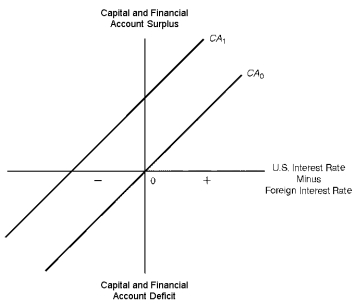 -Refer to Figure 13.1. U.S. capital and financial account schedule CA0 would shift upwards, or downwards, for all of the following reasons
 (Multiple Choice)
4.9/5 (80)
(80) Under the price-adjustment mechanism, trade-deficit nations realize price inflation and a loss of competitiveness while trade surplus nations realize price deflation and an improvement in competitiveness.
(True/False)
5.0/5 (75)
(75) When a country's current account moves into disequilibrium, automatic adjustments in tariffs and quotas occur which move the current account back into equilibrium.
(True/False)
4.7/5 (76)
(76) According to the quantity theory of money, a change in the domestic money supply will bring about:
(Multiple Choice)
4.8/5 (74)
(74) Under the gold standard, a surplus nation facing a gold inflow and an increase in its money supply would also experience a:
(Multiple Choice)
4.8/5 (89)
(89) If the marginal propensity to save equals 0.2 and the marginal propensity to import equals 0.3, an autonomous decrease in investment spending of $1 million leads to a $2 million decrease in domestic income and a $600,000 decrease in imports.
(True/False)
4.8/5 (70)
(70) Figure 13.4. Canadian Economy Under a Fixed Exchange Rate System
-Refer to Figure 13.4. Starting at equilibrium income $100 billion, where (S - I)0 intersects (X - M)0, an autonomous decrease in saving of $10 billion leads to a $20 billion increase in income and a trade deficit of $5 billion.
-Refer to Figure 13.4. Starting at equilibrium income $100 billion, where (S - I)0 intersects (X - M)0, an autonomous decrease in saving of $10 billion leads to a $20 billion increase in income and a trade deficit of $5 billion. (True/False)
4.7/5 (76)
(76) 
Filters
- Essay(0)
- Multiple Choice(0)
- Short Answer(0)
- True False(0)
- Matching(0)