



 Chat with AI
Exam 17: International Banking: Reserves, Debt, and Risk

Exam 1: The International Economy and Globalization48 Questions
Exam 2: Foundations of Modern Trade Theory: Comparative Advantage170 Questions
Exam 3: Sources of Comparative Advantage109 Questions
Exam 4: Tariffs124 Questions
Exam 5: Nontariff Trade Barriers133 Questions
Exam 6: Trade Regulations and Industrial Policies129 Questions
Exam 7: Trade Policies for the Developing Nations100 Questions
Exam 8: Regional Trading Arrangements130 Questions
Exam 9: International Factor Movements and Multinational Enterprises96 Questions
Exam 10: The Balance of Payments99 Questions
Exam 11: Foreign Exchange121 Questions
Exam 12: Exchange-Rate Determination133 Questions
Exam 13: Mechanisms of International Adjustment107 Questions
Exam 14: Exchange-Rate Adjustments and the Balance of Payments100 Questions
Exam 15: Exchange-Rate Systems and Currency Crises107 Questions
Exam 16: Macroeconomic Policy in an Open Economy72 Questions
Exam 17: International Banking: Reserves, Debt, and Risk96 Questions
Select questions type


Which of the following is a condition of the international gold standard? That a nation must:

Free
(Multiple Choice)
4.8/5  (90)
(90) Correct Answer: Verified
C
The U.S. dollar has been considered a reserve (key) currency because trading nations have been willing to hold it as an international reserve asset.
Free
(True/False)
4.9/5 (75)
(75) Correct Answer:Verified
VerifiedTrue
Gold is currently the most widely used asset in the international monetary system.
Free
(True/False)
4.9/5 (81)
(81) Correct Answer:Verified
VerifiedFalse
When granting loans to financially troubled nations, the International Monetary Fund requires some degree of conditionality, meaning that the borrowing nation must agree to implement economic policies as mandated by the IMF.
(True/False)
4.8/5 (71)
(71) Because the value of the SDR is tied directly to the value of the U.S. dollar, a 10 percent dollar depreciation would result in a 10 percent decrease in the SDR's value.
(True/False)
4.8/5 (70)
(70) Which of the following assets was (were) created in 1970 to provide additional international liquidity, in the belief that increasing world trade requires more liquidity for larger expected payments imbalances?
(Multiple Choice)
4.9/5 (83)
(83) The U.S. gold that began in the late 1940s and continued through the 1960s was due in part to:
(Multiple Choice)
4.9/5 (77)
(77) To the extent that adjustments in prices, interest rates, and income levels promote balance-of-payments equilibrium, the demand for international reserves decreases.
(True/False)
4.8/5 (77)
(77) Concerning international lending risk of commercial banks, ____ is closely related to political developments in a borrowing country, especially the government's views concerning international investments and loans.
(Multiple Choice)
4.9/5 (89)
(89) Swap arrangements are bilateral agreements between central banks to allow countries to temporarily borrow funds to ease current-account deficits and discourage speculative capital flows.
(True/False)
4.8/5 (77)
(77) The diagram below represents the exchange market position of the United States in trade with the United Kingdom. Starting at the equilibrium exchange rate of $3 per pound, suppose the demand for pounds rises from D0 to D1.
Figure 17.1 Foreign Exchange Market
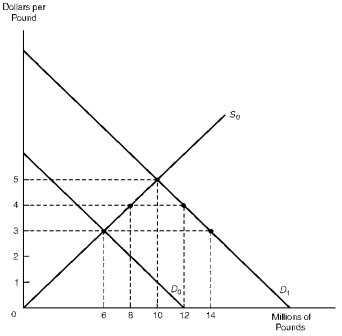 -In the market for British Pounds the demand is represented by D0 and supply by S0. If the exchange rate is fixed at $3 and the demand for pounds increases to D1, US monetary authorities will need to
 (Multiple Choice)
4.8/5 (87)
(87) In 1974 the United States revoked a 41-year ban on U.S. citizen's ownership of gold.
(True/False)
4.9/5 (78)
(78) The diagram below represents the exchange market position of the United States in trade with the United Kingdom. Starting at the equilibrium exchange rate of $3 per pound, suppose the demand for pounds rises from D0 to D1.
Figure 17.1 Foreign Exchange Market
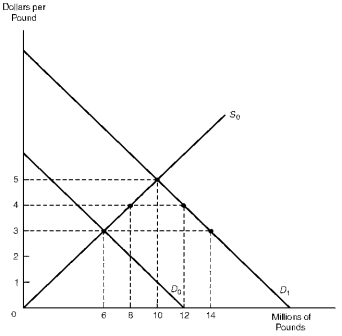 -Refer to Figure 17.1. If the exchange rate was allowed to rise to $4 per pound, U.S. monetary authorities would have to supply 6 million pounds to the foreign exchange market in exchange for dollars to maintain this rate.
 (True/False)
4.9/5 (67)
(67) The greater a nation's propensity to apply tariffs and quotas to key sectors, the greater will be the need for international reserves.
(True/False)
4.7/5 (86)
(86) 
Filters
- Essay(0)
- Multiple Choice(0)
- Short Answer(0)
- True False(0)
- Matching(0)