



 Chat with AI
Exam 17: International Banking: Reserves, Debt, and Risk

Exam 1: The International Economy and Globalization48 Questions
Exam 2: Foundations of Modern Trade Theory: Comparative Advantage170 Questions
Exam 3: Sources of Comparative Advantage109 Questions
Exam 4: Tariffs124 Questions
Exam 5: Nontariff Trade Barriers133 Questions
Exam 6: Trade Regulations and Industrial Policies129 Questions
Exam 7: Trade Policies for the Developing Nations100 Questions
Exam 8: Regional Trading Arrangements130 Questions
Exam 9: International Factor Movements and Multinational Enterprises96 Questions
Exam 10: The Balance of Payments99 Questions
Exam 11: Foreign Exchange121 Questions
Exam 12: Exchange-Rate Determination133 Questions
Exam 13: Mechanisms of International Adjustment107 Questions
Exam 14: Exchange-Rate Adjustments and the Balance of Payments100 Questions
Exam 15: Exchange-Rate Systems and Currency Crises107 Questions
Exam 16: Macroeconomic Policy in an Open Economy72 Questions
Exam 17: International Banking: Reserves, Debt, and Risk96 Questions
Select questions type


With floating exchange rates, countries require sizable amounts of international reserves for the stabilization of exchange rates.
(True/False)
4.7/5  (81)
(81) IMF drawings, swap arrangements, buffer stock facility, and compensatory financing for exports are classified as owned reserves rather than borrowed reserves.
(True/False)
4.9/5 (78)
(78) Concerning international lending risk, currency risk is the risk of asset losses due to changing currency values.
(True/False)
4.8/5 (76)
(76) International reserves allow a country to finance disequilibria in its balance-of-payments position.
(True/False)
4.8/5 (77)
(77) Which of the following is a main central bank function of the International Monetary Fund?
(Multiple Choice)
4.9/5 (72)
(72) With floating exchange rates, payments imbalances tend to be corrected by market-induced fluctuations in the exchange rate, and the need for exchange-rate stabilization and international reserves disappears.
(True/False)
4.9/5 (73)
(73) A debt-equity swap results in a trade surplus nation forgiving the loans made to a trade-deficit nation.
(True/False)
4.9/5 (66)
(66) When a deficit nation borrows from the International Monetary Fund, it purchases with its currency the foreign currency required to help finance the payments deficit.
(True/False)
4.8/5 (77)
(77) Which of the following does represent a form of international liquidity?
(Multiple Choice)
4.8/5 (68)
(68) Eurocurrencies are deposits, denominated and payable in dollars and other foreign currencies, in banks outside the United States, primarily in London, the market's center.
(True/False)
4.9/5 (81)
(81) Which international reserve asset was officially phased out of the international monetary system by the United States in the early 1970s?
(Multiple Choice)
4.8/5 (79)
(79) All of the following exchange-rate systems require international reserves to finance balance-of-payments disequilibriums :
(Multiple Choice)
4.8/5 (85)
(85) Under a debt-for-debt swap, a commercial bank sells its loans at a discount to a developing country government for local currency which it then uses to finance an equity investment in the debtor country.
(True/False)
4.8/5 (81)
(81) Concerning international lending risk of commercial banks, ____ is associated with possible changes in the exchange value of a nation's currency.
(Multiple Choice)
4.8/5 (84)
(84) When exchange rates are fixed by central bankers, the need for international reserves disappears.
(True/False)
4.8/5 (78)
(78) The main purpose of the International Monetary Fund is to grant long-term loans to developing nations to help them finance the development of infrastructure such as roads, dams, and bridges.
(True/False)
4.7/5 (94)
(94) Which of the following constitute(s) the component of the world's international reserves?
(Multiple Choice)
4.8/5 (72)
(72) The U.S. dollar, Japanese yen, British pound, and Mexican peso are the major reserve currencies of the international monetary system.
(True/False)
4.9/5 (98)
(98) The diagram below represents the exchange market position of the United States in trade with the United Kingdom. Starting at the equilibrium exchange rate of $3 per pound, suppose the demand for pounds rises from D0 to D1.
Figure 17.1 Foreign Exchange Market
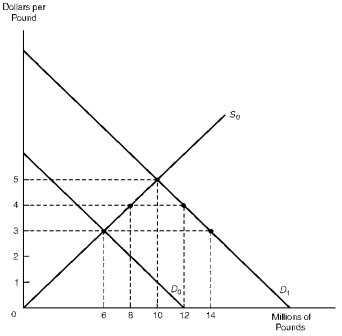 -In the market for British Pounds the demand is represented by D0 and supply by S0. If the exchange rate is flexible and the demand for pounds increases to D1, US monetary authorities will need to
 (Multiple Choice)
4.7/5 (71)
(71) 
Filters
- Essay(0)
- Multiple Choice(0)
- Short Answer(0)
- True False(0)
- Matching(0)