



 Chat with AI
Exam 17: International Banking: Reserves, Debt, and Risk

Exam 1: The International Economy and Globalization48 Questions
Exam 2: Foundations of Modern Trade Theory: Comparative Advantage170 Questions
Exam 3: Sources of Comparative Advantage109 Questions
Exam 4: Tariffs124 Questions
Exam 5: Nontariff Trade Barriers133 Questions
Exam 6: Trade Regulations and Industrial Policies129 Questions
Exam 7: Trade Policies for the Developing Nations100 Questions
Exam 8: Regional Trading Arrangements130 Questions
Exam 9: International Factor Movements and Multinational Enterprises96 Questions
Exam 10: The Balance of Payments99 Questions
Exam 11: Foreign Exchange121 Questions
Exam 12: Exchange-Rate Determination133 Questions
Exam 13: Mechanisms of International Adjustment107 Questions
Exam 14: Exchange-Rate Adjustments and the Balance of Payments100 Questions
Exam 15: Exchange-Rate Systems and Currency Crises107 Questions
Exam 16: Macroeconomic Policy in an Open Economy72 Questions
Exam 17: International Banking: Reserves, Debt, and Risk96 Questions
Select questions type


Concerning international lending risk of commercial banks, ____ refers to the probability that part/all of the interest/principal of a loan will not be repaid.
(Multiple Choice)
4.8/5  (92)
(92) Created by the International Monetary Fund, special drawing rights (SDRs) are unconditional rights to draw currencies of other nations, thus enabling countries to finance their current-account deficits.
(True/False)
4.8/5 (72)
(72) Concerning international debt, ____ refers to a negotiated reduction in the contractual obligations of the debtor country and includes schemes such as markdowns and write-offs of debt.
(Multiple Choice)
4.8/5 (74)
(74) In response to the international debt problem, the United States set up a special fund in 1986 to help make up for lost oil revenues. Under the plan, the United States would make more money available as world oil prices fell. This plan was designed to help:
(Multiple Choice)
4.9/5 (78)
(78) Under a system of fixed exchange rates, international reserves are needed to bridge the gap between monetary receipts and monetary payments.
(True/False)
4.9/5 (72)
(72) The value of the SDR is tied to a currency basket consisting of the U.S. dollar, German mark, Japanese yen, French franc, and British pound.
(True/False)
4.9/5 (76)
(76) Bilateral agreements between central banks, which provide for an exchange of currencies to help finance temporary balance-of-payments disequilibriums, are referred to as:
(Multiple Choice)
4.8/5 (84)
(84) The so-called General Arrangements to Borrow provide a permanent increase in the supply of international reserves.
(True/False)
4.8/5 (92)
(92) With an international gold standard, if a country ended up with a from the balances on its current and capital accounts, it would:
(Multiple Choice)
4.8/5 (87)
(87) The diagram below represents the exchange market position of the United States in trade with the United Kingdom. Starting at the equilibrium exchange rate of $3 per pound, suppose the demand for pounds rises from D0 to D1.
Figure 17.1 Foreign Exchange Market
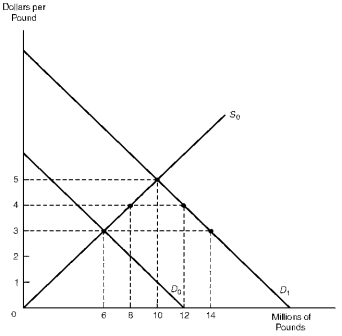 -Refer to Figure 17.1. Under a fixed exchange rate system, U.S. monetary authorities would have to supply 8 million pounds in exchange for dollars to keep the exchange rate at $3 per pound.
 (True/False)
4.9/5 (82)
(82) The International Monetary Fund has sometimes demanded that financially-troubled nations, that borrow from the IMF, undergo austerity programs including slashing of public spending and private consumption.
(True/False)
4.8/5 (75)
(75) International trade and investment are frequently financed by the U.S. dollar and the:
(Multiple Choice)
4.9/5 (89)
(89) Which indicator of international debt burden schedules interest and principal payments on long-term debt as a percent of export earnings?
(Multiple Choice)
5.0/5 (93)
(93) How can a bank reduce its exposure to the debt of developing nations?
(Essay)
4.9/5 (80)
(80) If a nation with a balance-of-payments deficit is willing and able to initiate quick actions to increase export receipts and decrease import payments, the amount of international reserves needed will be relatively large.
(True/False)
4.9/5 (75)
(75) The diagram below represents the exchange market position of the United States in trade with the United Kingdom. Starting at the equilibrium exchange rate of $3 per pound, suppose the demand for pounds rises from D0 to D1.
Figure 17.1 Foreign Exchange Market
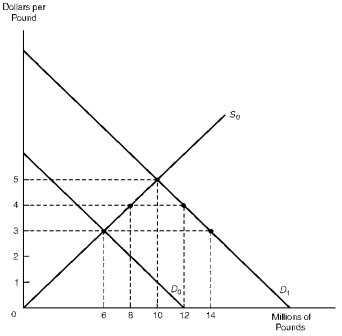 -In the market for British Pounds the demand is represented by D0 and supply by S0. If the exchange rate is allowed to rise as high as $4 and the demand for pounds increases to D1, US monetary authorities will need to
 (Multiple Choice)
4.9/5 (78)
(78) Concerning international lending risk, credit risk refers to the probability that part or all of the interest rate or principal of a loan will not be repaid.
(True/False)
4.9/5 (71)
(71) 
Filters
- Essay(0)
- Multiple Choice(0)
- Short Answer(0)
- True False(0)
- Matching(0)