



 Chat with AI
Exam 8: Regional Trading Arrangements

Exam 1: The International Economy and Globalization48 Questions
Exam 2: Foundations of Modern Trade Theory: Comparative Advantage170 Questions
Exam 3: Sources of Comparative Advantage109 Questions
Exam 4: Tariffs124 Questions
Exam 5: Nontariff Trade Barriers133 Questions
Exam 6: Trade Regulations and Industrial Policies129 Questions
Exam 7: Trade Policies for the Developing Nations100 Questions
Exam 8: Regional Trading Arrangements130 Questions
Exam 9: International Factor Movements and Multinational Enterprises96 Questions
Exam 10: The Balance of Payments99 Questions
Exam 11: Foreign Exchange121 Questions
Exam 12: Exchange-Rate Determination133 Questions
Exam 13: Mechanisms of International Adjustment107 Questions
Exam 14: Exchange-Rate Adjustments and the Balance of Payments100 Questions
Exam 15: Exchange-Rate Systems and Currency Crises107 Questions
Exam 16: Macroeconomic Policy in an Open Economy72 Questions
Exam 17: International Banking: Reserves, Debt, and Risk96 Questions
Select questions type


The common agriculture policy of the European Union has supported European farmers via:

Free
(Multiple Choice)
4.8/5  (88)
(88) Correct Answer: Verified
D
Under the common agricultural policy, exports of any surplus quantities of EU produce are encouraged through the usage of:
Free
(Multiple Choice)
4.8/5 (71)
(71) Correct Answer:Verified
VerifiedB
Negotiating the North American Free Trade Agreement was relatively easy since it involved meshing two large industrial countries with a developing country.
Free
(True/False)
5.0/5 (76)
(76) Correct Answer:Verified
VerifiedFalse
The figure below depicts the steel market for Portugal, a small nation that is unable to affect the world price. Assume that Germany and France can supply steel to Portugal at a price of $200 and $300 respectively.
Figure 8.2. Portugal's Steel Market
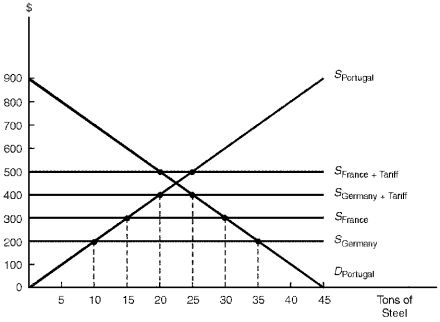 -Consider Figure 8.2. With free trade Portugal will
 (Multiple Choice)
4.9/5 (69)
(69) Suppose that government procurement liberalization results in the U.K. government importing automobiles from Germany, the low-cost EU manufacturer. Cost savings could result from all of the following
(Multiple Choice)
4.9/5 (69)
(69) Some trade creation was expected to occur as a result of the U.S.-Canada free-trade agreement, since Canadian exports to the United States and U.S. exports to Canada were expected to expand at the expense of imports from Germany and Japan that faced trade restrictions.
(True/False)
4.8/5 (97)
(97) Concerning transition economies, what do the advocates of shock therapy propose?
(Essay)
4.8/5 (78)
(78) Economic integration is the process of eliminating restrictions on international trade, payments, and factor mobility.
(True/False)
4.8/5 (93)
(93) Which of the following organizations is considered a regional trading arrangement?
(Multiple Choice)
5.0/5 (87)
(87) The figure below depicts the steel market for Portugal, a small nation that is unable to affect the world price. Assume that Germany and France can supply steel to Portugal at a price of $200 and $300 respectively.
Figure 8.2. Portugal's Steel Market
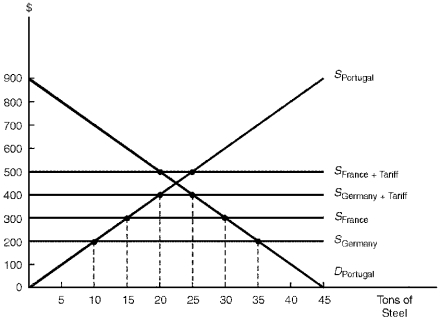 -Consider Figure 8.2. As a result of a customs union formed with France, Portugal's overall welfare rises by $900.
 (True/False)
4.8/5 (72)
(72) If a customs union included all of the countries in the world, there could exist only trade creation, not trade diversion.
(True/False)
4.8/5 (78)
(78) A welfare gain resulting from the formation of the European Union would be:
(Multiple Choice)
4.8/5 (88)
(88) A political dilemma facing the former communist countries in the 1990s was that the transition from a centrally-planned economy to a market economy would result in short-run costs but long-run benefits.
(True/False)
4.9/5 (80)
(80) The failure of the centrally-planned economies was exemplified by all of the following
(Multiple Choice)
4.7/5 (88)
(88) The figure below depicts the steel market for Portugal, a small nation that is unable to affect the world price. Assume that Germany and France can supply steel to Portugal at a price of $200 and $300 respectively.
Figure 8.2. Portugal's Steel Market
-Consider Figure 8.2. If Portugal forms a customs union with France, the resulting trade-creation effect equals $500.
-Consider Figure 8.2. If Portugal forms a customs union with France, the resulting trade-creation effect equals $500. (True/False)
4.8/5 (82)
(82) For decades, the Eastern European countries have suffered from
(Multiple Choice)
5.0/5 (82)
(82) The transition of the former communist countries to market economies requires:
(Multiple Choice)
4.8/5 (78)
(78) By joining NAFTA, the United States, Canada, and Mexico would find their short-run welfare decreasing due to the:
(Multiple Choice)
4.9/5 (69)
(69) At the Maastricht Summit of 1991, European Union negotiators called for the pursuit of a:
(Multiple Choice)
4.8/5 (66)
(66) 
Filters
- Essay(0)
- Multiple Choice(0)
- Short Answer(0)
- True False(0)
- Matching(0)