



 Chat with AI
Exam 8: Regional Trading Arrangements

Exam 1: The International Economy and Globalization48 Questions
Exam 2: Foundations of Modern Trade Theory: Comparative Advantage170 Questions
Exam 3: Sources of Comparative Advantage109 Questions
Exam 4: Tariffs124 Questions
Exam 5: Nontariff Trade Barriers133 Questions
Exam 6: Trade Regulations and Industrial Policies129 Questions
Exam 7: Trade Policies for the Developing Nations100 Questions
Exam 8: Regional Trading Arrangements130 Questions
Exam 9: International Factor Movements and Multinational Enterprises96 Questions
Exam 10: The Balance of Payments99 Questions
Exam 11: Foreign Exchange121 Questions
Exam 12: Exchange-Rate Determination133 Questions
Exam 13: Mechanisms of International Adjustment107 Questions
Exam 14: Exchange-Rate Adjustments and the Balance of Payments100 Questions
Exam 15: Exchange-Rate Systems and Currency Crises107 Questions
Exam 16: Macroeconomic Policy in an Open Economy72 Questions
Exam 17: International Banking: Reserves, Debt, and Risk96 Questions
Select questions type


Figure 8.1 depicts the supply and demand schedules of calculators for Greece, a "small" country that is unable to affect the world price. Greece's supply and demand schedules of calculators are respectively depicted by SG and DG. Assume that Greece imports calculators from either Germany or France. Suppose Germany is the world's low-cost producer who can supply calculators to Greece at $20 per unit, while France can supply calculators at $30 per unit.
Figure 8.1. Effects of a Customs Union
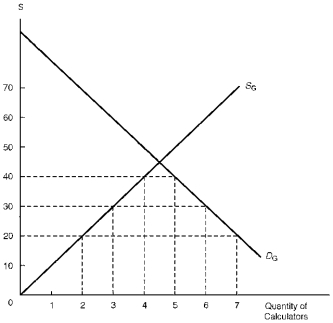 -Consider to Figure 8.1. Assume Greece levies a per-unit tariff of $20 on imports from both Germany and France. Greece will import:
 (Multiple Choice)
4.9/5  (70)
(70) The transition from government-controlled prices to market-determined prices in the former communist countries would be expected to result in:
(Multiple Choice)
4.9/5 (83)
(83) Which form of economic integration occurs when participating countries abolish tariffs on trade among themselves, establish a common tariff on imports from nonmembers, and permit free movement of capital and labor within the organization?
(Multiple Choice)
4.9/5 (79)
(79) To protect its farmers from imports of agricultural goods, the European Union has implemented tariff rates that vary directly with world prices.
(True/False)
4.8/5 (80)
(80) As of 2002, members of the European Monetary Union agreed to replace their currencies with the:
(Multiple Choice)
5.0/5 (87)
(87) The former Soviet Union was characterized by central economic planning and public ownership of manufacturing enterprises.
(True/False)
4.8/5 (83)
(83) If the United Kingdom and Italy eliminate all tariffs on each other's goods and all restrictions to factor movements between them, and implement a uniform system of import restrictions against the rest of the world, these countries have formed a common market.
(True/False)
4.7/5 (91)
(91) It is generally agreed that completing the common market stage of integration for the European Union contributed to overall welfare losses due to trade diversion exceeding trade creation.
(True/False)
4.9/5 (79)
(79) Under the variable levy system of the European Union, EU farmers are protected against import competition by tariffs that vary inversely with the world price.
(True/False)
5.0/5 (73)
(73) Which organization was founded in 1957 whose objective was to create an economic union among its members?
(Multiple Choice)
4.7/5 (86)
(86) Which nation is a member of the North American Free Trade Association?
(Multiple Choice)
5.0/5 (89)
(89) The regional trade block of the former communist countries, which lasted from 1949-1991, was known as the:
(Multiple Choice)
4.9/5 (82)
(82) If a customs union includes the low-cost supplier of the world, there would be no adverse trade-diversion effect that would counteract the positive trade-creation effect.
(True/False)
4.8/5 (72)
(72) The figure below depicts the steel market for Portugal, a small nation that is unable to affect the world price. Assume that Germany and France can supply steel to Portugal at a price of $200 and $300 respectively.
Figure 8.2. Portugal's Steel Market
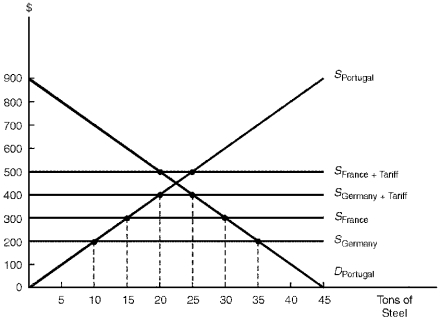 -Consider Figure 8.2. If Portugal levies a 100 percent nondiscriminatory tariff on its steel imports, it will purchase 5 tons of steel from France at a price of $500 per ton.
 (True/False)
4.7/5 (75)
(75) The former communist countries included all of the following
(Multiple Choice)
4.8/5 (91)
(91) The figure below depicts the steel market for Portugal, a small nation that is unable to affect the world price. Assume that Germany and France can supply steel to Portugal at a price of $200 and $300 respectively.
Figure 8.2. Portugal's Steel Market
-Consider Figure 8.2. If Portugal forms a customs union with France, the resulting trade-diversion effect equals $400.
-Consider Figure 8.2. If Portugal forms a customs union with France, the resulting trade-diversion effect equals $400. (True/False)
4.9/5 (84)
(84) The transition of the former Soviet Union from a planned economy to a market economy would require the elimination of price controls, the privatization of public property, and the promotion of business competition.
(True/False)
4.9/5 (67)
(67) Which organization of nations permits free trade among its members in industrial goods, while each member maintains freedom in its trade policies toward non-member countries?
(Multiple Choice)
4.7/5 (95)
(95) If Chile and Mexico form a free-trade agreement, the welfare of the two countries will necessarily increase.
(True/False)
4.9/5 (83)
(83) During the 1980s and 1990s, the United States negotiated free-trade agreements with Israel, Mexico, and Canada.
(True/False)
4.8/5 (74)
(74) 
Filters
- Essay(0)
- Multiple Choice(0)
- Short Answer(0)
- True False(0)
- Matching(0)