



 Chat with AI
Exam 6: Trade Regulations and Industrial Policies

Exam 1: The International Economy and Globalization48 Questions
Exam 2: Foundations of Modern Trade Theory: Comparative Advantage170 Questions
Exam 3: Sources of Comparative Advantage109 Questions
Exam 4: Tariffs124 Questions
Exam 5: Nontariff Trade Barriers133 Questions
Exam 6: Trade Regulations and Industrial Policies129 Questions
Exam 7: Trade Policies for the Developing Nations100 Questions
Exam 8: Regional Trading Arrangements130 Questions
Exam 9: International Factor Movements and Multinational Enterprises96 Questions
Exam 10: The Balance of Payments99 Questions
Exam 11: Foreign Exchange121 Questions
Exam 12: Exchange-Rate Determination133 Questions
Exam 13: Mechanisms of International Adjustment107 Questions
Exam 14: Exchange-Rate Adjustments and the Balance of Payments100 Questions
Exam 15: Exchange-Rate Systems and Currency Crises107 Questions
Exam 16: Macroeconomic Policy in an Open Economy72 Questions
Exam 17: International Banking: Reserves, Debt, and Risk96 Questions
Select questions type


According to the Reciprocal Trade Agreements Act of 1934, the President could lower tariffs by up to 10 percent of the existing level without congressional approval.
(True/False)
4.8/5  (81)
(81) The Commodity Credit Corporation makes available export credit financing for U.S. agricultural exports.
(True/False)
4.8/5 (70)
(70) The Export-Import Bank of the United States encourages American firms to sell overseas by providing direct loans and loan guarantees to foreign purchasers of American goods. To American firms, this represents a:
(Multiple Choice)
4.9/5 (99)
(99) Trade theory suggests that the United States would gain from a subsidy provided by Japan to its calculator producers if the gains to American consumers of calculators more than offset the losses to American calculator producers. This occurs as long as the United States:
(Multiple Choice)
4.9/5 (77)
(77) Established in 1995, the World Trade Organization took charge of administering the new global trade rules agreed in the Uruguay Round of multilateral trade negotiations.
(True/False)
5.0/5 (73)
(73) The classical theory of comparative advantage assumes that firms operate in imperfectly competitive markets, while the theory of strategic trade policy assumes that firms operate in perfectly competitive markets.
(True/False)
5.0/5 (70)
(70) The strongest political pressure for a trade policy that results in higher protectionism comes from:
(Multiple Choice)
4.9/5 (70)
(70) Figure 6.2 illustrates the calculator market for Mexico, assumed to be a small nation that is unable influence the South Korean (world) price. Assume the South Korean price to be $60 per calculator.
Figure 6.2. Effects of an Export Subsidy
 -Consider Figure 6.2. As a result of the South Korean subsidy, Mexicans find their consumer surplus:
 (Multiple Choice)
4.8/5 (84)
(84) Figure 6.3 represents the Iraqi computer market. Assume Iraq purchases all of its computers from the United States.
Figure 6.3 Iraqi Computer Market and Economic Sanctions
 -Consider Figure 6.3. With free trade, Iraq purchases ____ computers at a price of $____, and realizes $____ of consumer surplus from the availability of computers.
 (Multiple Choice)
4.9/5 (79)
(79) Figure 6.3 represents the Iraqi computer market. Assume Iraq purchases all of its computers from the United States.
Figure 6.3 Iraqi Computer Market and Economic Sanctions
-Consider Figure 6.3. Of the quota-induced change in Iraqi consumer surplus, the amount of the change in Iraq's consumer surplus that is transferred to other sectors of Iraq's economy is captured by the United States as:
-Consider Figure 6.3. Of the quota-induced change in Iraqi consumer surplus, the amount of the change in Iraq's consumer surplus that is transferred to other sectors of Iraq's economy is captured by the United States as: (Multiple Choice)
4.7/5 (80)
(80) The General Agreement on Tariffs and Trade and its successor, the World Trade Organization, have resulted in:
(Multiple Choice)
4.9/5 (99)
(99) Industrial policy attempts to foster the development of industries that offer long-run comparative disadvantages and which are insulated from other sectors of the economy.
(True/False)
4.9/5 (71)
(71) Figure 6.4 Japanese Market for Jetliners
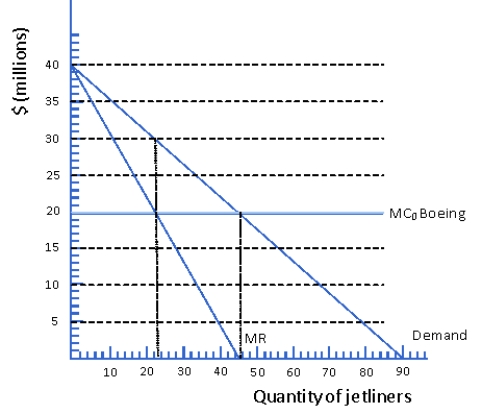 -Consider the Japanese market for jetliners as depicted in Figure 6.4. Suppose lone producer of jetliners in the world is Boeing and Boeing faces a constant marginal cost of $20 million per jetliner. What price will Boeing charge for jetliners in the Japanese market and how many will they sell?
 (Multiple Choice)
4.8/5 (76)
(76) U.S. tariffs on imports from countries issued normal-trade-relations (most-favored-nation) status are often three or four times as high as those on comparable imports from nations not receiving that status.
(True/False)
4.9/5 (83)
(83) Figure 6.2 illustrates the calculator market for Mexico, assumed to be a small nation that is unable influence the South Korean (world) price. Assume the South Korean price to be $60 per calculator.
Figure 6.2. Effects of an Export Subsidy
-Consider Figure 6.2. The South Korean subsidy helps/hurts Mexican manufacturers, since their producer surplus rises/falls by $____.
-Consider Figure 6.2. The South Korean subsidy helps/hurts Mexican manufacturers, since their producer surplus rises/falls by $____. (Multiple Choice)
4.8/5 (78)
(78) Assume Boeing Inc. (of the United States) and Airbus Industrie (of Europe) rival for monopoly profits in the Canadian aircraft market. Suppose the two firms face identical cost and demand conditions, as seen in Figure 6.1.
Figure 6.1. Strategic Trade Policy: Boeing versus Airbus
 -Consider Figure 6.1. Suppose the European government provides Airbus a subsidy of $4 million on each aircraft manufactured, and that the subsidy convinces Boeing to exit the Canadian market. As the monopoly seller, Airbus maximizes profit by selling ____ aircraft at a price of $____, and realizes profits totaling $____.
 (Multiple Choice)
4.9/5 (74)
(74) The World Trade Organization brings into the multilateral trading system manufactured goods and agricultural products, but not trade in services, intellectual property protection, and investment.
(True/False)
5.0/5 (81)
(81) Figure 6.4 Japanese Market for Jetliners
-Consider the Japanese market for jetliners as depicted in Figure 6.4. Suppose lone producer of jetliners in the world is Boeing and Boeing faces a constant marginal cost of $20 million per jetliner. How much consumer surplus will the Japanese airlines who purchase the jetliners earn from their transactions with Boeing?
-Consider the Japanese market for jetliners as depicted in Figure 6.4. Suppose lone producer of jetliners in the world is Boeing and Boeing faces a constant marginal cost of $20 million per jetliner. How much consumer surplus will the Japanese airlines who purchase the jetliners earn from their transactions with Boeing? (Multiple Choice)
4.9/5 (82)
(82) For the United States, which organization makes loans to foreign buyers of U.S. manufactured goods?
(Multiple Choice)
4.8/5 (81)
(81) Unlike the Tokyo Round of multilateral trade negotiations, the Uruguay Round addressed the issues of intellectual property protection, trade barriers in services, and agricultural subsidies.
(True/False)
4.8/5 (80)
(80) 
Filters
- Essay(0)
- Multiple Choice(0)
- Short Answer(0)
- True False(0)
- Matching(0)