



 Chat with AI
Exam 11: Foreign Exchange

Exam 1: The International Economy and Globalization48 Questions
Exam 2: Foundations of Modern Trade Theory: Comparative Advantage170 Questions
Exam 3: Sources of Comparative Advantage109 Questions
Exam 4: Tariffs124 Questions
Exam 5: Nontariff Trade Barriers133 Questions
Exam 6: Trade Regulations and Industrial Policies129 Questions
Exam 7: Trade Policies for the Developing Nations100 Questions
Exam 8: Regional Trading Arrangements130 Questions
Exam 9: International Factor Movements and Multinational Enterprises96 Questions
Exam 10: The Balance of Payments99 Questions
Exam 11: Foreign Exchange121 Questions
Exam 12: Exchange-Rate Determination133 Questions
Exam 13: Mechanisms of International Adjustment107 Questions
Exam 14: Exchange-Rate Adjustments and the Balance of Payments100 Questions
Exam 15: Exchange-Rate Systems and Currency Crises107 Questions
Exam 16: Macroeconomic Policy in an Open Economy72 Questions
Exam 17: International Banking: Reserves, Debt, and Risk96 Questions
Select questions type


In the forward market, the exchange rate is agreed on at the time of the currency contract, but payment is not made until the future delivery of the currency actually takes place.
(True/False)
4.8/5  (85)
(85) A person needing foreign exchange immediately would purchase it on the spot market.
(True/False)
4.7/5 (80)
(80) Table 11.1 gives the exchange rate quotations for the U.S. dollar and the British pound.
Table 11.1. Foreign Exchange Quotations
U.S. Dollar Currency Per Equivalent U.S. Dollar Britain (Pound) 1.4270 1.4390 .7008 .6949 30-day Forward 1.4211 1.4333 .7037 .6977 60-day Forward 1.4090 1.4220 .7097 .7032 180-day Forward 1.3930 1.4070 .7179 .7107
-Consider Table 11.1. Comparing Tuesday to the previous Monday, by Tuesday the dollar had:
(Multiple Choice)
4.8/5 (75)
(75) Figure 11.1 illustrates the supply and demand schedules for the Swiss franc. Assume that exchange rates are flexible.
Figure 11.1. Supply and Demand Schedules of Francs
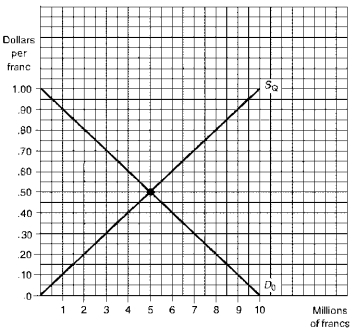 -Refer to Figure 11.1. Suppose the exchange rate is $.30 per franc. At this exchange rate there is an ____ of francs which leads to a ____ in the dollar price of the franc, a (an) ____ in the quantity of francs supplied, and a (an) ____ in the quantity of francs demanded.
 (Multiple Choice)
4.8/5 (82)
(82) Given an upward-sloping supply schedule of pounds and a downward-sloping demand schedule for pounds, an increase in the supply schedule causes an appreciation of the dollar against the pound.
(True/False)
4.8/5 (71)
(71) The supply of francs is derived from the desire of the Swiss to purchase German goods, make investments in Germany, repay debts to German lenders, and extend transfer payments to German residents.
(True/False)
4.9/5 (71)
(71) Movements along the demand schedule for pounds are caused by changes in the pound's exchange rate.
(True/False)
4.9/5 (69)
(69) If it takes 113.28 yen to buy $1, it takes $.009624 to buy 1 yen.
(True/False)
4.8/5 (84)
(84) Stabilizing speculation reinforces market forces by intensifying an appreciation or a depreciation in a currency's exchange value.
(True/False)
4.7/5 (77)
(77) Suppose there occurs an increase in the Canadian demand for Japanese computers. This results in:
(Multiple Choice)
4.8/5 (80)
(80) Table 11.1 gives the exchange rate quotations for the U.S. dollar and the British pound.
Table 11.1. Foreign Exchange Quotations
U.S. Dollar Currency Per Equivalent U.S. Dollar Britain (Pound) 1.4270 1.4390 .7008 .6949 30-day Forward 1.4211 1.4333 .7037 .6977 60-day Forward 1.4090 1.4220 .7097 .7032 180-day Forward 1.3930 1.4070 .7179 .7107
-Consider Table 11.1. If one were to sell dollars for immediate delivery, on Tuesday the pound cost of each dollar would be:
(Multiple Choice)
4.9/5 (91)
(91) The demand for foreign exchange is derived from credit transactions on the balance of payments.
(True/False)
4.9/5 (87)
(87) Table 11.4. Forward Exchange Rates
U.S. Dallar Equivalent Wedinesday Tuesday Switzerland (Franc) .6598 .6590 30- day Farward .6592 .6585 90-day Farward .6585 .6578 180- tay Farward .6577 .6572
-Refer to Table 11.4. Comparing the franc's forward rates against the franc's spot rate, the exchange market's consensus is that over the period of a forward contract, the franc's spot rate will:
(Multiple Choice)
4.8/5 (84)
(84) Most foreign exchange transactions are conducted between commercial banks and household customers.
(True/False)
4.8/5 (84)
(84) Figure 11.1 illustrates the supply and demand schedules for the Swiss franc. Assume that exchange rates are flexible.
Figure 11.1. Supply and Demand Schedules of Francs
-Refer to Figure 11.1. At the equilibrium exchange rate of ____ per franc, ____ francs will be purchased at a total dollar cost of ____.
-Refer to Figure 11.1. At the equilibrium exchange rate of ____ per franc, ____ francs will be purchased at a total dollar cost of ____. (Multiple Choice)
4.9/5 (84)
(84) Suppose that Sears owes 1 million yen to a Japanese electronics manufacturer in 3 months. It could hedge against the risk of a depreciation of the dollar against the yen by contracting to purchase 1 million yen in the forward market, at today's forward rate, for delivery in 3 months.
(True/False)
4.9/5 (62)
(62) In the early 1980s, the Federal Reserve pursued a tight monetary policy. All else being equal, the impact of that policy was to ____ interest rates in the United States relative to those in Europe and cause the dollar to ____ against European currencies.
(Multiple Choice)
4.8/5 (69)
(69) Table 11.4. Forward Exchange Rates
U.S. Dallar Equivalent Wedinesday Tuesday Switzerland (Franc) .6598 .6590 30- day Farward .6592 .6585 90-day Farward .6585 .6578 180- tay Farward .6577 .6572
-Refer to Table 11.4. On Wednesday, the 180-day forward franc was selling at a:
(Multiple Choice)
4.8/5 (81)
(81) The exchange rate is kept the same in all parts of the market by:
(Multiple Choice)
4.9/5 (65)
(65) 
Filters
- Essay(0)
- Multiple Choice(0)
- Short Answer(0)
- True False(0)
- Matching(0)