



 Chat with AI
Exam 4: Tariffs

Exam 1: The International Economy and Globalization48 Questions
Exam 2: Foundations of Modern Trade Theory: Comparative Advantage170 Questions
Exam 3: Sources of Comparative Advantage109 Questions
Exam 4: Tariffs124 Questions
Exam 5: Nontariff Trade Barriers133 Questions
Exam 6: Trade Regulations and Industrial Policies129 Questions
Exam 7: Trade Policies for the Developing Nations100 Questions
Exam 8: Regional Trading Arrangements130 Questions
Exam 9: International Factor Movements and Multinational Enterprises96 Questions
Exam 10: The Balance of Payments99 Questions
Exam 11: Foreign Exchange121 Questions
Exam 12: Exchange-Rate Determination133 Questions
Exam 13: Mechanisms of International Adjustment107 Questions
Exam 14: Exchange-Rate Adjustments and the Balance of Payments100 Questions
Exam 15: Exchange-Rate Systems and Currency Crises107 Questions
Exam 16: Macroeconomic Policy in an Open Economy72 Questions
Exam 17: International Banking: Reserves, Debt, and Risk96 Questions
Select questions type


Relatively low wages in Mexico make it impossible for U.S. manufacturers of labor-intensive goods to compete against Mexican manufacturers.
(True/False)
4.9/5  (77)
(77) When the production of a commodity does utilize imported inputs, the effective tariff rate on the commodity:
(Multiple Choice)
4.7/5 (84)
(84) If I purchase a stereo from South Korea, I obtain the stereo and South Korea obtains the dollars. But if I purchase a stereo produced in the United States, I obtain the stereo and the dollars remain in America. This line of reasoning is:
(Multiple Choice)
4.9/5 (74)
(74) Table 4.1. Production Costs and Prices of Imported and Domestic VCRs
Imparted VCRs Damestic VCRs Campanent parts 4150 Imported campanent parts \ 150 Assembly cast/profit 50 Assembly cast 50 Naminal tariff 25 Profit 25 --- --- Impart price Damestic price 225 after tariff 225 after tariff 225
-Consider Table 4.1. Prior to the tariff, the total price of imported VCRs is:
(Multiple Choice)
4.9/5 (86)
(86) According to the tariff escalation effect, industrial countries apply low tariffs to imports of finished goods and high tariffs to imports of raw materials.
(True/False)
4.8/5 (92)
(92) A $100 specific tariff provides home producers protection from foreign competition when:
(Multiple Choice)
4.8/5 (87)
(87) Is it possible for a low nominal tariff rate to understate the effective rate of protection? What is tariff escalation?
(Essay)
4.8/5 (88)
(88) Figure 4.4 Market for Gasoline in a Small Nation
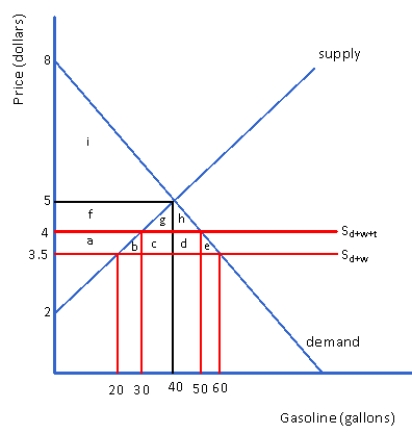 -Figure 4.4 represents the market for gasoline in a small nation. The free trade world price of gasoline is $3.50. Suppose this small nation imposes a tariff on gasoline of $.50 per gallon. The change in producer surplus would be
 (Multiple Choice)
4.9/5 (93)
(93) Which of the following is a fixed percentage of the value of an imported product as it enters the country?
(Multiple Choice)
4.9/5 (82)
(82) Figure 4.1 illustrates the demand and supply schedules for pocket calculators in Mexico, a "small" nation that is unable to affect the world price.
Figure 4.1. Import Tariff Levied by a "Small" Country
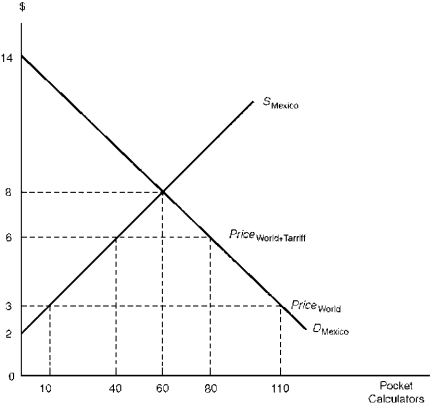 -Consider Figure 4.1. In the absence of trade, Mexico produces and consumes:
 (Multiple Choice)
4.8/5 (86)
(86) Suppose that the United States its tariff on steel imports, permitting foreign-produced steel to enter the U.S. market. Steel prices to U.S. consumers would be expected to:
(Multiple Choice)
4.9/5 (70)
(70) A tax of 20 cents per unit of imported cheese would be an example of:
(Multiple Choice)
4.8/5 (76)
(76) Table 4.1. Production Costs and Prices of Imported and Domestic VCRs
Imparted VCRs Damestic VCRs Campanent parts 4150 Imported campanent parts \ 150 Assembly cast/profit 50 Assembly cast 50 Naminal tariff 25 Profit 25 --- --- Impart price Damestic price 225 after tariff 225 after tariff 225
-Consider Table 4.1. Prior to the tariff, domestic value added equals:
(Multiple Choice)
4.8/5 (85)
(85) Suppose that the production of $500,000 worth of steel in the United States requires $100,000 worth of iron ore. The U.S. nominal tariff rates for importing these goods are 15 percent for steel and 5 percent for iron ore. Given this information, the effective rate of protection for the U.S. steel industry is approximately:
(Multiple Choice)
4.8/5 (84)
(84) If we consider the impact on both consumers and producers, then protection of the steel industry is:
(Multiple Choice)
4.7/5 (73)
(73) Figure 4.1 illustrates the demand and supply schedules for pocket calculators in Mexico, a "small" nation that is unable to affect the world price.
Figure 4.1. Import Tariff Levied by a "Small" Country
-Consider Figure 4.1. With free trade, Mexico imports:
-Consider Figure 4.1. With free trade, Mexico imports: (Multiple Choice)
4.9/5 (84)
(84) 
Filters
- Essay(0)
- Multiple Choice(0)
- Short Answer(0)
- True False(0)
- Matching(0)