



 Chat with AI
Exam 14: Exchange-Rate Adjustments and the Balance of Payments

Exam 1: The International Economy and Globalization48 Questions
Exam 2: Foundations of Modern Trade Theory: Comparative Advantage170 Questions
Exam 3: Sources of Comparative Advantage109 Questions
Exam 4: Tariffs124 Questions
Exam 5: Nontariff Trade Barriers133 Questions
Exam 6: Trade Regulations and Industrial Policies129 Questions
Exam 7: Trade Policies for the Developing Nations100 Questions
Exam 8: Regional Trading Arrangements130 Questions
Exam 9: International Factor Movements and Multinational Enterprises96 Questions
Exam 10: The Balance of Payments99 Questions
Exam 11: Foreign Exchange121 Questions
Exam 12: Exchange-Rate Determination133 Questions
Exam 13: Mechanisms of International Adjustment107 Questions
Exam 14: Exchange-Rate Adjustments and the Balance of Payments100 Questions
Exam 15: Exchange-Rate Systems and Currency Crises107 Questions
Exam 16: Macroeconomic Policy in an Open Economy72 Questions
Exam 17: International Banking: Reserves, Debt, and Risk96 Questions
Select questions type


When manufacturing computer software, suppose that Microsoft Inc. uses labor and materials whose costs are denominated in dollars and francs respectively. If the dollar's exchange value depreciates 10 percent against the franc, the franc-denominated cost of the firm's software falls by 10 percent.
(True/False)
4.9/5  (73)
(73) The shift in focus toward imperfectly competitive markets in domestic and international trade questions the concept of:
(Multiple Choice)
4.9/5 (80)
(80) Assume that Ford Motor Company obtains some of its inputs in Mexico (foreign sourcing). As the peso becomes a larger portion of Ford's total costs, a dollar leads to a (an) ____ in the peso cost of a Ford vehicle and a (an) ____ in the dollar cost of a Ford compared to the cost changes that occur when all input costs are dollar denominated.
(Multiple Choice)
4.8/5 (94)
(94) According to the J-curve effect, an appreciation of the yens exchange value has:
(Multiple Choice)
4.9/5 (89)
(89) The shorter the currency pass-through period, the ____ required for currency depreciation to have the intended effect on the trade balance.
(Multiple Choice)
5.0/5 (77)
(77) By increasing relative U.S. production costs, a dollar depreciation tends to increase U.S. export prices in foreign-currency terms, which results in an increase in the quantity of U.S. goods exported abroad.
(True/False)
4.8/5 (75)
(75) Table 14.1. Hypothetical Costs of Producing an Automobile for Toyota Inc. of Japan
Cast Campanent Yen Cost Dollar-Equivalent Cost Labar 1,200,000 Materials Steel 800,000 Other materials 1,600,000 Tatal material casts 2,400,000 Other casts 400,000 Total costs 4,000,000
-Refer to Table 14.1. Assume that Toyota Inc. obtains all of its automobile inputs from Japanese suppliers. If the yen's exchange value appreciates from 200 yen = $1 to 100 yen = $1, the yen cost of a Toyota automobile equals:
(Multiple Choice)
5.0/5 (93)
(93) Suppose the U.S. economy is operating at full capacity and the dollar's exchange value depreciates. According to the absorption approach, the United States would have to accept reductions in domestic spending if the U.S. trade balance is to improve as a result of the depreciation.
(True/False)
4.8/5 (93)
(93) The longer the currency pass-through period, the ____ required for currency depreciation to have the intended effect on the trade balance.
(Multiple Choice)
4.9/5 (73)
(73) Because of the J-curve effect and partial currency pass-through, a depreciation of the domestic currency tends to increase the size of a:
(Multiple Choice)
4.8/5 (74)
(74) Given favorable elasticity conditions, an appreciation of the yen results in
(Multiple Choice)
4.9/5 (78)
(78) The elasticity approach to currency depreciation emphasizes the relative price effects of depreciation and suggests that depreciation best improves a country's trade balance when the elasticities of demand for the country's imports and exports are high.
(True/False)
4.7/5 (96)
(96) Figure 14.2 The US Market for Imported Toyotas
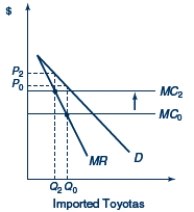 -In Figure 14.2, D represents the US demand curve for Toyotas and MC0 represents the marginal cost of producing Toyotas. A shift in the marginal cost curve from MC0 to MC2 represents
 (Multiple Choice)
5.0/5 (72)
(72) Assume that Ford Motor Company obtains some of its inputs in Mexico (foreign sourcing). As the peso becomes a larger portion of Ford's total costs, a dollar leads to a ____ in the peso cost of a Ford vehicle and a ____ in the dollar cost of a Ford compared to the cost changes that occur when all input costs are dollar denominated.
(Multiple Choice)
4.8/5 (83)
(83) The time period that it takes for companies to increase output of commodities for which demand has increased due to currency depreciation is known as the:
(Multiple Choice)
4.9/5 (87)
(87) The absorption approach to currency devaluation deals with the income effects of devaluation while the elasticity approach to devaluation deals with the price effects of devaluation.
(True/False)
4.7/5 (83)
(83) Assume an economy operates at full employment and faces a trade deficit. According to the absorption approach, currency devaluation will improve the trade balance if domestic:
(Multiple Choice)
4.9/5 (92)
(92) If foreign manufacturers cut manufacturing costs and profit margins in response to a depreciation in the U.S. dollar, the effect of these actions is to:
(Multiple Choice)
4.9/5 (82)
(82) Figure 14.1 US market for Imported Toyotas
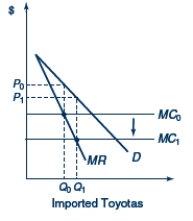 -In Figure 14.1, D represents the US demand curve for Toyotas and MC0 represents the marginal cost of producing Toyotas. A shift in the marginal cost curve from MC0 to MC1 represents
 (Multiple Choice)
4.7/5 (88)
(88) 
Filters
- Essay(0)
- Multiple Choice(0)
- Short Answer(0)
- True False(0)
- Matching(0)