



 Chat with AI
Exam 14: Exchange-Rate Adjustments and the Balance of Payments

Exam 1: The International Economy and Globalization48 Questions
Exam 2: Foundations of Modern Trade Theory: Comparative Advantage170 Questions
Exam 3: Sources of Comparative Advantage109 Questions
Exam 4: Tariffs124 Questions
Exam 5: Nontariff Trade Barriers133 Questions
Exam 6: Trade Regulations and Industrial Policies129 Questions
Exam 7: Trade Policies for the Developing Nations100 Questions
Exam 8: Regional Trading Arrangements130 Questions
Exam 9: International Factor Movements and Multinational Enterprises96 Questions
Exam 10: The Balance of Payments99 Questions
Exam 11: Foreign Exchange121 Questions
Exam 12: Exchange-Rate Determination133 Questions
Exam 13: Mechanisms of International Adjustment107 Questions
Exam 14: Exchange-Rate Adjustments and the Balance of Payments100 Questions
Exam 15: Exchange-Rate Systems and Currency Crises107 Questions
Exam 16: Macroeconomic Policy in an Open Economy72 Questions
Exam 17: International Banking: Reserves, Debt, and Risk96 Questions
Select questions type


Table 14.1. Hypothetical Costs of Producing an Automobile for Toyota Inc. of Japan
Cast Campanent Yen Cost Dollar-Equivalent Cost Labar 1,200,000 Materials Steel 800,000 Other materials 1,600,000 Tatal material casts 2,400,000 Other casts 400,000 Total costs 4,000,000
-Refer to Table 14.1. Assume that Toyota Inc. obtains all of its automobile inputs from Japanese suppliers. If the yen's exchange value appreciates from 200 yen = $1 to 100 yen = $1, the dollar-equivalent cost of a Toyota automobile equals:
(Multiple Choice)
4.9/5  (83)
(83) Figure 14.1 US market for Imported Toyotas
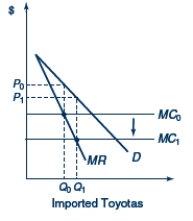 -In Figure 14.1, D represents the US demand curve for Toyotas and MC0 represents the marginal cost of producing Toyotas. Assume that Toyota behaves like a monopolist in the US market. A shift in the marginal cost curve from MC0 to MC1 leads to
 (Multiple Choice)
4.9/5 (78)
(78) How do movements in exchange rates affect domestic costs, in the presence of foreign sourcing?
(Essay)
4.9/5 (78)
(78) According to the J-curve effect, when the exchange value of a country's currency appreciates, the country's trade balance:
(Multiple Choice)
4.7/5 (82)
(82) Reversing balance of payments disequilibria may came at the expense of
(Multiple Choice)
4.7/5 (78)
(78) If a currency's exchange rate is undervalued, a government would likely initiate actions to devalue the currency.
(True/False)
4.7/5 (89)
(89) The analysis of the effects of currency depreciation include all of the following except the:
(Multiple Choice)
4.9/5 (88)
(88) According to the J-curve effect, a depreciation of the pound's exchange value has:
(Multiple Choice)
4.9/5 (81)
(81) Complete currency pass through suggests that if the dollar's exchange value depreciates by 10 percent, imports will become 10 percent more expensive to Americans while U.S. exports will become 10 percent cheaper to foreigners.
(True/False)
4.8/5 (76)
(76) Assume that Ford Motor Company obtains all of its inputs in the United States and all of its costs are denominated in dollars. A depreciation of the dollar's exchange value:
(Multiple Choice)
4.8/5 (73)
(73) The Marshall-Lerner condition asserts that if the sum of a country's elasticity of demand for imports and the foreign elasticity of demand for the country's exports equals 1.0, a depreciation of the country's currency will not affect its balance of trade.
(True/False)
4.9/5 (71)
(71) The monetary approach emphasizes the effects of currency depreciation on the purchasing power of money, and the resulting impact on domestic expenditure levels.
(True/False)
4.9/5 (87)
(87) According to the absorption approach (B = Y - A), currency devaluation improves a nation's trade balance if:
(Multiple Choice)
4.9/5 (93)
(93) According to the absorption approach, the economic circumstances that best warrant a currency devaluation is where the domestic economy faces:
(Multiple Choice)
4.9/5 (86)
(86) Table 14.1. Hypothetical Costs of Producing an Automobile for Toyota Inc. of Japan
Cast Campanent Yen Cost Dollar-Equivalent Cost Labar 1,200,000 Materials Steel 800,000 Other materials 1,600,000 Tatal material casts 2,400,000 Other casts 400,000 Total costs 4,000,000
-Refer to Table 14.1. Assuming that Toyota obtains all inputs from Japanese suppliers and that the yen/dollar exchange rate is 200 yen per dollar. The dollar-equivalent cost of a Toyota automobile equals:
(Multiple Choice)
4.8/5 (80)
(80) Assume the Canadian demand elasticity for imports equals 0.2, while the foreign demand elasticity for Canadian exports equals 0.3. Responding to a trade deficit, suppose the Canadian dollar depreciates by 20 percent. For Canada, the depreciation would lead to a:
(Multiple Choice)
4.8/5 (79)
(79) Given favorable elasticity conditions, a depreciation of the lira tends to result in:
(Multiple Choice)
4.9/5 (81)
(81) The ____ effect suggests that following a currency depreciation a country's trade balance worsens for a period before it improves.
(Multiple Choice)
4.8/5 (84)
(84) 
Filters
- Essay(0)
- Multiple Choice(0)
- Short Answer(0)
- True False(0)
- Matching(0)