



 Chat with AI
Exam 14: Exchange-Rate Adjustments and the Balance of Payments

Exam 1: The International Economy and Globalization48 Questions
Exam 2: Foundations of Modern Trade Theory: Comparative Advantage170 Questions
Exam 3: Sources of Comparative Advantage109 Questions
Exam 4: Tariffs124 Questions
Exam 5: Nontariff Trade Barriers133 Questions
Exam 6: Trade Regulations and Industrial Policies129 Questions
Exam 7: Trade Policies for the Developing Nations100 Questions
Exam 8: Regional Trading Arrangements130 Questions
Exam 9: International Factor Movements and Multinational Enterprises96 Questions
Exam 10: The Balance of Payments99 Questions
Exam 11: Foreign Exchange121 Questions
Exam 12: Exchange-Rate Determination133 Questions
Exam 13: Mechanisms of International Adjustment107 Questions
Exam 14: Exchange-Rate Adjustments and the Balance of Payments100 Questions
Exam 15: Exchange-Rate Systems and Currency Crises107 Questions
Exam 16: Macroeconomic Policy in an Open Economy72 Questions
Exam 17: International Banking: Reserves, Debt, and Risk96 Questions
Select questions type


The extent to which a change in the exchange rate leads to changes in import and export prices is known as:
(Multiple Choice)
4.9/5  (88)
(88) Which analysis considers the extent by which foreign and domestic prices adjust to a change in the exchange rate in the short run:
(Multiple Choice)
5.0/5 (77)
(77) Figure 14.2 The US Market for Imported Toyotas
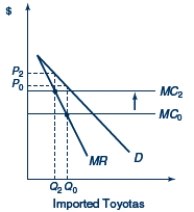 -In Figure 14.2, D represents the US demand curve for Toyotas and MC0 represents the marginal cost of producing Toyotas. Assume that Toyota behaves like a monopolist in the US market. A shift in the marginal cost curve from MC0 to MC2 leads to
 (Multiple Choice)
4.9/5 (66)
(66) The absorption approach to currency depreciation focuses on the
(Multiple Choice)
4.7/5 (82)
(82) According to the Marshall-Lerner condition, currency depreciation will worsen a country's balance of trade if the country's elasticity of demand for imports plus the foreign demand elasticity for the country's exports exceeds 1.0.
(True/False)
5.0/5 (66)
(66) The Marshall-Lerner condition deals with the impact of currency depreciation on:
(Multiple Choice)
4.9/5 (79)
(79) The J-curve effect implies that following a currency appreciation, a country's trade balance:
(Multiple Choice)
4.8/5 (78)
(78) When manufacturing automobiles, suppose that General Motors uses labor and materials whose costs are denominated in dollars and pounds respectively. If the dollar's exchange value appreciates by 15 percent against the pound, the pound-denominated cost of a GM vehicle rises by 15 percent.
(True/False)
4.8/5 (84)
(84) Suppose the U.S. price elasticity of demand for imports equals 0.4 and the foreign demand elasticity for the U.S. exports equals 0.2. According to the Marshall-Lerner condition, a depreciation of the dollar's exchange value will improve the U.S. balance of trade.
(True/False)
4.8/5 (78)
(78) The purpose of currency revaluation is to cause an appreciation in a currency's exchange value.
(True/False)
4.8/5 (86)
(86) The J-curve effect implies that in the short run a currency depreciation will result in a balance of trade surplus for the home country. As time passes, however, the home country's balance of trade will move toward deficit.
(True/False)
4.9/5 (79)
(79) Assume that Brazil has a constant money supply and that it devalues its currency. The monetary approach to devaluation reasons that one of the following tends to occur for Brazil:
(Multiple Choice)
4.7/5 (71)
(71) Assume that General Motors employs labor and materials, whose costs are denominated in dollars, in the production of automobiles. If the dollar's exchange value appreciates by 10 percent against the yen, the yen-denominated cost of a GM vehicle falls by 10 percent.
(True/False)
4.7/5 (72)
(72) Table 14.1. Hypothetical Costs of Producing an Automobile for Toyota Inc. of Japan
Cast Campanent Yen Cost Dollar-Equivalent Cost Labar 1,200,000 Materials Steel 800,000 Other materials 1,600,000 Tatal material casts 2,400,000 Other casts 400,000 Total costs 4,000,000
-Refer to Table 14.1. Assume that Toyota Inc. imports steel from U.S. suppliers, whose costs are denominated in dollars, while all other inputs are obtained from Japanese suppliers whose costs are denominated in yen. If the yen's exchange value appreciates from 200 yen = $1 to 100 yen = $1, the yen cost of a Toyota automobile equals:
(Multiple Choice)
4.7/5 (70)
(70) The time period that it takes for companies to form new business connections and place new orders in response to currency depreciation is known as the:
(Multiple Choice)
4.8/5 (75)
(75) Assume that General Motors employs labor and materials, whose costs are denominated in dollars, in the production of automobiles. If the dollar's exchange value depreciates by 10 percent against the yen, the yen-denominated cost of a GM vehicle rises by 10 percent.
(True/False)
4.9/5 (99)
(99) The elasticity approach to currency depreciation emphasizes the income effects of depreciation.
(True/False)
4.8/5 (78)
(78) If a currency's exchange rate is overvalued, a government would likely initiate actions to revalue the currency.
(True/False)
4.9/5 (78)
(78) Partial currency pass-through implies that if the dollar's exchange value appreciates by 10 percent, imports would become, say, 6 percent more expensive to Americans while U.S. exports would become, say, 8 percent cheaper to foreigners.
(True/False)
4.8/5 (82)
(82) 
Filters
- Essay(0)
- Multiple Choice(0)
- Short Answer(0)
- True False(0)
- Matching(0)