



 Chat with AI
Exam 40: The Resurgence of Conservatism,1980-1992


What were Ronald Reagan's goals as he entered the presidency in 1981? How successful was he in implementing them? In what ways did he fail to achieve his goals? Why?

 (88)
 Answered by Examlex AI Copilot
Ronald Reagan's goals as he entered the presidency in 1981 were primarily focused on revitalizing the American economy, reducing government intervention in the economy, and promoting conservative social policies. He aimed to achieve these goals through a combination of tax cuts, deregulation, and increased military spending.
Reagan was largely successful in implementing his economic agenda. His administration implemented significant tax cuts, which helped stimulate economic growth and reduce inflation. He also pursued deregulation in various industries, which contributed to economic expansion. Additionally, his emphasis on military spending helped to bolster the defense industry and project American strength abroad.
However, Reagan faced challenges in achieving all of his goals. While his economic policies led to overall growth, they also contributed to a significant increase in the national debt. Additionally, his efforts to reduce government intervention in social issues, such as abortion and affirmative action, were met with resistance and ultimately did not lead to significant policy changes.
In terms of foreign policy, Reagan's goal of confronting the Soviet Union and promoting democracy around the world was largely successful. His administration's support for anti-communist movements in countries such as Nicaragua and Afghanistan contributed to the eventual collapse of the Soviet Union.
Overall, while Reagan was successful in implementing many of his economic and foreign policy goals, he faced challenges in achieving his social policy objectives and in managing the long-term economic impact of his policies. These challenges were due to a combination of political opposition, unintended consequences of his policies, and the complexities of governing a diverse and rapidly changing society.
Identify and state the historical significance of the following:
-yuppies
(101) Answered by Examlex AI CopilotYuppies is a term that stands for "young urban professionals." It emerged in the 1980s to describe a specific demographic of young, affluent, and career-driven individuals who lived in urban areas, typically in their 20s and 30s. The term became a cultural catchphrase that encapsulated the ethos of a generation that was seen as valuing material wealth, upward mobility, and a consumerist lifestyle.
The historical significance of yuppies lies in their impact on culture, economics, and social trends during the 1980s and beyond. Here are some key points of their influence:
1. Economic Impact: Yuppies were often associated with the financial and business sectors, which saw significant growth during the 1980s. Their focus on career success and high earnings contributed to the economic boom of the decade, particularly in industries like finance, real estate, and technology.
2. Consumerism: Yuppies were known for their spending habits, favoring luxury goods, designer labels, and the latest technological gadgets. Their consumer behavior helped fuel the growth of brands and products that catered to an upscale market, influencing trends in fashion, electronics, and automotive industries.
3. Cultural Shift: The yuppie lifestyle represented a shift from the more communal and socially conscious movements of the 1960s and 70s to a more individualistic and materialistic ethos. This shift was reflected in popular media, with movies, television shows, and literature depicting the lives and values of this demographic.
4. Urban Revitalization: Yuppies often preferred to live in urban centers close to their workplaces and social scenes. Their presence and investment in city living contributed to the gentrification of many urban neighborhoods, leading to both positive and negative consequences, such as urban revitalization and increased property values, but also displacement of lower-income residents.
5. Political Influence: The yuppie demographic had a significant impact on politics, as their interests and values were reflected in the policies of political leaders who catered to middle- and upper-class urban professionals. The Reagan era in the United States, for example, saw economic policies that were favorable to the financial sector and the affluent, which aligned with the yuppie ethos.
6. Backlash and Criticism: The yuppie lifestyle also faced criticism and became a target for satire. Critics argued that yuppies were superficial, self-absorbed, and indifferent to social issues. The term "yuppie" eventually took on a pejorative connotation for some, symbolizing unchecked capitalism and inequality.
In summary, yuppies played a significant role in shaping the economic, cultural, and social landscape of the 1980s. Their influence extended into various aspects of society, from consumer trends to urban development, and their legacy continues to be a subject of analysis and debate in understanding the evolution of modern urban life and professional culture.
President Ronald Reagan and the new British prime minister,Margaret Thatcher,shared all of the following goals except
(71)  Verified
D
Identify and state the historical significance of the following:
-Iran-Contra Affair
(77) Ronald Reagan's supply side economic advisers assured him that the combination of budgetary discipline and tax reduction would do all of the following except
(86) Identify and state the historical significance of the following:
-Margaret Thatcher
(68) Identify and state the historical significance of the following:
-Old Right
(93) Identify and state the historical significance of the following:
-Contras
(82) Identify and state the historical significance of the following:
-"ABC" movement
(74) In the cases of Webster v.Reproductive Health Services and Planned Parenthood v.Casey,the Supreme Court
(71) Identify and state the historical significance of the following:
-Boris Yeltsin
(92) How did the New Right of the 1980s differ from the Old Right of the 1930s and earlier? Where were they similar? What were the most important things that New Right conservatives wanted to conserve?
(80) The explosive Senate hearings that nearly prevented Supreme Court Justice Clarence Thomas from being confirmed involved charges that Thomas was guilty of
(81) Ronald Reagan was similar to Franklin D.Roosevelt in that both men
(71) Despite his failure in the White House,President Jimmy Carter earned widespread admiration in his post-presidential years for his
(82) Locate the following places by reference number on the map:
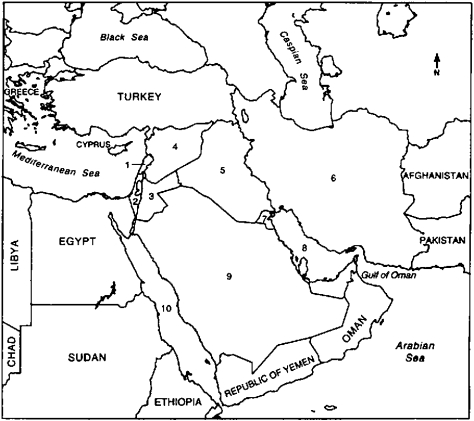 -____ Lebanon
 (67) 
Filters
- Essay(0)
- Multiple Choice(0)
- Short Answer(0)
- True False(0)
- Matching(0)