



 Chat with AI
Exam 35: America in World War II,1941-1945


Match each of the wartime agencies below with its correct function: 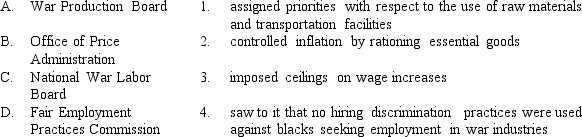

 (79)
 Verified
B
Identify and state the historical significance of the following:
-Henry Stimson
(83)  Answered by Examlex AI Copilot
Henry Lewis Stimson (1867–1950) was an American statesman, lawyer, and Republican Party politician who served in various capacities in the U.S. government, most notably as Secretary of War under President William Howard Taft, President Franklin D. Roosevelt, and as Secretary of State under President Herbert Hoover. His career spanned over five decades, and he was a significant figure in the shaping of U.S. foreign and military policy during the first half of the 20th century.
Stimson's historical significance can be attributed to several key aspects of his career:
1. **Secretary of War (1911–1913, 1940–1945):** Stimson served as Secretary of War under President Taft and then again under President Franklin D. Roosevelt during World War II. His leadership during WWII was crucial in the mobilization and management of the U.S. military effort. He oversaw the expansion of the Army, the development of the Manhattan Project, and the decision to use atomic bombs on Hiroshima and Nagasaki.
2. **Secretary of State (1929–1933):** As Secretary of State under President Hoover, Stimson dealt with foreign policy during the early years of the Great Depression. He is known for the Stimson Doctrine (1932), which declared that the United States would not recognize territorial changes achieved by force, specifically in response to Japan's invasion of Manchuria. This doctrine was an early American attempt to establish principles of international law and order.
3. **Manhattan Project:** Stimson was instrumental in the decision to develop the atomic bomb, overseeing the project as Secretary of War. He was a key figure in the discussions about the use of the bomb and its implications for international relations and warfare.
4. **Advocate of Internationalism:** Throughout his career, Stimson was a strong advocate for international cooperation and engagement. He supported the League of Nations and later the United Nations, believing that international institutions were vital for maintaining peace and stability.
5. **Opposition to Isolationism:** In the interwar period, Stimson was a vocal critic of isolationist policies and argued for greater U.S. involvement in world affairs to prevent conflict and promote global stability.
6. **Good Neighbor Policy:** While Secretary of State, Stimson was involved in the early development of the Good Neighbor Policy, which aimed to improve relations with Latin American countries.
7. **Stimson's Memoirs:** His memoirs, "On Active Service in Peace and War" (1948), provide valuable insights into the decision-making processes of the U.S. government during critical periods such as World War II and offer a firsthand account of the development of U.S. foreign policy.
Henry Stimson's career reflects the evolution of American foreign policy from a more isolationist stance to one of global engagement. His work helped lay the groundwork for the United States' role as a world leader in the post-World War II era. His influence on military and foreign policy, his role in the development and use of nuclear weapons, and his commitment to internationalism are key aspects of his historical significance.
Identify and state the historical significance of the following:
-Fair Employment Practices Commission
(68) Answered by Examlex AI CopilotThe Fair Employment Practices Commission (FEPC) was a significant agency established in the United States during World War II, aimed at addressing and preventing employment discrimination within the war industries. It was created by Executive Order 8802, signed by President Franklin D. Roosevelt on June 25, 1941. The order prohibited racial discrimination in the national defense industry and was the first federal action, though not a law, to promote equal opportunity and prohibit employment discrimination in the United States.
The historical significance of the FEPC lies in its role as a pioneering step towards civil rights and equal employment opportunities for all Americans, regardless of race, creed, color, or national origin. The FEPC was the result of a strong push by civil rights activists, including A. Philip Randolph, who threatened a March on Washington to demand desegregation of the armed forces and equal opportunities in defense jobs. To avert the march and address these concerns, President Roosevelt issued the executive order.
The FEPC had the authority to investigate complaints and take action against employers who were found to be practicing discrimination. While the commission faced significant opposition and limitations in its power and reach, it laid the groundwork for future civil rights advancements. Its efforts raised public awareness about the issues of employment discrimination and set a precedent for subsequent civil rights policies, including the Civil Rights Act of 1964 and the establishment of the Equal Employment Opportunity Commission (EEOC).
The FEPC's work during the war demonstrated that federal intervention could promote social change and provided a model for future civil rights enforcement. It also helped to open up new job opportunities for African Americans and other minority groups during a time of national crisis, contributing to the beginnings of the breakdown of racial barriers in the labor market.
Identify and state the historical significance of the following:
-Congress of Racial Equality
(74) The major consequence of the Allied conquest of Sicily in August 1943 was
(78) The greatest consequence of World War II for American race relations was
(78) Identify and state the historical significance of the following:
-Albert Einstein
(85) Identify and state the historical significance of the following:
-D-Day
(84) Why,with major wars in Europe and the Pacific,did American troops see their first active combat in World War II in North Africa? What were the strategic objectives of that campaign?
(70) The cross-channel invasion of Normandy to open a second front in Europe was commanded by General
(79) By the end of World War II,the heart of the United States' African American community had shifted to
(72) Identify and state the historical significance of the following:
-Casablanca Conference
(81) The employment of more than six million women in American industry during World War II led to
(93) African Americans did all of the following during World War II except
(75) Identify and state the historical significance of the following:
-Potsdam Conference
(78) The unconditional surrender policy toward Japan was finally modified by
(84) The first naval battle in history in which all the fighting was done by carrier-based aircraft was the Battle of
(88) About half of the women war workers said that the main reason they left the labor force at the end of World War II was
(72) Identify and state the historical significance of the following:
-Jiang Jieshi (Chiang Kai-shek)
(85) The minority group most adversely affected by Washington's wartime policies was
(85) 
Filters
- Essay(0)
- Multiple Choice(0)
- Short Answer(0)
- True False(0)
- Matching(0)