



 Chat with AI
Exam 27: Empire and Expansion,1890-1909


Identify and state the historical significance of the following:
-Panama Canal

 (86)
 Answered by Examlex AI Copilot
The Panama Canal is a man-made waterway that connects the Atlantic Ocean to the Pacific Ocean through the Isthmus of Panama in Central America. It was officially opened on August 15, 1914, and its construction was one of the largest and most difficult engineering projects ever undertaken.
Historical Significance:
1. Global Trade and Shipping: The Panama Canal revolutionized maritime trade by significantly reducing the time and distance required for ships to travel between the Atlantic and Pacific Oceans. Before the canal, vessels had to make the perilous and lengthy journey around the southern tip of South America via the Strait of Magellan or Cape Horn. The canal cut the sea voyage by thousands of miles and allowed for quicker and more cost-effective transportation of goods.
2. Engineering Marvel: The construction of the Panama Canal was a monumental achievement in engineering. It involved the excavation of millions of cubic yards of earth, the creation of an artificial lake (Lake Gatun), and the construction of a series of locks to lift and lower ships as they passed through the canal. The project overcame numerous challenges, including tropical diseases like malaria and yellow fever, which were mitigated through extensive public health measures.
3. U.S. Influence and Control: The United States played a crucial role in the construction and early administration of the Panama Canal. The U.S. supported Panama's independence from Colombia in 1903 and subsequently negotiated the Hay-Bunau-Varilla Treaty, which granted the U.S. control over the Canal Zone. The canal became a strategic asset for the U.S., both commercially and militarily, and symbolized American ingenuity and power in the early 20th century.
4. Political and Economic Impact on Panama: The presence of the Panama Canal has had a profound impact on Panama's economy and its relations with the United States. The canal has been a significant source of revenue for Panama, and control over the canal has been a central issue in Panamanian politics. The Torrijos-Carter Treaties, signed in 1977, eventually led to the transfer of control of the canal from the U.S. to Panama on December 31, 1999, marking a significant moment in Panama's sovereignty and self-determination.
5. Military and Strategic Importance: Throughout its history, the Panama Canal has held significant military and strategic importance. It has served as a key route for the movement of naval forces between oceans, particularly during World War I and World War II. The ability to quickly transfer warships between the Atlantic and Pacific theaters was a considerable advantage for the United States.
In summary, the Panama Canal is historically significant due to its impact on global trade, its status as an engineering wonder, its role in expanding U.S. influence, its economic and political importance to Panama, and its strategic military value. It remains one of the most vital waterways in the world today.
Theodore Roosevelt's aggressive policies,along with the economic and political instability in Central America and the Caribbean,frequently led to
(88)  Verified
B
In what sense might the original public demand for intervention in Cuba be said to reflect traditional American idealism and anti-imperialism? How did that idealistic crusade end up leading to America's first major imperialistic ventures?
(71) Answered by Examlex AI CopilotThe original public demand for intervention in Cuba can be said to reflect traditional American idealism and anti-imperialism in the sense that it was driven by a desire to support the Cuban people in their struggle for independence from Spanish colonial rule. This idealism was rooted in the belief that America should support the self-determination and freedom of oppressed peoples, and that it should stand against the oppressive practices of imperial powers.
However, this idealistic crusade ended up leading to America's first major imperialistic ventures as the United States became increasingly involved in Cuban affairs and ultimately intervened in the Spanish-American War. This intervention was driven by a combination of factors, including economic interests in Cuba, a desire to expand American influence in the Caribbean, and a growing sense of national pride and power. As a result, the United States ended up acquiring territories such as Puerto Rico, Guam, and the Philippines, marking the beginning of its imperialistic expansion.
In this way, the original idealistic demand for intervention in Cuba ultimately led to America's first major imperialistic ventures as the country sought to assert its power and influence on the global stage. This shift from anti-imperialism to imperialism reflects the complex and often contradictory nature of American foreign policy and the tensions between idealistic principles and pragmatic interests.
The United States asserted that it had a virtual right of continuing intervention in Cuba in the
(85) The actual purpose of the battleship Maine's visit to Cuba was to
(71) When they first arrived in the US,Puerto Ricans worked in all of the following positions except
(86) The clash between Germany and America over the Samoan islands eventually resulted in
(81) In the 1900 presidential election,the Democratic party and its candidate,William Jennings Bryan,insisted that ____ was the paramount issue of the campaign.
(90) Theodore Roosevelt became involved in the peace settlement for the Russo-Japanese War
(89) Identify and state the historical significance of the following:
-Open Door notes
(89) A group of historians known as the New Left revisionists argued that the United States' burst of overseas expansion
(89) Locate the following places by reference number on the map:
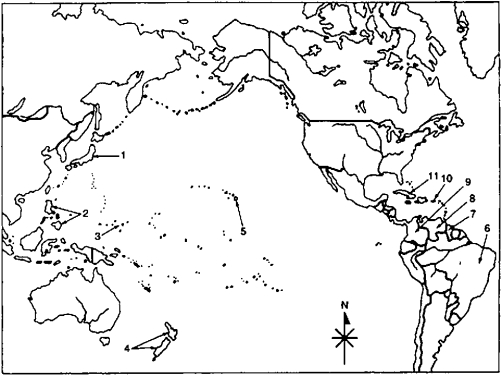 -____ Three territorial acquisitions made by the United States in the Treaty of Paris,which ended the Spanish-American War.
 (89) Identify and state the historical significance of the following:
-Queen Liliuokalani
Identify and state the historical significance of the following:
-"big stick"
(92) Identify and state the historical significance of the following:
-The Maine
(73) During the boundary dispute between Venezuela and Britain,the United States
(78) Identify and state the historical significance of the following:
-Henry Cabot Lodge
(79) 
Filters
- Essay(0)
- Multiple Choice(0)
- Short Answer(0)
- True False(0)
- Matching(0)