



 Chat with AI
Exam 13: The Rise of a Mass Democracy,1824-1840


Why has Andrew Jackson been called "the first modern president"?

 (92)
 Answered by Examlex AI Copilot
Andrew Jackson, the seventh President of the United States, has often been called "the first modern president" for several reasons that reflect a significant shift in the presidency and American politics. Here are some of the key factors that contribute to this characterization:
1. **Popular Appeal and Democratic Expansion**: Jackson was the first president to be elected by appealing directly to the mass of voters rather than through the support of a political elite or establishment. His election marked a shift towards greater democratic participation and the empowerment of the common man. He was seen as a champion of the average citizen, which was a departure from his predecessors who were often perceived as being part of an aristocratic or elite class.
2. **Use of the Presidential Veto**: Jackson was the first president to use the presidential veto power as a political tool rather than solely on constitutional grounds. He vetoed more bills than all previous presidents combined, asserting the power of the presidency in legislative matters and setting a precedent for his successors.
3. **Spoils System**: Jackson is credited with initiating the "spoils system," where political supporters are rewarded with government positions. This practice emphasized the importance of party loyalty and helped to solidify the two-party system. It also made the president a more central figure in determining the composition of the federal government.
4. **Strong Executive Leadership**: Jackson's presidency is marked by his strong executive leadership and willingness to confront and challenge other branches of government. His stance against the Second Bank of the United States and his handling of the Nullification Crisis with South Carolina are examples of his assertive approach to governance.
5. **Presidential Campaigning**: Jackson's election campaigns were among the first to involve extensive grassroots efforts, including rallies, slogans, and political events designed to mobilize voters. This style of campaigning has become a staple of modern presidential elections.
6. **Personal Politics**: Jackson's personal style was also a departure from his predecessors. He was known for his fiery temper and strong personal convictions, which he did not shy away from expressing. This personal approach to politics, where the president's character and beliefs play a significant role in their public perception, has become a hallmark of the modern presidency.
7. **Expansion of Presidential Power**: Jackson's actions during his presidency contributed to the expansion of the powers of the office. He set precedents for a more active role for the president in shaping policy and asserting authority, which subsequent presidents have built upon.
In summary, Andrew Jackson's presidency marked a turning point in the evolution of the office, with a shift towards a more direct relationship with the electorate, an expansion of executive power, and the establishment of practices that have become integral to the modern political landscape. His legacy is a complex one, with his contributions to the presidential office being weighed against the controversial aspects of his policies, such as his treatment of Native Americans and his support for slavery.
Locate the following places by reference number on the map:
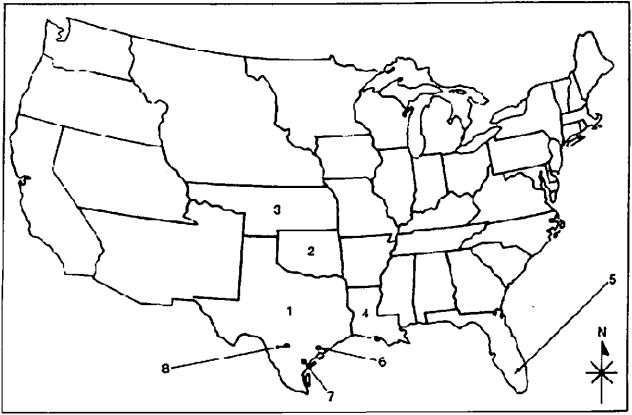 -____ Alamo
 (82)  Verified
8
Identify and state the historical significance of the following:
-Daniel Webster
(83) Answered by Examlex AI CopilotDaniel Webster was a prominent American statesman and lawyer who lived during the early 19th century. Born on January 18, 1782, in Salisbury, New Hampshire, he became one of the most influential and eloquent politicians of his time. Webster's historical significance can be attributed to several key aspects of his career and contributions to American politics and law.
1. **Orator and Debater**: Daniel Webster was renowned for his exceptional oratory skills. His speeches in the Senate were known for their eloquence and powerful rhetoric. He was a master debater, which helped him to become one of the most respected legislators of his era.
2. **Constitutional Lawyer**: As a lawyer, Webster argued numerous cases before the Supreme Court. Perhaps his most famous case was Gibbons v. Ogden (1824), which dealt with the scope of Congress's power to regulate interstate commerce. His arguments helped to shape the development of constitutional law in the United States.
3. **Advocate for Nationalism**: Webster was a strong advocate for a powerful and unified national government, which was a significant stance during a time when the country was often divided along regional lines. His philosophy was in contrast to the states' rights advocates of his day, and his defense of national unity was a recurring theme in his speeches, including his famous "Second Reply to Hayne" in 1830.
4. **The Great Triumvirate**: Alongside Henry Clay and John C. Calhoun, Webster was part of the "Great Triumvirate," three influential senators who dominated American politics in the first half of the 19th century. These men were instrumental in shaping legislative policy and were key figures in the debates surrounding the major issues of their day, including the tariff, slavery, and states' rights.
5. **Secretary of State**: Webster served as Secretary of State under three presidents: William Henry Harrison, John Tyler, and Millard Fillmore. In this role, he was responsible for conducting foreign policy at a time when the United States was expanding its influence. His most notable achievement as Secretary of State was negotiating the Webster-Ashburton Treaty with Great Britain in 1842, which resolved border disputes between the U.S. and Canada.
6. **Compromise of 1850**: Although a Northerner, Webster supported the Compromise of 1850, which was an attempt to stave off the sectional conflict between the North and South over the expansion of slavery. His support for the compromise, particularly the Fugitive Slave Act, was controversial and damaged his reputation among abolitionists and many in the North.
Daniel Webster's legacy is that of a statesman who championed the cause of national unity and the supremacy of federal law over state law. His contributions to American legal thought, his powerful oratory, and his efforts to navigate the country through a period of intense sectionalism are what make him a significant figure in American history. He passed away on October 24, 1852, but his impact on the nation's political and legal systems endures.
The nullification crisis started by South Carolina over the Tariff of 1828 ended when
(79) Texans won their independence as a result of the victory over Mexican armies at the Battle of
(69) Write your definition of political favoritism.Then use this definition to argue that the rotation in office/spoils system of the Jacksonians was or was not crass political favoritism.
(82) Locate the following places by reference number on the map:
-____ Everglades
-____ Everglades (80) People in the West tended to prefer Andrew Jackson in the 1824 election because he
(88) Identify and state the historical significance of the following:
-National Republicans
(89) It has been observed that "though Jackson was perhaps not himself a democrat,he was a democratic leader." Do you agree or disagree? Why?
(89) Identify and state the historical significance of the following:
-rotation in office
(77) The people who proposed the exceptionally high rates of the Tariff of 1828 were
(90) The House of Representatives decided the 1824 presidential election when
(86) Identify and state the historical significance of the following:
-annexation
(73) 
Filters
- Essay(0)
- Multiple Choice(0)
- Short Answer(0)
- True False(0)
- Matching(0)