



 Chat with AI
Exam 29: Wilsonian Progressivism at Home and Abroad,1912-1916


To secure passage of the Underwood Tariff Bill,Woodrow broke new ground by

 (79)
 Verified
B
Identify and state the historical significance of the following:
-Victoriano Huerta
(60)  Answered by Examlex AI Copilot
Victoriano Huerta was a Mexican military officer and politician who is most notably remembered for his role in the Mexican Revolution and for serving as the President of Mexico from 1913 to 1914. His historical significance lies in his controversial leadership and the pivotal role he played during a tumultuous period in Mexican history.
Born on March 23, 1845, Huerta joined the Mexican Army and rose through the ranks due to his military capabilities. He was known for his stern discipline and effectiveness as a soldier, which eventually led to his involvement in national politics.
The historical significance of Victoriano Huerta can be summarized in the following points:
1. Overthrow of Francisco I. Madero: Huerta is most infamously known for his role in the coup d'état against President Francisco I. Madero in February 1913, known as "La Decena Trágica" (The Ten Tragic Days). With the support of conservative factions, the U.S. ambassador Henry Lane Wilson, and other conspirators, Huerta arrested and later ordered the assassination of Madero and his vice president, José María Pino Suárez. This event shocked the nation and set a precedent for political instability.
2. Presidency and Dictatorship: After Madero's overthrow, Huerta declared himself President of Mexico. His regime was characterized by authoritarian rule and attempts to centralize power. He dissolved the Congress, censored the press, and used the military to suppress opposition, earning him the reputation of a dictator.
3. Opposition and the Constitutionalist Movement: Huerta's seizure of power galvanized opposition forces, leading to the rise of the Constitutionalist movement led by figures such as Venustiano Carranza, Álvaro Obregón, and Francisco "Pancho" Villa. This movement aimed to restore constitutional order and oppose Huerta's dictatorship.
4. U.S. Involvement: Huerta's regime was initially recognized by some foreign governments, but he quickly fell out of favor with the United States. President Woodrow Wilson, who came into office shortly after Huerta's rise to power, refused to recognize his government and supported his opponents. This led to further conflict, including the U.S. occupation of the port of Veracruz in 1914.
5. Downfall and Exile: Facing both internal rebellion and external pressure, Huerta's regime became untenable. He resigned from the presidency in July 1914 and went into exile, first to Britain and then to Spain. He attempted to return to Mexico with German assistance during World War I but was arrested in the United States and died in prison in 1916.
Victoriano Huerta's brief but impactful rule is a significant chapter in the Mexican Revolution. His dictatorship intensified the revolutionary struggle, leading to the eventual drafting of the 1917 Mexican Constitution, which introduced significant social and political reforms. Huerta's legacy is often viewed negatively due to his betrayal of democratic principles and the repressive nature of his regime.
Identify and state the historical significance of the following:
-Herbert Croly
(64) Answered by Examlex AI CopilotHerbert Croly (1869–1930) was an influential American political philosopher and journalist who played a significant role in shaping progressive political thought in the early 20th century. He is best known for his book "The Promise of American Life" (1909), which articulated a vision for a new form of liberalism that would address the social and economic challenges posed by industrialization and the rise of corporate power.
Croly's historical significance lies in several key contributions:
1. Progressive Movement Advocate: Croly's ideas were foundational to the Progressive Movement, which sought to address the problems of economic inequality, political corruption, and social injustice. Progressives aimed to use the power of government to regulate industry, improve working conditions, and promote social welfare.
2. Founding of The New Republic: In 1914, Croly co-founded the magazine "The New Republic," which became an important platform for progressive ideas and advocacy. The magazine influenced public opinion and policy debates, and it continues to be published to this day.
3. Influence on Political Leaders: Croly's work had a direct impact on several key political figures of the time, including Presidents Theodore Roosevelt and Woodrow Wilson. Roosevelt's "New Nationalism" and Wilson's "New Freedom" were both influenced by Croly's call for a more active government role in ensuring economic fairness and social justice.
4. Reinterpretation of American Democracy: Croly argued that traditional American individualism and laissez-faire economics were inadequate for dealing with the complexities of modern society. He advocated for a reinterpretation of American democratic ideals to include a stronger role for the state in managing the economy and protecting the public interest.
5. Advocacy for a Mixed Economy: Croly was an early proponent of a mixed economy, where both private enterprise and government intervention play roles in promoting economic growth and social welfare. This idea would later become a central tenet of modern liberal thought.
6. Nationalism and Democracy: Croly believed that a strong, centralized government was necessary to balance the interests of different social groups and to implement reforms that would benefit the nation as a whole. His vision of nationalism was tied to the idea of a democratic state that would actively engage in shaping economic and social policies.
Herbert Croly's ideas and advocacy left a lasting imprint on American political thought and policy. His work helped to lay the intellectual groundwork for the New Deal and the expansion of the welfare state in the mid-20th century. His emphasis on the need for a responsive and responsible government continues to influence debates about the role of the state in society.
Identify and state the historical significance of the following:
-New Freedom
(61) Identify and state the historical significance of the following:
-Venustiano Carranza
(81) The Underwood Tariff Act and the Sixteenth Amendment reflected Wilson's progressive goals by
(66) The Federal Trade Commission was established in 1914 to address all of these practices except
(81) Locate the following places by reference number on the map:
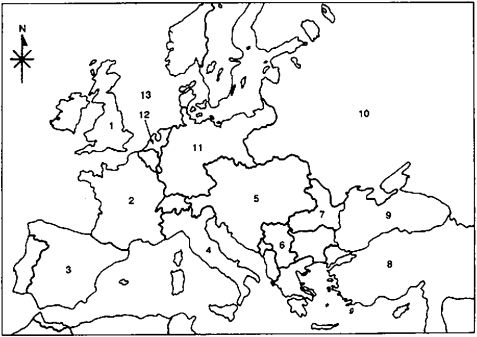 -____ Three nations associated as the Allies at the outbreak of World War I.
 (63) The flood of progressive legislation during Wilson's first term included laws to
(70) The Federal Reserve Act of 1913 guaranteed a substantial measure of public control over the American banking and currency system through the great authority given to
(90) Because of the benefits that it conferred on labor,Samuel Gompers called the ____ "labor's Magna Carta."
(74) Identify and state the historical significance of the following:
-Sussex pledge
(77) When Jane Addams placed Teddy Roosevelt's name in nomination for the presidency in 1912,it
(61) Identify and state the historical significance of the following:
-Bull Moose
(75) President Wilson's first direct use of American military forces in revolutionary Mexico occurred when he
(80) In 1912,Woodrow Wilson ran for the presidency on a Democratic platform that included all of the following except a call for
(88) Identify and state the historical significance of the following:
-Virgin Islands
(85) Which of these is NOT a true statement about the sinking of the Lusitania?
(66) 
Filters
- Essay(0)
- Multiple Choice(0)
- Short Answer(0)
- True False(0)
- Matching(0)