



 Chat with AI
Exam 2: Thinking Like an Economist

Exam 1: Ten Principles of Economics220 Questions
Exam 2: Thinking Like an Economist284 Questions
Exam 3: Interdependence and the Gains From Trade192 Questions
Exam 4: The Market Forces of Supply and Demand277 Questions
Exam 5: Elasticity and Its Application222 Questions
Exam 6: Supply, Demand, and Government Policies321 Questions
Exam 7: Consumers, Producers, and the Efficiency of Markets218 Questions
Exam 8: Applications: The Costs of Taxation203 Questions
Exam 9: Application: International Trade214 Questions
Exam 10: Externalities204 Questions
Exam 11: Public Goods and Common Resources182 Questions
Exam 12: The Design of the Tax System225 Questions
Exam 13: The Costs of Production261 Questions
Exam 14: Firms in Competitive Markets243 Questions
Exam 15: Monopoly231 Questions
Exam 16: Monopolistic Competition246 Questions
Exam 17: Oligopoly204 Questions
Exam 18: The Markets for the Factors of Production232 Questions
Exam 19: Earnings and Discrimination230 Questions
Exam 20: Income Inequality and Poverty194 Questions
Exam 21: The Theory of Consumer Choice209 Questions
Exam 22: Frontiers in Microeconomics185 Questions
Exam 23: Measuring a Nations Income231 Questions
Exam 24: Measuring the Cost of Living214 Questions
Exam 25: Production and Growth187 Questions
Exam 26: Saving, Investment, and the Financial System225 Questions
Exam 27: Tools of Finance198 Questions
Exam 28: Unemployment and Its Natural Rate361 Questions
Exam 29: The Monetary System210 Questions
Exam 30: Money Growth and Inflation201 Questions
Exam 31: Open-Economy Macroeconomics: Basic Concepts194 Questions
Exam 32: A Macroeconomic Theory of the Open Economy188 Questions
Exam 33: Aggregate Demand and Aggregate Supply189 Questions
Exam 34: The Influence of Monetary and Fiscal Policy on Aggregate Demand207 Questions
Exam 35: The Short-Run Tradeoff Between Inflation and Unemployment223 Questions
Exam 36: Six Debates Over Macroeconomic Policy154 Questions
Select questions type


If new government regulations designed to protect wetlands remove very productive farmland from production, then the production possibilities frontier will shift inward.
(True/False)
4.8/5  (67)
(67) When a relevant variable that is not named on either axis changes,
(Multiple Choice)
4.9/5 (81)
(81) Figure 2-3
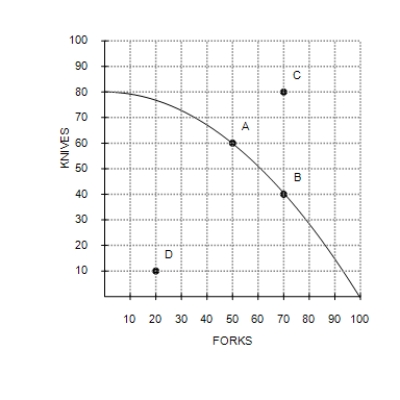 -Refer to Figure 2-3. The opportunity cost of this economy moving from point A to point B is
 (Multiple Choice)
4.8/5 (79)
(79) "Other things equal, an increase in supply causes a decrease in price" is a normative statement, not a positive statement.
(True/False)
4.9/5 (75)
(75) Is the following a positive or normative statement? The federal minimum wage is lower than many state minimum wages.
(Short Answer)
4.7/5 (91)
(91) What type of statement is a prescriptive statement about how the world ought to be?
(Short Answer)
4.8/5 (71)
(71) In surveys of professional economists, fourteen propositions were endorsed by an overwhelming majority of respondents.
(True/False)
4.8/5 (79)
(79) An outcome is said to be efficient if an economy is conserving the largest possible quantity of its scarce resources while still meeting the basic needs of society.
(True/False)
4.9/5 (74)
(74) Figure 2-12

-Just like other scientific models, economic models simplify reality using
-Just like other scientific models, economic models simplify reality using (Short Answer)
4.8/5 (66)
(66) Figure 2-12
-Refer to Figure 2-12. What do the outer arrows represent in the figure?
-Refer to Figure 2-12. What do the outer arrows represent in the figure? (Short Answer)
4.8/5 (77)
(77) The production possibilities frontier shows the opportunity cost of one good as measured in terms of the other good.
(True/False)
4.9/5 (82)
(82) From which of the following agencies does the President not receive economic policy advice from economists?
(Multiple Choice)
4.8/5 (74)
(74) When a production possibilities frontier is bowed outward, the opportunity cost of one good in terms of the other depends on how much of each good is being produced.
(True/False)
4.9/5 (75)
(75) Figure 2-4
Graph (a)
Graph (b)

 -Refer to Figure 2-4, Graph (a) and Graph (b). A shift of the economy's production possibilities frontier from Graph (a) to Graph (b) could be caused by
 (Multiple Choice)
4.9/5 (81)
(81) Figure 2-10

-Refer to Figure 2-10. Given the technology available for manufacturing doghouses and dishwashers, this economy does not have enough of the factors of production to support the level of output represented by point C.
-Refer to Figure 2-10. Given the technology available for manufacturing doghouses and dishwashers, this economy does not have enough of the factors of production to support the level of output represented by point C. (True/False)
4.9/5 (77)
(77) Figure 2-8
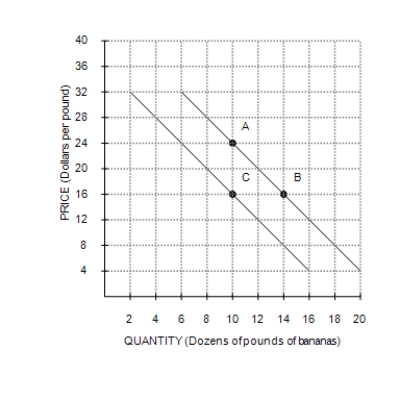 -Refer to Figure 2-8. The slope of the curve between points A and B is
 (Multiple Choice)
4.9/5 (73)
(73) 
Filters
- Essay(0)
- Multiple Choice(0)
- Short Answer(0)
- True False(0)
- Matching(0)