



 Chat with AI
Exam 2: Thinking Like an Economist

Exam 1: Ten Principles of Economics220 Questions
Exam 2: Thinking Like an Economist284 Questions
Exam 3: Interdependence and the Gains From Trade192 Questions
Exam 4: The Market Forces of Supply and Demand277 Questions
Exam 5: Elasticity and Its Application222 Questions
Exam 6: Supply, Demand, and Government Policies321 Questions
Exam 7: Consumers, Producers, and the Efficiency of Markets218 Questions
Exam 8: Applications: The Costs of Taxation203 Questions
Exam 9: Application: International Trade214 Questions
Exam 10: Externalities204 Questions
Exam 11: Public Goods and Common Resources182 Questions
Exam 12: The Design of the Tax System225 Questions
Exam 13: The Costs of Production261 Questions
Exam 14: Firms in Competitive Markets243 Questions
Exam 15: Monopoly231 Questions
Exam 16: Monopolistic Competition246 Questions
Exam 17: Oligopoly204 Questions
Exam 18: The Markets for the Factors of Production232 Questions
Exam 19: Earnings and Discrimination230 Questions
Exam 20: Income Inequality and Poverty194 Questions
Exam 21: The Theory of Consumer Choice209 Questions
Exam 22: Frontiers in Microeconomics185 Questions
Exam 23: Measuring a Nations Income231 Questions
Exam 24: Measuring the Cost of Living214 Questions
Exam 25: Production and Growth187 Questions
Exam 26: Saving, Investment, and the Financial System225 Questions
Exam 27: Tools of Finance198 Questions
Exam 28: Unemployment and Its Natural Rate361 Questions
Exam 29: The Monetary System210 Questions
Exam 30: Money Growth and Inflation201 Questions
Exam 31: Open-Economy Macroeconomics: Basic Concepts194 Questions
Exam 32: A Macroeconomic Theory of the Open Economy188 Questions
Exam 33: Aggregate Demand and Aggregate Supply189 Questions
Exam 34: The Influence of Monetary and Fiscal Policy on Aggregate Demand207 Questions
Exam 35: The Short-Run Tradeoff Between Inflation and Unemployment223 Questions
Exam 36: Six Debates Over Macroeconomic Policy154 Questions
Select questions type


Economists believe that production possibilities frontiers rarely have a bowed shape.
(True/False)
5.0/5  (71)
(71) In the circular-flow diagram, factors of production are the goods and services produced by firms.
(True/False)
4.9/5 (81)
(81) In the circular-flow diagram, firms produce goods and services using the factors of production.
(True/False)
4.9/5 (81)
(81) As a substitute for laboratory experiments, economists use evidence available through history's
(Short Answer)
4.9/5 (84)
(84) Who would be more likely to study the effects of government spending on the unemployment rate, a macroeconomist or a microeconomist?
(Short Answer)
4.7/5 (80)
(80) In the simple circular-flow diagram, which of the following is not true?
(Multiple Choice)
4.9/5 (80)
(80) When constructing a production possibilities frontier, which of the following assumptions is not made?
(Multiple Choice)
4.8/5 (62)
(62) Table 2-4
Mobile Phones Pizzas 0 10,000 200 8,000 500 6,000 900 4,000 1400 2,000 2000 0
-Refer to Table 2-4. Consider the production possibilities table for an economy that produces only mobile phones and pizzas. What is the opportunity cost of increasing production of pizzas from 4,000 to 6,000?
(Short Answer)
4.9/5 (78)
(78) Figure 2-11
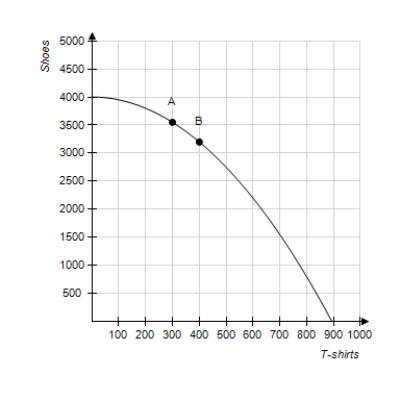
-Refer to Figure 2-11. The opportunity cost of moving from point A to point B is zero.
-Refer to Figure 2-11. The opportunity cost of moving from point A to point B is zero. (True/False)
4.8/5 (72)
(72) In the circular-flow diagram, one loop represents the flow of goods, services, and factors of production, and the other loop represents the corresponding flow of dollars.
(True/False)
4.9/5 (78)
(78) Points on the production possibilities frontier represent efficient levels of production.
(True/False)
4.8/5 (87)
(87) It is difficult for economists to make observations and develop theories, but it is easy for economists to run experiments to generate data to test their theories.
(True/False)
4.8/5 (80)
(80) Figure 2-12

-Suppose a war in the Middle East interrupts the flow of crude oil and oil prices skyrocket around the world. For economists, this historical episode serves as a
-Suppose a war in the Middle East interrupts the flow of crude oil and oil prices skyrocket around the world. For economists, this historical episode serves as a (Short Answer)
4.8/5 (71)
(71) Suppose an economist develops a theory that higher housing prices arise from lower gas prices. According to the scientific method, which of the following is the economist's next step?
(Multiple Choice)
4.9/5 (75)
(75) An economic model can accurately explain how the economy is organized because it is designed to include, to the extent possible, all features of the real world.
(True/False)
4.9/5 (74)
(74) A production point is said to be efficient if there is no way for the economy to produce more of one good without producing less of another.
(True/False)
4.9/5 (84)
(84) Figure 2-10

-Refer to Figure 2-10. Point B represents an inefficient outcome for this economy.
-Refer to Figure 2-10. Point B represents an inefficient outcome for this economy. (True/False)
4.9/5 (81)
(81) The production possibilities frontier provides an illustration of the principle that
(Multiple Choice)
4.7/5 (85)
(85) The president of the United States receives tax policy advice from economists in the
(Multiple Choice)
4.9/5 (66)
(66) 
Filters
- Essay(0)
- Multiple Choice(0)
- Short Answer(0)
- True False(0)
- Matching(0)