



 Chat with AI
Exam 2: Thinking Like an Economist

Exam 1: Ten Principles of Economics220 Questions
Exam 2: Thinking Like an Economist284 Questions
Exam 3: Interdependence and the Gains From Trade192 Questions
Exam 4: The Market Forces of Supply and Demand277 Questions
Exam 5: Elasticity and Its Application222 Questions
Exam 6: Supply, Demand, and Government Policies321 Questions
Exam 7: Consumers, Producers, and the Efficiency of Markets218 Questions
Exam 8: Applications: The Costs of Taxation203 Questions
Exam 9: Application: International Trade214 Questions
Exam 10: Externalities204 Questions
Exam 11: Public Goods and Common Resources182 Questions
Exam 12: The Design of the Tax System225 Questions
Exam 13: The Costs of Production261 Questions
Exam 14: Firms in Competitive Markets243 Questions
Exam 15: Monopoly231 Questions
Exam 16: Monopolistic Competition246 Questions
Exam 17: Oligopoly204 Questions
Exam 18: The Markets for the Factors of Production232 Questions
Exam 19: Earnings and Discrimination230 Questions
Exam 20: Income Inequality and Poverty194 Questions
Exam 21: The Theory of Consumer Choice209 Questions
Exam 22: Frontiers in Microeconomics185 Questions
Exam 23: Measuring a Nations Income231 Questions
Exam 24: Measuring the Cost of Living214 Questions
Exam 25: Production and Growth187 Questions
Exam 26: Saving, Investment, and the Financial System225 Questions
Exam 27: Tools of Finance198 Questions
Exam 28: Unemployment and Its Natural Rate361 Questions
Exam 29: The Monetary System210 Questions
Exam 30: Money Growth and Inflation201 Questions
Exam 31: Open-Economy Macroeconomics: Basic Concepts194 Questions
Exam 32: A Macroeconomic Theory of the Open Economy188 Questions
Exam 33: Aggregate Demand and Aggregate Supply189 Questions
Exam 34: The Influence of Monetary and Fiscal Policy on Aggregate Demand207 Questions
Exam 35: The Short-Run Tradeoff Between Inflation and Unemployment223 Questions
Exam 36: Six Debates Over Macroeconomic Policy154 Questions
Select questions type


Figure 2-10

-Refer to Figure 2-10. If this economy uses all its resources in the dishwasher industry, it produces 35 dishwashers and no doghouses.
-Refer to Figure 2-10. If this economy uses all its resources in the dishwasher industry, it produces 35 dishwashers and no doghouses. (True/False)
4.9/5  (78)
(78) Assumptions can simplify the complex world and make it easier to understand.
(True/False)
4.8/5 (72)
(72) Figure 2-12

-Refer to Figure 2-12. What do the ovals represent in the figure?
-Refer to Figure 2-12. What do the ovals represent in the figure? (Essay)
4.7/5 (89)
(89) Which of the following would likely be studied by a microeconomist rather than a macroeconomist?
(Multiple Choice)
4.8/5 (78)
(78) Figure 2-12
-Refer to Figure 2-12. What do the inner arrows represent in the figure?
-Refer to Figure 2-12. What do the inner arrows represent in the figure? (Short Answer)
4.9/5 (73)
(73) Figure 2-11
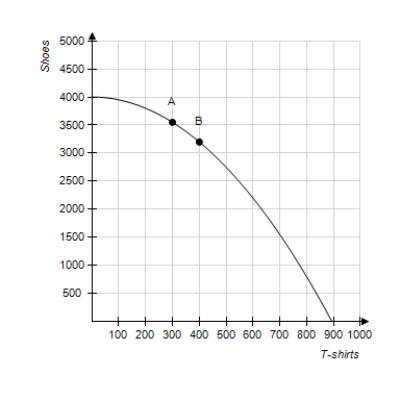
-Refer to Figure 2-11. It is possible for this economy to produce 1000 shoes.
-Refer to Figure 2-11. It is possible for this economy to produce 1000 shoes. (True/False)
4.9/5 (89)
(89) Figure 2-10
-Refer to Figure 2-10. This economy fully employs its resources when it produces 35 dishwashers and zero doghouses.
-Refer to Figure 2-10. This economy fully employs its resources when it produces 35 dishwashers and zero doghouses. (True/False)
4.8/5 (85)
(85) Which of the following transactions does not take place in the markets for factors of production in the circular-flow diagram?
(Multiple Choice)
4.8/5 (79)
(79) Figure 2-15
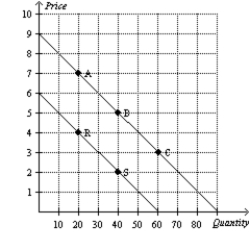
-Refer to Figure 2-15. Is a move from point A to point B considered a shift of the curve or a movement along the curve?
-Refer to Figure 2-15. Is a move from point A to point B considered a shift of the curve or a movement along the curve? (Short Answer)
4.9/5 (65)
(65) In the ordered pair (10,30), 10 is the y-coordinate and 30 is the z-coordinate.
(True/False)
4.9/5 (64)
(64) Economic models omit many details to allow us to see what is truly important.
(True/False)
4.7/5 (82)
(82) The opportunity cost of something is what you give up to get it.
(True/False)
4.9/5 (85)
(85) Using the outline below, draw a circular-flow diagram representing the interactions between households and firms in a simple economy. Explain briefly the various parts of the diagram.
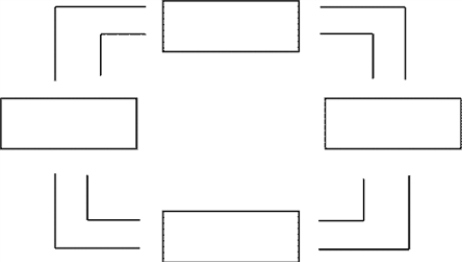
(Essay)
4.7/5 (79)
(79) Figure 2-14

-Refer to Figure 2-14. Consider the production possibilities frontier for an economy that produces only sofas and cars. The opportunity cost of one sofa is
-Refer to Figure 2-14. Consider the production possibilities frontier for an economy that produces only sofas and cars. The opportunity cost of one sofa is (Short Answer)
4.7/5 (70)
(70) Figure 2-1
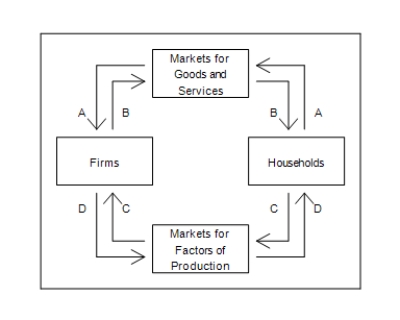 -Refer to Figure 2-1. Which arrow represents the flow of spending by households?
 (Multiple Choice)
4.7/5 (68)
(68) 
Filters
- Essay(0)
- Multiple Choice(0)
- Short Answer(0)
- True False(0)
- Matching(0)