



 Chat with AI
Exam 2: Thinking Like an Economist

Exam 1: Ten Principles of Economics220 Questions
Exam 2: Thinking Like an Economist284 Questions
Exam 3: Interdependence and the Gains From Trade192 Questions
Exam 4: The Market Forces of Supply and Demand277 Questions
Exam 5: Elasticity and Its Application222 Questions
Exam 6: Supply, Demand, and Government Policies321 Questions
Exam 7: Consumers, Producers, and the Efficiency of Markets218 Questions
Exam 8: Applications: The Costs of Taxation203 Questions
Exam 9: Application: International Trade214 Questions
Exam 10: Externalities204 Questions
Exam 11: Public Goods and Common Resources182 Questions
Exam 12: The Design of the Tax System225 Questions
Exam 13: The Costs of Production261 Questions
Exam 14: Firms in Competitive Markets243 Questions
Exam 15: Monopoly231 Questions
Exam 16: Monopolistic Competition246 Questions
Exam 17: Oligopoly204 Questions
Exam 18: The Markets for the Factors of Production232 Questions
Exam 19: Earnings and Discrimination230 Questions
Exam 20: Income Inequality and Poverty194 Questions
Exam 21: The Theory of Consumer Choice209 Questions
Exam 22: Frontiers in Microeconomics185 Questions
Exam 23: Measuring a Nations Income231 Questions
Exam 24: Measuring the Cost of Living214 Questions
Exam 25: Production and Growth187 Questions
Exam 26: Saving, Investment, and the Financial System225 Questions
Exam 27: Tools of Finance198 Questions
Exam 28: Unemployment and Its Natural Rate361 Questions
Exam 29: The Monetary System210 Questions
Exam 30: Money Growth and Inflation201 Questions
Exam 31: Open-Economy Macroeconomics: Basic Concepts194 Questions
Exam 32: A Macroeconomic Theory of the Open Economy188 Questions
Exam 33: Aggregate Demand and Aggregate Supply189 Questions
Exam 34: The Influence of Monetary and Fiscal Policy on Aggregate Demand207 Questions
Exam 35: The Short-Run Tradeoff Between Inflation and Unemployment223 Questions
Exam 36: Six Debates Over Macroeconomic Policy154 Questions
Select questions type


While the scientific method is applicable to studying natural sciences, it is not applicable to studying a nation's economy.
(True/False)
4.9/5  (78)
(78) Figure 2-10

-Refer to Figure 2-10. The opportunity cost of moving from point B to point D is 15 doghouses.
-Refer to Figure 2-10. The opportunity cost of moving from point B to point D is 15 doghouses. (True/False)
4.9/5 (76)
(76) The concept of slope can be used to answer questions about how much one variable responds to changes in another variable.
(True/False)
4.8/5 (83)
(83) Which of the following steps does an economist not take when studying the economy?
(Multiple Choice)
4.8/5 (83)
(83) The circular-flow diagram explains, in general terms, how the economy is organized and how participants in the economy interact with one another.
(True/False)
4.8/5 (79)
(79) Figure 2-15
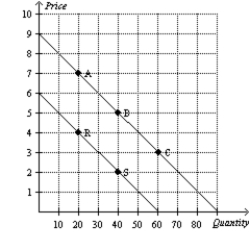
-Refer to Figure 2-15. What is the slope of the line with points A, B, and C?
-Refer to Figure 2-15. What is the slope of the line with points A, B, and C? (Short Answer)
4.9/5 (82)
(82) In the circular flow diagram, when Daphne purchases a new mobile phone, she participates in the markets for
(Short Answer)
4.9/5 (65)
(65) In the circular-flow diagram, payments for labor, land, and capital flow from firms to households through the markets for the factors of production.
(True/False)
4.8/5 (87)
(87) A production possibilities frontier will be bowed outward if some of the economy's resources are better suited to producing one good than another.
(True/False)
4.9/5 (77)
(77) Historical episodes allow economists to illustrate and evaluate current economic theories.
(True/False)
4.9/5 (86)
(86) Table 2-4
Mobile Phones Pizzas 0 10,000 200 8,000 500 6,000 900 4,000 1400 2,000 2000 0
-Refer to Table 2-4. Consider the production possibilities table for an economy that produces only mobile phones and pizzas. What is the opportunity cost of increasing production of mobile phones from 200 to 500?
(Short Answer)
4.8/5 (68)
(68) Sometimes economists disagree because their scientific judgments differ. Which of the following instances best reflects this source of disagreement?
(Multiple Choice)
4.7/5 (87)
(87) Figure 2-4
Graph (a)
Graph (b)

 -Refer to Figure 2-4, Graph (a). Production is
 (Multiple Choice)
4.9/5 (86)
(86) How are economists not like mathematicians, physicists, and biologists?
(Multiple Choice)
4.8/5 (87)
(87) In economics, graphs serve two purposes: they offer a way to visually express ideas, and they provide a way of finding and interpreting patterns when analyzing economic data.
(True/False)
4.8/5 (79)
(79) Examples of graphs of a single variable include pie charts, bar graphs, and time-series graphs.
(True/False)
4.9/5 (69)
(69) The art in scientific thinking-whether in chemistry, economics, or engineering-is
(Multiple Choice)
4.9/5 (97)
(97) Economists at which administrative department help design tax policy?
(Short Answer)
4.9/5 (74)
(74) "Society would be better off if the welfare system were abolished" is a normative statement, not a positive statement.
(True/False)
4.9/5 (85)
(85) In the simple circular-flow diagram, the participants in the economy are
(Multiple Choice)
4.8/5 (99)
(99) 
Filters
- Essay(0)
- Multiple Choice(0)
- Short Answer(0)
- True False(0)
- Matching(0)