



 Chat with AI
Exam 2: Thinking Like an Economist

Exam 1: Ten Principles of Economics220 Questions
Exam 2: Thinking Like an Economist284 Questions
Exam 3: Interdependence and the Gains From Trade192 Questions
Exam 4: The Market Forces of Supply and Demand277 Questions
Exam 5: Elasticity and Its Application222 Questions
Exam 6: Supply, Demand, and Government Policies321 Questions
Exam 7: Consumers, Producers, and the Efficiency of Markets218 Questions
Exam 8: Applications: The Costs of Taxation203 Questions
Exam 9: Application: International Trade214 Questions
Exam 10: Externalities204 Questions
Exam 11: Public Goods and Common Resources182 Questions
Exam 12: The Design of the Tax System225 Questions
Exam 13: The Costs of Production261 Questions
Exam 14: Firms in Competitive Markets243 Questions
Exam 15: Monopoly231 Questions
Exam 16: Monopolistic Competition246 Questions
Exam 17: Oligopoly204 Questions
Exam 18: The Markets for the Factors of Production232 Questions
Exam 19: Earnings and Discrimination230 Questions
Exam 20: Income Inequality and Poverty194 Questions
Exam 21: The Theory of Consumer Choice209 Questions
Exam 22: Frontiers in Microeconomics185 Questions
Exam 23: Measuring a Nations Income231 Questions
Exam 24: Measuring the Cost of Living214 Questions
Exam 25: Production and Growth187 Questions
Exam 26: Saving, Investment, and the Financial System225 Questions
Exam 27: Tools of Finance198 Questions
Exam 28: Unemployment and Its Natural Rate361 Questions
Exam 29: The Monetary System210 Questions
Exam 30: Money Growth and Inflation201 Questions
Exam 31: Open-Economy Macroeconomics: Basic Concepts194 Questions
Exam 32: A Macroeconomic Theory of the Open Economy188 Questions
Exam 33: Aggregate Demand and Aggregate Supply189 Questions
Exam 34: The Influence of Monetary and Fiscal Policy on Aggregate Demand207 Questions
Exam 35: The Short-Run Tradeoff Between Inflation and Unemployment223 Questions
Exam 36: Six Debates Over Macroeconomic Policy154 Questions
Select questions type


Which of the following would likely be studied by a macroeconomist rather than a microeconomist?
(Multiple Choice)
4.8/5  (75)
(75) When a production possibilities frontier is bowed outward, the opportunity cost of the first good in terms of the second good increases as more of the second good is produced.
(True/False)
4.8/5 (67)
(67) Economists at which administrative department help enforce the nation's antitrust laws?
(Short Answer)
4.9/5 (67)
(67) A pie chart is a way to display information regarding two variables.
(True/False)
4.9/5 (77)
(77) Economists acting as scientists make positive statements, while economists acting as policy advisers make normative statements.
(True/False)
4.8/5 (84)
(84) Figure 2-10

-Refer to Figure 2-10. The opportunity cost of an additional doghouse increases as more doghouses are produced.
-Refer to Figure 2-10. The opportunity cost of an additional doghouse increases as more doghouses are produced. (True/False)
4.8/5 (90)
(90) Table 2-4
Mobile Phones Pizzas 0 10,000 200 8,000 500 6,000 900 4,000 1400 2,000 2000 0
-Refer to Table 2-4. Consider the production possibilities table for an economy that produces only mobile phones and pizzas. Describe the shape of the production possibilities frontier.
(Short Answer)
4.8/5 (67)
(67) Figure 2-15
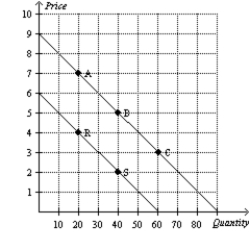
-Refer to Figure 2-15. What is the x-coordinate of point R?
-Refer to Figure 2-15. What is the x-coordinate of point R? (Short Answer)
5.0/5 (76)
(76) In the markets for goods and services in the circular flow diagram, households act as
(Short Answer)
4.8/5 (76)
(76) Instead of conducting laboratory experiments to generate data to test their theories, economists often
(Multiple Choice)
4.9/5 (74)
(74) Figure 2-10
-Refer to Figure 2-10. The opportunity cost of moving from point B to point A is zero.
-Refer to Figure 2-10. The opportunity cost of moving from point B to point A is zero. (True/False)
5.0/5 (80)
(80) The bowed-outward shape of the production possibilities frontier can be explained by the fact that
(Multiple Choice)
4.9/5 (63)
(63) Production possibilities frontiers can be used to illustrate scarcity, trade-offs, opportunity cost, efficiency, unemployment, technological advances, and economic growth.
(True/False)
4.7/5 (61)
(61) Figure 2-3
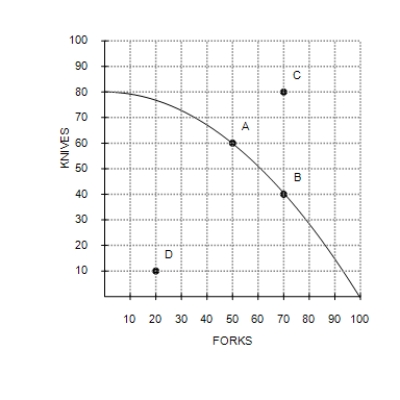 -Refer to Figure 2-3. Efficient production is represented by which point(s)?
 (Multiple Choice)
4.9/5 (77)
(77) Table 2-3
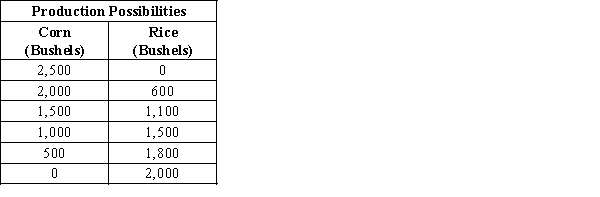 -Refer to Table 2-3. What is the opportunity cost of increasing the production of corn from 500 bushels to 1000 bushels?
 (Multiple Choice)
4.8/5 (85)
(85) Figure 2-10
-Refer to Figure 2-10. Points B and C represent infeasible outcomes for this economy.
-Refer to Figure 2-10. Points B and C represent infeasible outcomes for this economy. (True/False)
4.9/5 (83)
(83) Figure 2-12

-Refer to Figure 2-12. What is the name of the model depicted in the figure?
-Refer to Figure 2-12. What is the name of the model depicted in the figure? (Short Answer)
4.8/5 (83)
(83) If a major union goes on strike, then the country would be operating inside its production possibilities frontier.
(True/False)
4.7/5 (87)
(87) Draw a production possibilities frontier showing increasing opportunity cost of hammers in terms of horseshoes.
a.On the graph, identify the area of feasible outcomes and the area of infeasible outcomes.
b.On the graph, label a point that is efficient and a point that is inefficient.
c.On the graph, illustrate the effect of the discovery of a new vein of iron ore, a resource needed to make both horseshoes and hammers, on this economy.
d.On a second graph, illustrate the effect of a new computerized assembly line in the production of hammers on this economy.
(Essay)
4.9/5 (73)
(73) 
Filters
- Essay(0)
- Multiple Choice(0)
- Short Answer(0)
- True False(0)
- Matching(0)