



 Chat with AI
Exam 2: Thinking Like an Economist

Exam 1: Ten Principles of Economics220 Questions
Exam 2: Thinking Like an Economist284 Questions
Exam 3: Interdependence and the Gains From Trade192 Questions
Exam 4: The Market Forces of Supply and Demand277 Questions
Exam 5: Elasticity and Its Application222 Questions
Exam 6: Supply, Demand, and Government Policies321 Questions
Exam 7: Consumers, Producers, and the Efficiency of Markets218 Questions
Exam 8: Applications: The Costs of Taxation203 Questions
Exam 9: Application: International Trade214 Questions
Exam 10: Externalities204 Questions
Exam 11: Public Goods and Common Resources182 Questions
Exam 12: The Design of the Tax System225 Questions
Exam 13: The Costs of Production261 Questions
Exam 14: Firms in Competitive Markets243 Questions
Exam 15: Monopoly231 Questions
Exam 16: Monopolistic Competition246 Questions
Exam 17: Oligopoly204 Questions
Exam 18: The Markets for the Factors of Production232 Questions
Exam 19: Earnings and Discrimination230 Questions
Exam 20: Income Inequality and Poverty194 Questions
Exam 21: The Theory of Consumer Choice209 Questions
Exam 22: Frontiers in Microeconomics185 Questions
Exam 23: Measuring a Nations Income231 Questions
Exam 24: Measuring the Cost of Living214 Questions
Exam 25: Production and Growth187 Questions
Exam 26: Saving, Investment, and the Financial System225 Questions
Exam 27: Tools of Finance198 Questions
Exam 28: Unemployment and Its Natural Rate361 Questions
Exam 29: The Monetary System210 Questions
Exam 30: Money Growth and Inflation201 Questions
Exam 31: Open-Economy Macroeconomics: Basic Concepts194 Questions
Exam 32: A Macroeconomic Theory of the Open Economy188 Questions
Exam 33: Aggregate Demand and Aggregate Supply189 Questions
Exam 34: The Influence of Monetary and Fiscal Policy on Aggregate Demand207 Questions
Exam 35: The Short-Run Tradeoff Between Inflation and Unemployment223 Questions
Exam 36: Six Debates Over Macroeconomic Policy154 Questions
Select questions type


Figure 2-10

-Refer to Figure 2-10. When this economy produces 30 doghouses and 25 dishwashers there is full employment.
-Refer to Figure 2-10. When this economy produces 30 doghouses and 25 dishwashers there is full employment. (True/False)
4.8/5  (71)
(71) Figure 2-12

-Refer to Figure 2-12. What do the rectangles represent in the figure?
-Refer to Figure 2-12. What do the rectangles represent in the figure? (Short Answer)
4.8/5 (91)
(91) When economists are trying to explain the world, they are scientists, and when they are trying to help improve the world, they are policy advisers.
(True/False)
4.9/5 (81)
(81) The slope of an upward-sloping line is positive, and the slope of a downward-sloping line is negative.
(True/False)
4.8/5 (91)
(91) Is the following a positive or normative statement? The Federal Reserve should set an inflation target and employ policies to meet the target.
(Short Answer)
4.8/5 (65)
(65) The slope of a line is the ratio of the vertical distance covered to the horizontal distance covered along the line.
(True/False)
4.9/5 (75)
(75) Points inside the production possibilities frontier represent inefficient levels of production.
(True/False)
4.9/5 (97)
(97) In the simple-circular flow diagram, the flow of money from the firms to the markets for factors of production is called
(Multiple Choice)
4.9/5 (79)
(79) Figure 2-11
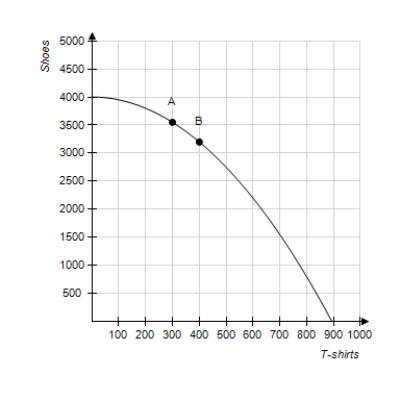
-Refer to Figure 2-11. The opportunity cost of producing an additional pair of shoes increases as more shoes are produced.
-Refer to Figure 2-11. The opportunity cost of producing an additional pair of shoes increases as more shoes are produced. (True/False)
5.0/5 (79)
(79) The inner loop of the circular-flow diagram represents the flow of inputs and outputs. Which of the following does not appear on the inner loop?
(Multiple Choice)
4.7/5 (85)
(85) "The US should not restrict employers from outsourcing work to foreign countries" is a normative statement.
(True/False)
4.9/5 (79)
(79) Figure 2-4
Graph (a)
Graph (b)

 -Refer to Figure 2-4, Graph (a). The opportunity cost of moving from point S to point R is
 (Multiple Choice)
4.9/5 (82)
(82) When economists disagree about whether the government should tax a household's income or its consumption, they are expressing a difference in
(Short Answer)
4.9/5 (70)
(70) Figure 2-10
-Refer to Figure 2-10. Points A, B, and D represent efficient outcomes for this economy.
-Refer to Figure 2-10. Points A, B, and D represent efficient outcomes for this economy. (True/False)
4.9/5 (80)
(80) Economists at which administrative department help formulate spending plans and regulatory policies?
(Short Answer)
4.8/5 (77)
(77) All scientific models, including economic models, simplify reality in order to improve our understanding of it.
(True/False)
4.8/5 (95)
(95) Figure 2-11
-Refer to Figure 2-11. This economy fully employs its resources when it produces 4000 shoes and zero t-shirts.
-Refer to Figure 2-11. This economy fully employs its resources when it produces 4000 shoes and zero t-shirts. (True/False)
4.9/5 (71)
(71) 
Filters
- Essay(0)
- Multiple Choice(0)
- Short Answer(0)
- True False(0)
- Matching(0)