



 Chat with AI
Exam 2: Thinking Like an Economist

Exam 1: Ten Principles of Economics220 Questions
Exam 2: Thinking Like an Economist284 Questions
Exam 3: Interdependence and the Gains From Trade192 Questions
Exam 4: The Market Forces of Supply and Demand277 Questions
Exam 5: Elasticity and Its Application222 Questions
Exam 6: Supply, Demand, and Government Policies321 Questions
Exam 7: Consumers, Producers, and the Efficiency of Markets218 Questions
Exam 8: Applications: The Costs of Taxation203 Questions
Exam 9: Application: International Trade214 Questions
Exam 10: Externalities204 Questions
Exam 11: Public Goods and Common Resources182 Questions
Exam 12: The Design of the Tax System225 Questions
Exam 13: The Costs of Production261 Questions
Exam 14: Firms in Competitive Markets243 Questions
Exam 15: Monopoly231 Questions
Exam 16: Monopolistic Competition246 Questions
Exam 17: Oligopoly204 Questions
Exam 18: The Markets for the Factors of Production232 Questions
Exam 19: Earnings and Discrimination230 Questions
Exam 20: Income Inequality and Poverty194 Questions
Exam 21: The Theory of Consumer Choice209 Questions
Exam 22: Frontiers in Microeconomics185 Questions
Exam 23: Measuring a Nations Income231 Questions
Exam 24: Measuring the Cost of Living214 Questions
Exam 25: Production and Growth187 Questions
Exam 26: Saving, Investment, and the Financial System225 Questions
Exam 27: Tools of Finance198 Questions
Exam 28: Unemployment and Its Natural Rate361 Questions
Exam 29: The Monetary System210 Questions
Exam 30: Money Growth and Inflation201 Questions
Exam 31: Open-Economy Macroeconomics: Basic Concepts194 Questions
Exam 32: A Macroeconomic Theory of the Open Economy188 Questions
Exam 33: Aggregate Demand and Aggregate Supply189 Questions
Exam 34: The Influence of Monetary and Fiscal Policy on Aggregate Demand207 Questions
Exam 35: The Short-Run Tradeoff Between Inflation and Unemployment223 Questions
Exam 36: Six Debates Over Macroeconomic Policy154 Questions
Select questions type


The production possibilities frontier is a graph that shows the various combinations of outputs that the economy can possibly produce given the available factors of production and the available production technology.
(True/False)
4.7/5  (84)
(84) If a line passes through the points (20,5) and (10,10), then the slope of the line is 1/2.
(True/False)
4.9/5 (85)
(85) Economists use one standard set of assumptions to answer all economic questions.
(True/False)
4.8/5 (94)
(94) The institution that sets the nation's monetary policy is called the
(Short Answer)
4.9/5 (80)
(80) Deciding that A causes B when in fact B causes A is a mistake called omitted variable bias.
(True/False)
4.7/5 (70)
(70) Different values are not a reason for disagreement among economists.
(True/False)
4.9/5 (69)
(69) Figure 2-15
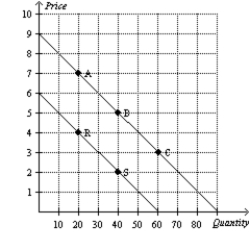
-Refer to Figure 2-15. Is a move from point A to point R considered a shift of the curve or a movement along the curve?
-Refer to Figure 2-15. Is a move from point A to point R considered a shift of the curve or a movement along the curve? (Short Answer)
4.7/5 (77)
(77) The circular flow model is not used anymore because it fails to perfectly replicate real world situations.
(True/False)
4.8/5 (75)
(75) When a production possibilities frontier is bowed outward, the opportunity cost of one good in terms of the other is constant.
(True/False)
4.9/5 (84)
(84) Good assumptions simplify a problem without substantially affecting the answer.
(True/False)
4.9/5 (66)
(66) Economists at which of the following government offices help formulate spending plans and regulatory policies?
(Multiple Choice)
5.0/5 (77)
(77) Which of the following is an example of a positive, as opposed to normative, statement?
(Multiple Choice)
4.8/5 (87)
(87) Table 2-3
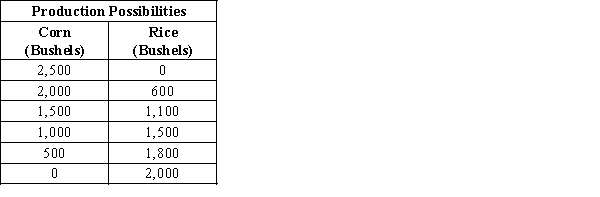 -Refer to Table 2-3. Which of the following combinations of corn and rice is not currently attainable but would be attainable if there was an improvement in overall production technology?
 (Multiple Choice)
4.8/5 (79)
(79) Figure 2-12

-Refer to Figure 2-12. What does the arrow going from oval B to rectangle 2 represent in the figure?
-Refer to Figure 2-12. What does the arrow going from oval B to rectangle 2 represent in the figure? (Short Answer)
4.9/5 (92)
(92) The effects of foreign competition on the U.S. textile industry would be studied by a microeconomist rather than a macroeconomist.
(True/False)
4.8/5 (78)
(78) Economists devise theories, collect data, and then analyze these data in an attempt to verify or refute their theories.
(True/False)
4.8/5 (77)
(77) Which of the following statements is correct about the roles of economists?
(Multiple Choice)
5.0/5 (78)
(78) Figure 2-3
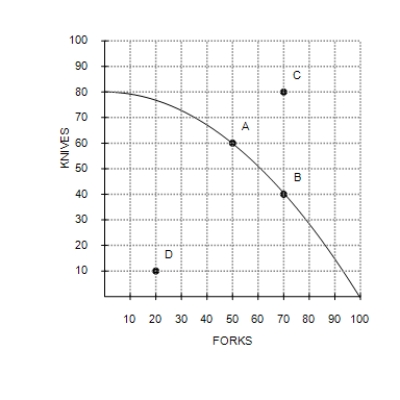 -Refer to Figure 2-3. It is not possible for this economy to produce at point
 (Multiple Choice)
4.9/5 (70)
(70) "Minimum wage laws result in unemployment" is a normative statement, while "the minimum wage should be higher" is a positive statement.
(True/False)
4.9/5 (67)
(67) 
Filters
- Essay(0)
- Multiple Choice(0)
- Short Answer(0)
- True False(0)
- Matching(0)